


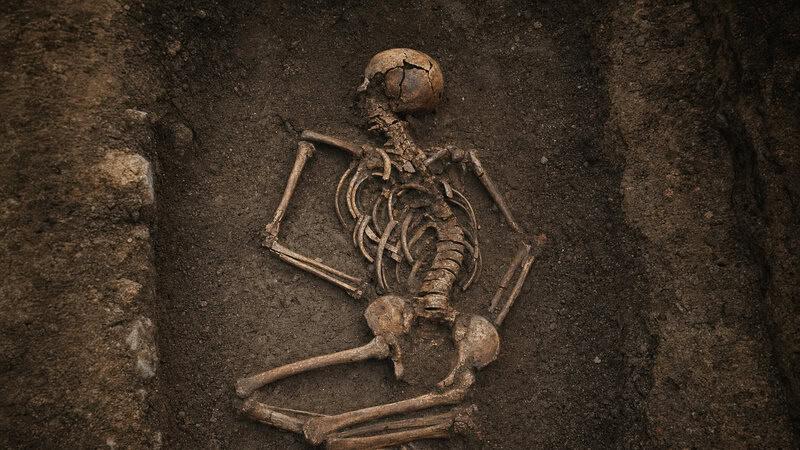

In September 2012, archaeologists peeled back the tarmac of a council car park in Leicester and found a skeleton that had been waiting, quietly, for 527 years. The bones had a curved spine, a shattered skull, and the unmistakable marks of a violent, chaotic death — and they belonged to a king.
A King Under the Asphalt

The discovery of Richard III beneath a Leicester parking lot was, depending on your sensibility, either grimly comic or genuinely haunting. Here was the last Plantagenet king of England — the man whose defeat at Bosworth Field in 1485 closed the door on medieval English kingship — lying under decades of tarmac in what had once been the choir of Greyfriars Church. DNA testing matched his remains to living maternal-line descendants. Dental analysis confirmed his approximate age. And the skeleton’s scoliosis, a pronounced lateral curvature of the spine, placed him firmly in the historical record, if not quite in the grotesque, withered-armed caricature Shakespeare had made famous.
Richard III’s death at Bosworth didn’t just end a man. It ended thirty years of dynastic bloodshed, launched the Tudor age, and drew a line under a conflict so consuming that England essentially forgot where it had buried one of its own kings. That parking lot, in the most literal sense imaginable, is the final resting place of medieval England itself — and it is as good a place as any to begin unpacking the full, ferocious sweep of the Wars of the Roses.
What Were the Wars of the Roses, Really?

The name itself is a later invention. The phrase was popularized in the Tudor era and cemented by Shakespeare’s history plays, but the people actually living through the conflict used no such label. They called it, with bleak practicality, the Civil Wars. What it was, stripped of the floral mythology, was a series of armed confrontations, political machinations, battles, and campaigns fought between 1455 and 1485 for control of the English throne.
The two sides were both branches of the royal House of Plantagenet: the House of Lancaster, whose heraldic badge included a red rose, and the House of York, associated with a white rose. Cousins fighting cousins for a crown — a dynastic argument carried out with swords, executions, and legal attainders when negotiation failed, which it often did.
It is important to resist the image of thirty years of unbroken battlefield carnage. The Wars of the Roses were, in practice, a long political crisis punctuated by relatively brief, explosive bursts of open warfare, with stretches of uneasy, fragile peace in between. What made the conflict so destabilizing was not the battle count but the underlying rot: a disputed inheritance, a catastrophically weak king, and an English nobility that had grown powerful enough to field private armies and make or break monarchs according to self-interest.
To understand why that rot set in, it helps to go back a generation further, to a wound that never properly healed.
The Root Cause: A Crown That Never Quite Fit

The deeper origins of the Wars of the Roses lie in 1399, when Henry Bolingbroke deposed and replaced his cousin Richard II, becoming Henry IV. The act was legally dubious and dynastically dangerous. The Lancastrian kings — Henry IV, Henry V, Henry VI — ruled under a shadow of illegitimacy that rival claimants could exploit whenever royal authority weakened. Henry V’s stunning victories in France, including Agincourt in 1415, papered over those cracks with military glory. But glory faded. By the 1440s, the English were losing their French territories, the royal finances were catastrophically overstretched, and the man on the throne was entirely unequal to the crisis.
The Spark: A Weak King and a Powder Keg

The powder keg had a name: Henry VI of Lancaster. Pious, gentle, and catastrophically ill-suited to rule in a period that demanded hard men making hard decisions, Henry suffered episodes of complete psychological collapse in the early 1450s — possibly catatonic in nature, though the precise diagnosis remains uncertain — that left England effectively leaderless. He could not govern. He arguably could not function. The machinery of royal power stalled.
Into that vacuum stepped Richard, Duke of York, a man with a strong claim to the throne through both the Lionel of Antwerp line and the Edmund of Langley line — arguably a stronger hereditary claim than Henry VI’s own — and the ambition to press it. The first open military clash came at the First Battle of St Albans in May 1455, less a pitched battle than a street fight that killed several prominent Lancastrian lords and established the pattern for everything that followed: brief, brutal, decisive in the short term, inconclusive in the long one.
For years the conflict lurched between negotiation and violence. York was formally named heir to Henry VI by the Act of Accord in 1460, disinheriting Henry’s own son, Prince Edward — a settlement that satisfied nobody, least of all the Lancastrian queen, Margaret of Anjou, who refused to accept the disinheritance of her child. Full-scale war erupted again with renewed ferocity almost immediately. Richard of York himself was killed at the Battle of Wakefield in December 1460, and the treatment of his body afterward tells you everything about how total the stakes had become: his severed head was reportedly displayed on the gates of York city wearing a paper crown, a piece of theatrical cruelty that underscores how far beyond ordinary political rivalry this conflict had traveled.
House of York vs. House of Lancaster: The Seesaw Decades

York’s eldest son Edward did not flinch. He seized the momentum his father had created, rallied Yorkist forces, and crushed the Lancastrians at the Battle of Towton in March 1461 — fought in a snowstorm in Yorkshire, with estimates of casualties running into the tens of thousands on both sides, making it by most reckonings the bloodiest battle ever fought on English soil. Edward had himself crowned Edward IV, and for a moment it seemed the House of York had simply won.
The conflict refused to cooperate with that conclusion. Richard Neville, Earl of Warwick — the powerful magnate known to history as “the Kingmaker” for his pivotal role in Edward’s rise — fell out with his protégé over foreign policy and matters of court influence, switched sides to Lancaster, and briefly restored the addled Henry VI to the throne in 1470. Edward IV went into exile in Burgundy, regrouped, returned the following year, and killed Warwick at the Battle of Barnet in April 1471. Shortly afterward, the Lancastrian cause was extinguished at the Battle of Tewkesbury, where Prince Edward of Westminster — Henry VI’s son and the last plausible Lancastrian heir in the direct line — was killed. Henry VI himself died in the Tower of London within days, almost certainly murdered on Edward IV’s orders.
It seemed, again, like an ending. It wasn’t. Edward IV’s sudden death in April 1483 — he was only forty years old — reopened everything. His twelve-year-old son was proclaimed Edward V, but the boy never came close to a coronation. His uncle Richard, Duke of Gloucester, intercepted the young king while en route to London, took him into what was officially called “protection,” and had both Edward V and his younger brother Richard placed in the Tower. The two boys — the Princes in the Tower — were never seen in public again. What happened to them remains one of history’s most debated and genuinely unanswered questions, and one that the discovery of Richard III’s bones in 2012 did nothing to resolve.
Richard of Gloucester had himself crowned Richard III in July 1483. England waited to see whether the surviving Lancastrian claimant, Henry Tudor — exiled on the Continent since childhood, with a tenuous bloodline claim through the illegitimate Beaufort line and an army he had yet to assemble — would dare to cross the Channel and press his case by force.
Bosworth: The Day That Ended an Era

He dared. On August 7, 1485, Henry Tudor landed with a small Franco-Welsh force at Milford Haven on the Welsh coast, marched through Wales gathering support, and met Richard III’s army at Bosworth Field in Leicestershire on August 22. The battle that followed was decided as much by betrayal as by any martial superiority.
The Stanley family — commanding a substantial force positioned on the battlefield’s edge — waited, calculating, watching which way the day was turning before committing to either side. When Richard III, seeing Henry Tudor exposed at some distance from his main force, made a bold cavalry charge directly toward the Lancastrian claimant, the Stanleys finally moved. They moved against Richard.
Richard III died in the fighting — the last English king to be killed in battle. His crown, according to tradition, was retrieved from a hawthorn bush on the field and placed on Henry Tudor’s head on the spot. His body was stripped, slung over a horse, and eventually interred at Greyfriars Church in Leicester, where it would lie undisturbed until a Leicester City Council car park was built over the ruins of the church centuries later.
Henry VII’s subsequent marriage to Elizabeth of York — the red rose wedding the white — provides satisfying symbolic closure. But the more accurate explanation for why Bosworth ended the wars where earlier battles had not is simpler and grimmer: Richard III had run out of people willing to die for him, and Henry Tudor was shrewd enough to consolidate power quickly before anyone could mount a credible alternative.
What the Wars of the Roses Actually Changed
The consequences rippled forward for generations. The Tudors — Henry VII, Henry VIII, Edward VI, Mary I, Elizabeth I — governed with the memory of dynastic civil war as their permanent cautionary tale. They were obsessive about succession, ruthless with rival claimants, and extraordinarily conscious of how quickly apparently legitimate kings could be unmade. The shadow of the Wars of the Roses shaped Tudor policy in ways that touched everything from the management of noble power to Henry VIII’s desperate pursuit of a male heir — a pursuit that drove the English Reformation itself.
The old Plantagenet magnate class had been decimated. Battle, execution, and legal attainder had weakened or destroyed the great noble families who had made England effectively ungovernable during the conflict. That destruction, however brutal, inadvertently cleared space for a more centralized monarchy — the kind Henry VII was determined to build and Henry VIII inherited. The age of the overmighty subject, the magnate who could field an army and topple a king, was effectively over.
English culture was shaped too, in ways that persist to this day. Shakespeare’s history plays, written under the Tudors a full century after Bosworth, gave generations their mental image of this period: a monstrous, scheming Richard III; a saintly, helpless Henry VI; an inevitable Tudor triumph representing providence restoring order to England. That framing served Tudor propaganda as much as historical truth, and understanding the Wars of the Roses means reckoning seriously with how thoroughly the winners shaped the story. The version of events most people carry — villainous Yorkists, victimized Lancastrians, righteous Tudor resolution — is, in large measure, the version history’s survivors chose to tell.
Which is precisely why the skeleton under the car park matters so much.
The Parking Lot and What It Means
Richard III’s reburial at Leicester Cathedral in March 2015 drew crowds and global media coverage in a way that surprised almost everyone. Something about the discovery had snagged the public imagination — perhaps the sheer improbability of it, a king under tarmac, or perhaps the sense that here was a piece of genuinely unmediated history, a body untouched by Tudor spin doctors, speaking for itself through its bones.
What those bones said was instructive. Yes, there was scoliosis — a real condition, not the wholesale physical monstrosity Shakespeare described. No withered arm. The remains were of a man in his early thirties, apparently physically capable, who had sustained at least eleven wounds at or around the moment of his death, several of them to the skull and likely inflicted after he had already fallen. The skeleton describes a man who died in close combat — which resolves nothing about whether he was a good king or a murderous one, but does confirm that bones refuse to follow a pre-written narrative.
His discovery reignited old arguments: about the Princes in the Tower, about Richard’s culpability for their disappearance, about how much of what we think we know about this period has been filtered through sources — Tudor chronicles, Shakespeare’s plays, More’s biography of Richard — with compelling reasons to blacken his name. The history of the Wars of the Roses that reaches us is, more than most periods, a history written entirely by the side that survived it.
There is a final image worth sitting with. Richard III’s end was so chaotic, so complete, so thoroughly erased by the victors who followed him, that England literally forgot where it had put him. A church fell, a city grew over the rubble, tarmac followed, and a king lay beneath it all — not in some remote and romantic field, but under a working car park in a provincial English city — for more than five centuries. That forgetting is the perfect metaphor for the Wars of the Roses themselves: a conflict so total, so self-consuming, that it swallowed even its own conclusion whole, and left the rest of us still digging for what it meant.

 Arabic
 French
 Spanish
 Portuguese
 Deutsch
 Turkish
 Dutch
Dutch
 Italiano
 Russian
 Romaian
 Portuguese (Brazil)
 Greek
Greek