


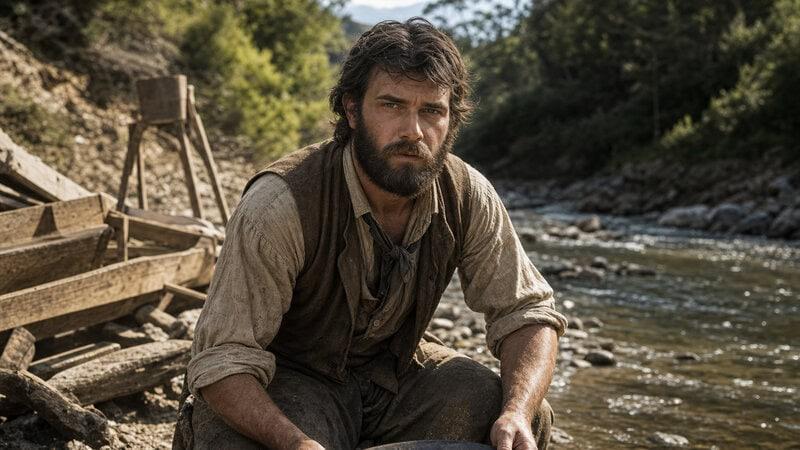

On the morning of January 24, 1848, a carpenter named James W. Marshall noticed something glinting at the bottom of a millrace on the American River in California’s Sacramento Valley — and in that unguarded moment of disbelief, he lit a fuse that would draw a hundred thousand strangers across a continent, transform a territory into a state, and reshape the American economy in ways that are still visible today. Almost none of the resulting fortunes would belong to men like him.
The Discovery That Ruined Its Discoverers

Marshall was building a sawmill for Swiss entrepreneur John Sutter when he spotted the flakes in the water. Both men grasped immediately what the find might mean, and both tried to keep it secret. They failed spectacularly. Word leaked, spread, then exploded. By the spring of 1849, the largest gold rush in American history was fully underway, and Sutter’s carefully cultivated agricultural empire — his ranches, his herds, his painstakingly laid plans — was being trampled by thousands of trespassers who cared nothing for his property and everything for what lay beneath it. His workers deserted. Squatters seized his land. Courts tangled his titles in litigation for decades. John Sutter died nearly broke in 1880, still petitioning Congress for compensation that never came. James Marshall fared no better, drifting through the diggings without luck, eventually selling his autograph to tourists for pocket change, and dying poor in 1885.
The two men most responsible for triggering one of history’s great migrations never figured out how to profit from it. That is not a footnote to the California Gold Rush — it is the whole story in miniature.
One Hundred Thousand Strangers

The speed of what followed Marshall’s discovery remains astonishing. Gold was confirmed in the Sacramento Valley in early 1848; by 1849, California’s non-native population had exploded to nearly 100,000 people. They came by every available route, each one a gamble before a single flake of gold was touched.
The overland California Trail was the most traveled corridor — an estimated 140,000 emigrants used it between 1849 and 1854, trudging across plains, deserts, and mountain passes in wagon trains that sometimes stretched beyond the horizon. Others spent four to eight months sailing around Cape Horn, the southern tip of South America, enduring storms and scurvy on vessels that were barely seaworthy. The boldest, or most impatient, took the shortcut through Panama: a sweaty transit across the isthmus by canoe and mule, followed by an agonizing wait on the Pacific coast for a ship north, with malaria and cholera as constant companions.
Nearly two-thirds of the 1849 surge were Americans, but the rest composed a genuinely global scramble — Chileans who knew placer mining, Chinese laborers fleeing famine and upheaval, Australians from the convict colonies, Mexicans from Sonora, and Europeans of every nationality. In San Francisco Bay, abandoned ships listed quietly at anchor, their crews having deserted the moment the gangplank touched the wharf. The rush prompted one of the largest voluntary migrations in American history, and it drew not reckless drifters but ordinary people — farmers who mortgaged their land, clerks who quit steady jobs, husbands who left wives behind with promises to return rich within a year. Most did not return rich. Many did not return at all.
The human cost extended far beyond disappointed prospectors. California’s Native American population, already under severe pressure from Spanish and Mexican colonization, was devastated during the gold rush years by displacement, starvation, disease, and outright violence. Historians estimate that California’s Native population fell from roughly 150,000 in 1848 to fewer than 30,000 by 1870 — a catastrophe that the triumphant narrative of westward enterprise has long obscured.
The Math Nobody Wanted to Hear

The legend of the forty-niners rests on a specific, seductive image: a solitary prospector crouched over a pan in a sparkling mountain stream, pulling flakes from gravel with his own two hands. The image is not entirely false — it just describes the California Gold Rush of 1848, not 1849. The rich surface deposits that rewarded the earliest arrivals were largely picked clean by the time the mass wave reached the Sierra Nevada foothills. Late-comers found a landscape already crawling with competitors and claims already staked.
At the peak in 1848, a skilled miner in the right location might pan the equivalent of ten to sixteen dollars a day — genuinely life-changing wages at a time when factory work back East paid less than a dollar. But prices in the diggings were equally staggering. A simple meal could cost a dollar or more. Boots, flour, and blankets carried monopoly markups that erased whatever the pan produced. By the early 1850s, as hydraulic and hard-rock mining replaced the individual prospector, average returns had collapsed while corporate costs and company wages replaced the romantic dream of independent wealth.
The physical reality compounded the economic one. The Sierra Nevada foothills delivered dysentery, scurvy, and brutal winters to men living in canvas tents on creek banks. Claims flooded in spring and ran dry in summer. The work itself — hours of bending, sluicing, and hauling — was closer to brutal seasonal agricultural labor than adventure. The California Gold Rush lasted from 1848 to 1855, and for the majority of that arc, the men in the mud were effectively funding the fortunes of people who never got their boots dirty.
Environmental damage was similarly severe and lasting. Hydraulic mining — which used high-pressure water cannons to blast entire hillsides — stripped millions of cubic yards of sediment into California’s rivers, choking waterways, burying farmland downstream, and causing flooding that triggered the first major environmental lawsuit in American history, the landmark Woodruff v. North Bloomfield case of 1884. The scars of that era are still visible in parts of the Sierra Nevada foothills today.
The Merchants of the Diggings: Selling Shovels to Dreamers

Samuel Brannan understood something the miners did not. A newspaper publisher and Mormon elder who happened to be in California when gold was discovered, Brannan quietly bought up every shovel, pan, pickaxe, and tin wash bowl he could find in San Francisco. Then he walked through the streets waving a bottle of gold dust and shouting the news to the world. The rush he helped ignite flowed directly to his newly stocked stores. By some accounts he became California’s first millionaire — not by mining an ounce of gold himself, but by being the man everyone who mined had to pay.
Brannan’s instinct was replicated by merchants across the region who grasped a simple truth: the miner was the market. A man carrying a pick and a dream was a guaranteed customer for boots, rope, flour, coffee, whiskey, and canvas. The risk-reward ratio was immeasurably better on the selling side than in the diggings. Tent-city stores in camps like Nevada City and Placerville charged whatever the traffic would bear, then reinvested profits into permanent wooden buildings as the camps grew into towns.
The most durable monument to this insight is a pair of trousers. Levi Strauss arrived in San Francisco not to dig but to sell dry goods, and the sturdy riveted pants his business eventually produced — built for men who needed workwear that could survive the diggings — became an American institution that outlasted the gold rush by nearly two centuries. The miners are gone. The blue jeans remain.
Bankers, Lawyers, and Landlords: The Quiet Winners

Banking houses like Wells Fargo, founded in 1852 directly in response to gold rush demand, grew wealthy not on the gold in the ground but on the fees, assay services, and transport of other people’s gold. Carrying a poke of gold dust from the diggings to a San Francisco bank required trust, security, and infrastructure — and those things cost money. Wells Fargo charged for all of it and built a financial empire that still exists today.
Lawyers thrived in a different vein. California’s land-title system was chaos — Mexican land grants overlapped with squatter claims, federal surveys lagged far behind settlement, and every mining claim was a potential lawsuit. Attorneys who understood the inherited Spanish-Mexican legal framework and the new American overlay found themselves in extraordinary demand. They did not need gold to grow wealthy; they needed other people’s disputes about gold. The litigation bonanza of the early 1850s built some of California’s most prominent legal fortunes and established a culture of aggressive real-estate law that persists in the state to this day.
Landlords in San Francisco and Sacramento played perhaps the simplest game of all. Lots purchased for a few hundred dollars in 1848 commanded rents of thousands per month by 1849 as desperate arrivals needed somewhere to sleep, eat, and store equipment. The city’s permanent commercial core — its brick warehouses, its hotels, its banking district — was financed not by gold extracted from the Sierra Nevada but by the rent, interest, and legal fees extracted from those who tried to extract it.
The Women, the Cooks, and the Forgotten Entrepreneurs

The standard image of the forty-niners is overwhelmingly male, and the mining camps were indeed dominated by men — which created, for the women who did arrive, something close to a monopoly on domestic labor. Boarding-house operators and laundresses charged premium prices for services that in any Eastern city would have been ordinary and cheap. In camps where men outnumbered women by ratios that sometimes reached ten to one, a woman who could cook a decent meal or wash a shirt commanded extraordinary leverage. Some accumulated genuine savings while the men around them went broke in the diggings.
Among the most remarkable of these entrepreneurs was Mary Ellen Pleasant, a Black woman who came to California during the gold rush era. Using her formidable skills in catering and boarding-house management, Pleasant built substantial wealth in San Francisco and became one of the city’s most influential figures — an activist, a financier, and a businesswoman whose story complicates and enriches the standard gold rush narrative in ways that history has been slow to acknowledge.
The experience of foreign-born miners adds another layer of complexity. Latin American miners, particularly those from Sonora in Mexico, brought sophisticated placer-mining techniques that less experienced American arrivals quickly copied — then repaid that debt by lobbying for the Foreign Miners’ Tax of 1850, which levied a twenty-dollar monthly fee specifically designed to drive non-American miners from the diggings. The tax reflected a pattern of racial exclusion that ran throughout the gold rush: Chinese miners were pushed to claims already worked over by others, subject to the same Foreign Miners’ Tax when it was revived in 1852, and eventually targeted by outright anti-Chinese violence in camps across the foothills.
Chinese merchants in San Francisco, however, built parallel commercial networks that supplied the large and often mistreated Chinese mining population — food, goods, credit, and community — and when mining declined and anti-Chinese hostility intensified in the diggings, those merchants pivoted, establishing the commercial foundations of what would become Chinatown and the broader Chinese-American business community in California. The California Gold Rush was, in its fullest sense, a story of entrepreneurial diversity hiding in plain sight behind the romantic figure of the lone prospector with his pan.
What the Rush Actually Built — and What It Cost
By the time the California Gold Rush wound down around 1855, the state it had called into being was already larger than the mining camps that spawned it. California entered the Union in September 1850, less than two years after Marshall’s discovery, its statehood accelerated by the sheer mass of population the gold rush deposited on its shores. San Francisco had transformed from a mudflat settlement of a few hundred people into one of the Pacific world’s great commercial cities. The wealth aggregated by merchants, bankers, lawyers, and landlords funded the infrastructure — the telegraph lines, the roads, and eventually the transcontinental railroad — that stitched California permanently into the American economy.
The gold itself was real and vast: historians estimate that approximately 750,000 pounds of gold were extracted from California between 1848 and 1855, worth roughly 2 billion dollars at the time. That influx of specie rippled through the entire American monetary system, funding expansion, enabling credit, and accelerating industrialization across the country. The legacy of the California Gold Rush is therefore genuinely national in scope — not merely a California story.
But the cost side of the ledger deserves equal weight. The devastation of California’s Native peoples. The toxic legacy of hydraulic mining in watersheds that California farmers and communities still manage today. The patterns of racial exclusion written into early California law. The thousands of families across the United States, Chile, China, and Australia left waiting for men who came home broke or did not come home at all. These are not footnotes; they are structural features of the same story.
The gold rush is remembered as the great democratic adventure, the moment when any man with grit and a good eye could change his circumstances overnight. The myth is not entirely wrong — some miners did strike it rich, and the human drama of that era retains a genuine hold on the imagination. But the names that should sit alongside the iconic prospector are the names of Brannan and Strauss, the boarding-house operators and the banking clerks, the lawyers who knew the land-grant system and the landlords who knew where the next ship was docking — and the names of those who were systematically shut out of the wealth being generated around them.
On January 24, 1848, James Marshall found gold in a millrace on the American River and changed America forever. He just never figured out how to profit from it — and in that failure, repeated across thousands of muddy claims and shattered dreams over seven hard years, lies the truest lesson the gold rush ever taught: that the greatest fortunes rarely flow to the people who do the digging.

 English
 Arabic
 Spanish
 Portuguese
 Deutsch
 Turkish
 Dutch
Dutch
 Italiano
 Russian
 Romaian
 Portuguese (Brazil)
 Greek
Greek