



On a February night in 1497, the citizens of Florence dragged mirrors, wigs, playing cards, and paintings into the Piazza della Signoria and set them alight — and Sandro Botticelli, the man who had painted the most celebrated nude in Western art, is said to have stood among them, ready to feed his own work to the flames.
The Night the Bonfires Came for Venus
The fire in the piazza was not an accident of war or a riot. It was a theology. Girolamo Savonarola, a Dominican friar of ferocious charisma, had convinced Florence that its appetite for pagan beauty — the silks, the perfumes, the shimmering mythological canvases — was the very reason God was punishing Italy with plague and foreign armies. He called these objects vanità, vanities, and he wanted them destroyed. The citizens obliged with something close to ecstasy, hauling their luxuries into what history now calls the Bonfire of the Vanities.
Botticelli, then in his early fifties, had spent decades producing exactly the kind of work Savonarola despised. And yet, by multiple accounts, he had become a follower of the friar — his younger brother Simone a fervent convert, and Sandro himself apparently shaken to his foundations. Some historians believe he personally carried paintings to the pyre. Whether The Birth of Venus was ever genuinely at risk remains debated, but the psychological reality is striking enough: the artist who conjured Venus from foam and sea wind stood on the edge of destroying her.
To understand how that rupture happened, you have to understand what Botticelli buried inside the painting — and the dangerous world he painted it for.
A Commission Soaked in Blood and Mythology
The painting was most likely commissioned around 1484-1486 by Lorenzo di Pierfrancenzo de’ Medici, a younger cousin of the man Florence called Lorenzo the Magnificent. It was destined for a Medici villa at Castello, just outside the city — a private pleasure, not a public altarpiece. That distinction mattered enormously. Villa decoration was the space where the Florentine elite permitted themselves to think in pagan, classical terms, translating Greek and Roman myth into the language of Neoplatonic philosophy.
The myth Botticelli was handed, though, was not gentle. Its origin is one of the most violent in the Greek tradition: the Titan Kronos severs his father Uranus’s genitals and hurls them into the sea. From the foam that gathers around the wound, Aphrodite — Venus — is born, fully grown, luminous, and impossibly serene. Botticelli’s achievement was to take that founding act of cosmic mutilation and make it the invisible foundation of a canvas that radiates stillness. The violence is always present, beneath the surface, the way a cold current runs under warm coastal water.
The commission was also politically charged in ways every educated Florentine would have recognized. The Medici were at the height of their cultural ambition and at the peak of their enemies’ resentment. A painting celebrating Medici patronage, humanist philosophy, and divine beauty was not merely decoration — it was a statement of power, and it was meant to be read as one.
What the Canvas Actually Shows — and What Most People Miss
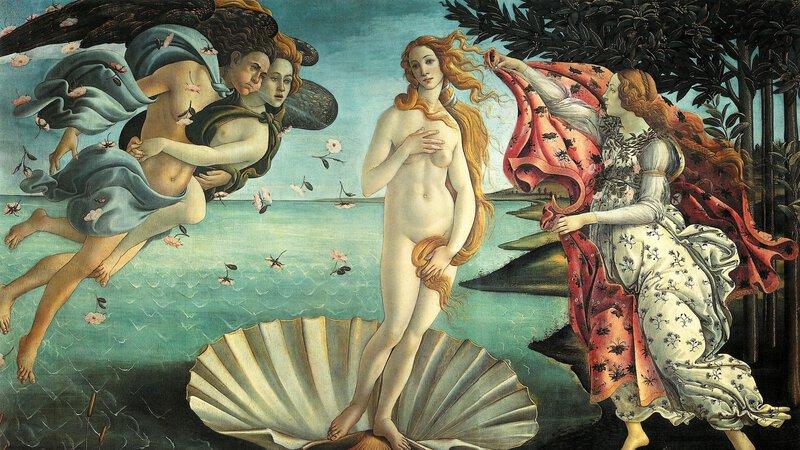
The title most people know — The Birth of Venus — is, strictly speaking, a misnomer. As the Uffizi Gallery notes in its own description of the work, the goddess is not being born on the canvas. She has already been born. What we witness is her arrival: she has emerged from the sea fully grown and is being carried toward the shore of Cyprus, the island sacred to her. Art historians call this type Venus Anadyomene, meaning “Venus rising from the sea,” a subject derived from a celebrated but now-lost painting by the ancient Greek master Apelles. Botticelli was consciously positioning himself in a lineage stretching back to antiquity.
Look at the composition carefully and three distinct zones of meaning emerge. On the left, the west wind Zephyr embraces the nymph Chloris; their intertwined bodies form a single propulsive force, their breath visibly billowing across the canvas, pushing Venus toward land. Their movement is the painting’s engine — everything flows from them. At the center, Venus herself stands on her shell in that famous pose of modest self-containment, one hand lifting her hair, one angled across her body. On the right, one of the Horai — goddesses of the seasons — rushes forward with a flower-embroidered cloak, ready to receive and dress the goddess the moment she steps ashore, marking her passage from divine wildness into the ordered world of human civilization.
And then there is the anatomy. Venus’s neck is unusually long, her left shoulder dropped at an angle no human shoulder naturally occupies, her spine curved in a way that defies skeletal reality. Generations of viewers assumed these were errors — evidence of a painter not yet fluent in rendering the human form. Many art historians now read them differently, arguing that Botticelli distorted Venus deliberately, echoing the conventions of ancient sculpture and pulling her figure just far enough outside natural proportion to signal that what you are seeing is not human. Her beauty is meant to feel other in the way the sublime is always slightly beyond reach — too still, too perfect, inaccessible to ordinary flesh.
The Warning Hidden in Plain Sight
Florentine society in the 1480s was fluent in the language of mythological allegory. Educated viewers read painted scenes the way a later age would read political cartoons — quickly, instinctively, catching the references before the surface beauty had fully registered. Scholars have long examined the painting’s layered meanings, and several researchers, including Liana De Girolami Cheney, have argued that its iconographic program encodes a pointed message aimed at the Medici’s enemies.
Consider what the myth actually says. Venus is born from an act that unmakes a tyrant — Uranus, the old order, is destroyed so that something transcendent can enter the world. She arrives with the west wind at her back, unstoppable, carried by forces older than any human political arrangement. She lands on Cyprus, linking the Medici’s cultural patronage to a divine lineage that predates Rome, predates Greece, predates the written record. The implication, for anyone who knew how to read it, was pointed: the family that commands this order of beauty commands something beyond ordinary politics. To move against them is to move against the grain of a divinely ordered cosmos.
That is the warning embedded in the image — not a scrawled note, not a poisoned letter, but a mythological argument woven into the most beautiful object in the room. It is a distinctly Florentine way of being formidable.
Botticelli’s World on the Edge of Catastrophe

The world that made The Birth of Venus possible dissolved with startling speed. Lorenzo the Magnificent died in 1492. The Medici were expelled from Florence in 1494. The French army of Charles VIII marched through the city. Everything the painting celebrated — Medici supremacy, Neoplatonic philosophy, the confident blending of Christian piety and pagan beauty — suddenly looked like the very hubris Savonarola preached had drawn God’s wrath down on Italy.
Botticelli’s late paintings tell the story of a man in crisis. The luminous, flowing mythologies give way to anguished religious works — raw, angular, deliberately intense in a way that seems to reject the earlier style’s grace. Art historians still debate the full extent of his attachment to Savonarola’s cause, but the visual evidence of a profound psychological shift is difficult to dispute. The painting as preserved in the Google Arts and Culture archive sits in strange contrast to this biographical shadow — the icon intact, the man who made it altered almost beyond recognition by the end of his life.
Savonarola himself was arrested, tortured, and burned in the same Piazza della Signoria where the Bonfires of the Vanities had blazed, in May 1498. Botticelli lived another twelve years, increasingly marginalized, his earlier style out of fashion. He died in 1510 in relative obscurity.
How the Painting Survived — and Was Then Forgotten

The canvas survived the Savonarolan years less through heroism than through geography. Safely housed at the Medici villa at Castello, away from the religious turmoil burning through the city streets, it simply remained where it was. Distance, not courage, kept Venus from the flames.
After the Medici reconsolidated power, the painting passed through the family’s hands and eventually entered the Uffizi Gallery in Florence, where it has remained ever since. But survival was not the same as fame. For nearly three centuries after Botticelli’s death, the work occupied a quiet corner of art history. Giorgio Vasari, the great chronicler of Renaissance artists, mentioned it politely but without excitement. The Baroque era had little use for what looked like archaic, linear work. Neoclassicists preferred their ancient references more monumental and anatomically correct.
It was the Romantic critics and the Pre-Raphaelite painters of the nineteenth century who rescued Botticelli from obscurity and elevated The Birth of Venus to its current iconic status. Writers such as John Ruskin and Walter Pater found in the painting’s trembling, melancholy beauty exactly what they felt the industrial age had forfeited. They gave it the language of transcendence that proved durable. The painting’s subsequent journey into modern popular culture — onto album covers, fashion campaigns, and film sets — flows directly from that Victorian rediscovery.
Why The Birth of Venus Still Unsettles Us
The painting’s lasting power comes from a contradiction it never resolves. Absolute serenity built on absolute violence. A goddess of love born from an act of mutilation. A symbol of civilization rising out of the raw, indifferent sea. Botticelli held those contradictions within a single frame and made them look like harmony — which is, perhaps, the most precise description of beauty anyone has ever committed to paint.
Notice, too, where Venus’s gaze falls. She looks at no one. Her eyes turn slightly downward and away, giving the viewer the unsettling sensation of having arrived a half-second too late, of witnessing something not designed to be witnessed. You are catching a divine arrival at an unguarded instant, an uninvited guest at a moment suspended between worlds.
The painting is simultaneously a Renaissance political document, a Neoplatonic philosophical treatise, a coded message to the Medici’s enemies, and the deeply personal work of an artist who would spend his last years questioning everything it represented. Nearly 540 years after Botticelli laid down his brush, The Birth of Venus remains the most reproduced painting in the Uffizi — evidence, perhaps, that beauty built on tension, danger, and concealed meaning outlasts beauty built on reassurance alone. The bonfire never came for it. But the man who painted it came close enough to the fire that we should never quite forget he was there.

 English
 Arabic
 French
 Spanish
 Portuguese
 Deutsch
 Turkish
 Dutch
Dutch
 Russian
 Romaian
 Portuguese (Brazil)
 Greek
Greek