


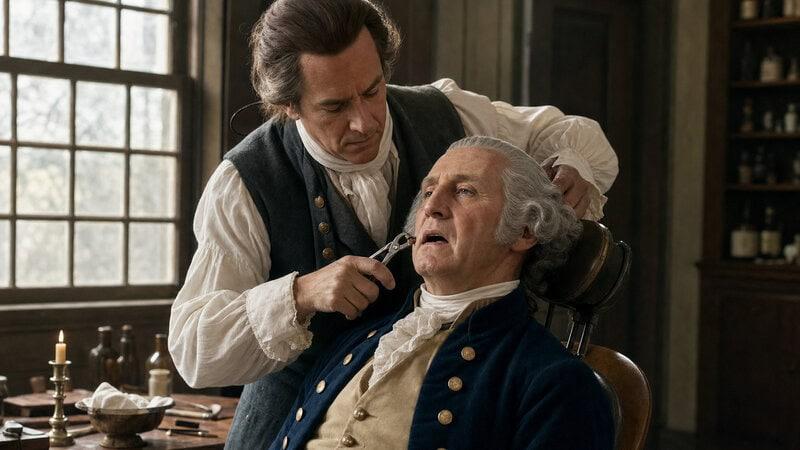

Somewhere in the early years of the American republic, a dentist pressed a pair of forceps around one of George Washington’s remaining molars, worked it free from the first president’s aching jaw, and then — instead of discarding it — slipped it into a locket and wore it around his own neck. The dentist’s name was John Greenwood, and the tooth stayed close to his heart for years. That single detail, strange and tender and entirely documented, is a fair introduction to a life that mainstream history has almost completely misplaced.
A Man Almost Nobody Remembers

John Greenwood was born in Boston in 1760, the son of a craftsman, and he grew up inside one of the most politically combustible cities in the British Atlantic world. He would go on to witness the Boston Massacre as a boy, march into the Revolutionary War as a sixteen-year-old fifer, survive privateering on the open Atlantic, and spend the back half of his life as George Washington’s most trusted dentist. He also wrote a memoir about it. He died in 1819, and the world largely forgot him anyway.
That forgetting is worth examining, because Greenwood’s life is not a minor footnote. It is a ground-level map of what the Revolution actually cost and created — not in the marble-and-monument version, but in the lived, bodily, improbable version that most textbooks skip over entirely. He was not an architect of the founding. He was something rarer in the historical record: an ordinary participant who wrote down what he saw.
Growing Up Inside the Storm: Boston Before the Revolution

Colonial Boston in the 1760s was a city coiled tight with grievance — overcrowded, economically squeezed, and electric with the kind of resentment that builds slowly and then breaks all at once. Greenwood grew up inside that pressure. On the night of March 5, 1770, British soldiers fired into a crowd on King Street and killed five colonists in what patriots quickly named the Boston Massacre. Greenwood was present, or close enough to witness its immediate aftermath, and the event lodged itself in his memory with the permanence of a first encounter with real violence. He described it decades later in his memoirs, the detail still sharp.
What distinguished Greenwood from many boys in that city was his training as a fifer. The fife — a small, high-pitched woodwind — was not a decorative instrument in eighteenth-century military life. It was functional communication: a way of transmitting commands across the noise of a battlefield, setting the tempo of a march, and keeping men moving forward when every instinct urged them to stop. Learning to play it demanded a precise ear, physical discipline, and the ability to perform under conditions most people would find paralyzing. Greenwood acquired all three before he was a teenager.
That early training shaped him in ways that would echo across every subsequent chapter of his life. He understood conflict through rhythm and sound before he understood it through gunpowder. He learned what it meant to hold your nerve and keep playing when the world around you was becoming dangerous. That capacity for steadiness under pressure proved to be the throughline of a life that kept demanding it.
Sixteen and Marching: The Fifer Who Set the Pace of a War

When the Revolution formally began, Greenwood enlisted as a fifer with a Massachusetts regiment at the age of sixteen. He served in Captain Theodore Bliss’s company for approximately twenty months — long enough to experience the full grinding reality of Revolutionary War service, which had very little to do with the heroic tableaux that later painters would produce and a great deal to do with cold, hunger, disease, exhaustion, and stretches of waiting interrupted by episodes of sudden, bewildering violence.
The fifer’s vantage point was unusual. He marched close to the action, responsible at all times for the coordination and morale of men who were far more frightened than they were willing to admit, but not positioned as the primary target in the way an infantryman was. He witnessed everything from a particular angle: indispensable to the machinery around him, not quite at its center. It was an education in how large events are held together by people whose names rarely appear in the subsequent accounts.
What those twenty months built in Greenwood was something that cannot be manufactured by any other means: the knowledge, held in the body as much as the mind, that he could function when things fell apart. That knowledge followed him out of the army and into every subsequent chapter of his life. It is not a coincidence that the man who survived the chaos of Revolutionary battlefields went on to practice a form of medicine that required precision inside another person’s pain.
Privateer, Apprentice, and an Unlikely Calling

Greenwood did not settle quietly after his military service ended. He turned to privateering — the licensed maritime raiding that occupied a legal and moral gray zone between patriotic enterprise and outright piracy — adding yet another improbable chapter to a biography that was already straining credulity. He was, in the terms that later characterized him, a musician, soldier, privateer, author, and dentist: a sequence of identities that no single life should reasonably contain and that his somehow did.
The path into dentistry came through apprenticeship, the standard route in an era before dental schools existed in America. A young man learned the craft by watching, assisting, and eventually practicing under the guidance of someone already established in it. Greenwood’s hands — disciplined by years of precise fife-playing and toughened by military and maritime service — proved well-suited to the delicate demands of early dental work. He took the work seriously, developing genuine skill in a field that ranged, in the late eighteenth century, from accomplished artisans to spectacular frauds.
American dentistry in the 1780s and 1790s was a painful and primitive affair by any standard. Extractions were common, anesthesia did not exist in any useful form, and the dentures of the era were constructed from materials — ivory, animal bone, and human teeth sourced from corpses or the desperately poor — that fit badly and degraded quickly. The practitioner who could work in that environment with accuracy and genuine care, who could manage a patient’s fear and pain without flinching, was genuinely valuable. Greenwood became that practitioner. He established himself in New York and built a reputation substantial enough to reach the most prominent patient in the country.
The President’s Mouth: Washington, Pain, and a Dentist He Trusted

By the time George Washington took the oath of office in 1789, his dental health was an open and miserable secret. Decades of extractions, inadequate care, and the chronic infections that plagued eighteenth-century mouths had left him with almost no natural teeth remaining. The dentures he wore were not, as legend has long insisted, made of wood — that particular myth has been thoroughly debunked by historians and archaeologists — but they were painful, ill-fitting, and constructed from materials that created their own ongoing problems. Washington needed a dentist whose discretion matched his competence, because the state of the president’s mouth was, in a very real sense, a matter of presidential dignity and political presentation.
Greenwood became that dentist. The relationship between Washington and Greenwood is documented in correspondence between the two men, in which Washington wrote directly to Greenwood about the fit and condition of his dentures with a frankness that reveals the degree of trust he extended to his dentist. Greenwood crafted dentures, adjusted existing sets, extracted what remained of Washington’s natural teeth, and served as the primary caretaker of the first president’s most private physical misery. The surviving letters make clear that Washington valued both the quality of Greenwood’s work and his reliability in keeping the details of that work private.
And then there is the locket. When Greenwood extracted one of Washington’s teeth, he kept it, worn against his own body. The gesture speaks to something that formal history rarely captures: the strange and real intimacy that forms between a patient in chronic pain and the person who relieves it. It also speaks to the particular nature of Greenwood’s relationship to Washington — not merely professional, but woven through with the reverence of a man who had, as a sixteen-year-old fifer, first understood the weight of that name in the chaos of a Revolutionary War camp. The boy who had marched for Washington’s cause grew up to hold Washington’s jaw in his hands. The locket was how he held onto that arc.
The Memoirs: Writing Himself Into the Record
Late in life, Greenwood wrote down what he had seen and done. The memoirs he composed after 1809 are both a personal document and an act of deliberate self-preservation by a man who understood that history had a way of forgetting the people who did not insist on being remembered. He had witnessed the Boston Massacre. He had marched with a Massachusetts regiment through twenty months of Revolutionary War service. He had tended the teeth of the first president of the United States. He wrote it down, in plain and specific language, with the detail of someone who had been paying attention the whole time.
Greenwood’s journal, held at the University of Michigan, survives as a primary source of genuine historical value. His grandson later published The Revolutionary Services of John Greenwood of Boston, ensuring that the memoirs reached a broader audience than a single manuscript could. The published account gives historians something rare in the documentary record of the Revolution: a sustained first-person view from someone who was present without being powerful, who participated without being an architect, who carried the war in his body and then tried to make something of what remained.
Ordinary soldiers almost never left written records. The texture of camp life in Captain Bliss’s company, the sound of a fife cutting through cold morning air, the specific fear of a teenager threading through a battlefield — that kind of knowledge was simply lost when the people who held it died. Greenwood’s memoirs are an exception that the historical profession has not yet fully rewarded with the recognition it deserves. They belong in the same conversation as better-known firsthand Revolutionary accounts, and largely they do not get there.
A Note on Sources and Further Reading
Readers who want to engage with the primary material directly can consult the Greenwood papers at the University of Michigan, which hold the manuscript journal and related documents. The Mount Vernon digital encyclopedia maintains a concise and well-sourced entry on Greenwood that is useful for orientation. The Journal of the American Revolution published a detailed assessment of Greenwood’s career in 2022 that draws on both the memoirs and secondary scholarship. For readers who want a book-length treatment aimed at a general audience, A Young Patriot in the American Revolution adapts Greenwood’s account for accessibility. The PBS companion site to Ken Burns’s documentary series on the Revolution includes a profile of Greenwood that serves as a useful introduction.
Why John Greenwood Still Matters
Search for john greenwood american revolution and what you mostly find is a thin outline where a fuller story should be. That gap is itself a kind of historical evidence. The Revolution produced thousands of John Greenwoods: people who witnessed the founding moments as children, served in the ranks as teenagers, survived, and went on to build lives that bore the permanent marks of everything they had carried. Most of them left nothing written. Most of them have no encyclopedia entry, no digital archive, no profile on any documentary website. They are simply gone.
Greenwood is not entirely gone because he was extraordinary in his particular accumulation of roles — fifer, soldier, privateer, dentist, memoirist, the man who kept a president’s tooth in a locket — and because his grandson made sure the memoirs survived in print. But his relative obscurity, even now, is a reminder that popular memory of the Revolution remains stubbornly concentrated on the men who wrote the documents and whose faces ended up on currency. The people who carried the war in their bodies, who set its pace with their instruments and their feet, who managed its human wreckage with their hands: those people are still mostly waiting to be found.
The locket is the right image to end on, because it is so purely human in its strangeness. A man keeps a tooth. He wears it close to his chest for years. He does not do this because he is morbid or because he is making a statement. He does it because the tooth belongs to someone he has served across the whole arc of his adult life — someone whose pain he has held in his hands, someone whose name he first heard as a boy in revolutionary Boston and never stopped carrying. History is full of connections like that one, strange and tender and entirely real. Most of them were never written down. Greenwood’s, at least, was.

 English
 Arabic
 Spanish
 Portuguese
 Deutsch
 Turkish
 Dutch
Dutch
 Italiano
 Russian
 Romaian
 Portuguese (Brazil)
 Greek
Greek