


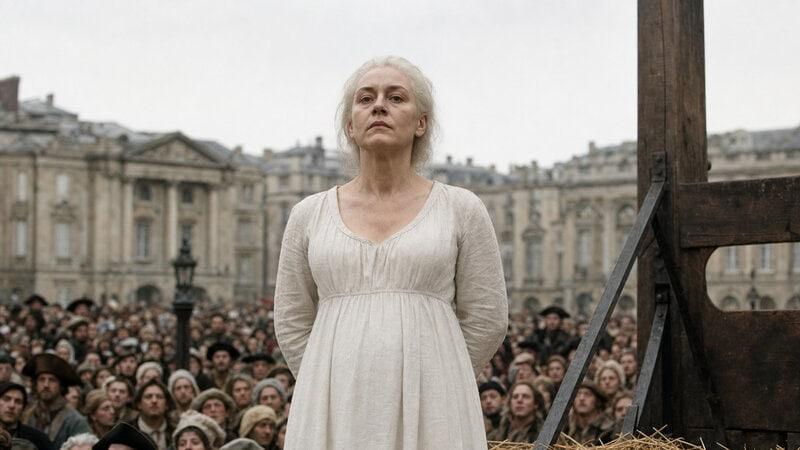

She stepped onto the wooden cart just after dawn, hands bound behind her back, white hair shorn close to the skull. For a long moment, the crowd that had gathered to jeer at the fallen queen of France went quiet. What stood before them was not the gilded creature of Versailles they had despised for so long, but a woman of thirty-seven, wrecked by illness and grief, carrying herself with a composure so absolute it seemed almost to unnerve them.
The Last Morning: October 16, 1793

The sixteenth of October, 1793, broke cold and grey over Paris. Marie Antoinette had spent the night in her cell at the Conciergerie prison — a damp, bare room stripped of every comfort — and she had not slept. There was something she needed to write first. By the time the guards came for her, she had finished the letter, folded it, and set it aside. It would never reach the person it was meant for. It would, instead, outlast almost everything else about her.
The tumbrel — an open wooden cart used to transport the condemned through the streets — was a deliberate humiliation. Louis XVI had ridden to his execution in a closed carriage; his wife was afforded no such dignity. She sat upright through more than an hour of public exposure, passing tens of thousands of staring eyes that lined every street between the Conciergerie and the Place de la Révolution. Once the most celebrated and scrutinized woman in Europe, she was by now hollowed by tuberculosis and, according to some historians, likely uterine cancer. Her body was already failing her before the blade could finish the work.
But this is not simply a story about how Marie Antoinette died. It is a story about what she chose to say on the last night of her life — and why those words, suppressed by the Revolution and recovered only later, quietly complicated what history thought it knew about her.
From Versailles to a Prison Cell: The Arc of a Fall

She had arrived in France as a fourteen-year-old Austrian archduchess in 1770, dispatched by her formidable mother, Empress Maria Theresa, to marry the future Louis XVI and cement a diplomatic alliance. For two decades she was the living symbol of the French monarchy — its glamour, its excess, and, as public resentment curdled into revolution, its guilt. The nickname “Madame Deficit” stuck to her like mud, capturing every accusation of extravagance, real and invented, that the French public had leveled at the crown.
When the Revolution came in earnest, it came for her family first. On 13 August 1792, she and the royal family were imprisoned in the Temple, a medieval tower complex in Paris repurposed as a political detention center. The monarchy she had spent her adult life embodying was dismantled around her within weeks. Then, nine months before her own execution, she watched Louis XVI go to the guillotine in January 1793. Contemporaries who observed her in the weeks that followed remarked that she seemed to age almost overnight — that something fundamental in her had gone silent.
By the time the Revolutionary Tribunal convened her trial, the outcome was never genuinely uncertain. The tribunal was not a court of law in any meaningful sense; it was a political instrument, and Marie Antoinette was its intended subject. The charges ranged from conspiring with foreign enemies — Austria, her homeland — to crimes against the French state, the indictment built from a mixture of genuine public fury and cold revolutionary calculation. As Britannica documents, she had become the embodiment of everything the Revolution needed to destroy.
The Trial: Two Days to Condemn a Queen

The proceedings lasted two days, beginning on 14 October 1793. Accusers came and went. Charges accumulated. The most savage of all — an accusation of sexual abuse involving her own son, the young Louis-Charles — drew from Marie Antoinette one of the most widely recorded moments of the entire trial. Her response was not legal argument but maternal anguish: she appealed to every mother present, declaring that nature itself recoiled from such a charge. Witnesses noted that even some hardened men in the courtroom looked away.
Her defense was composed and entirely hopeless. She was found guilty on all counts and sentenced to death by guillotine, the sentence to be carried out at the Place de la Révolution — the same square where her husband had died — without delay. The mechanics of her execution were identical to those used for thousands of others during the Terror: an open cart, a public square, a falling blade. What separated her case from the anonymous thousands was what she had written the night before.
The Letter That History Almost Lost

In the early hours of 16 October 1793, by candlelight in her cell at the Conciergerie, Marie Antoinette composed a letter addressed to her sister-in-law, Madame Élisabeth. It was her last deliberate act. She wrote carefully, with evident composure, knowing she would not survive the morning and knowing — or at least hoping — that these words might eventually reach the people she loved.
They did not. The letter was intercepted by revolutionary authorities and locked away. Élisabeth herself never read it; she was executed the following year, in May 1794, without ever knowing the letter existed. The document did not surface publicly until years after the Revolution had run its course. When it finally emerged, it carried the quiet force of something genuinely unexpected.
What made it historically significant was precisely what it lacked. There was no self-pity. No begging. No cursing of her enemies or the men who had condemned her. Detailed accounts of her final days make clear that the letter reads instead as a document of striking moral clarity — a mother arranging the emotional futures of her children, a woman choosing to make peace with her circumstances rather than rage against them in her final hours.
Historians have pointed to it ever since as evidence that the private Marie Antoinette was a considerably more complex figure than the caricature the Revolution required her to be. It did not erase the legitimate criticisms of her years at Versailles. But it substantially complicated the narrative of her execution as straightforward justice — because the woman in that letter does not behave like someone who believes herself guilty of the things she was condemned for, and she does not behave like a villain. She behaves like someone who has genuinely reckoned with her life and arrived at something resembling peace.
What She Actually Wrote

She expressed that she died in the Catholic faith of her childhood and asked forgiveness of God for all her faults. She wrote that she forgave all those who had caused her suffering — a line historians have returned to repeatedly, because it reads not as weakness or performance but as a deliberate act of moral agency from a woman who had nothing left to bargain with. Forgiveness, in that context, was the one power no revolutionary tribunal could strip from her.
She wrote at length about her children. She asked Élisabeth to care for them, and she addressed her son — the young Louis-Charles, who might one day grow into a man with both the means and the motivation to avenge his parents — with an explicit instruction: do not seek revenge for her death. It was a message aimed precisely at preventing the future violence that grief and dynastic loyalty might otherwise have demanded of him.
The letter reveals a woman acutely aware of how she would be remembered, and using her last coherent act to shape that memory away from the caricature toward something more honestly human. Scholars have since described it as one of the most remarkable personal documents of the entire Revolutionary period — not for its politics, which are largely absent, but for its psychological completeness. Here was a person facing death without self-deception, without theatrics, and without the performance of either martyrdom or remorse.
The Execution at the Place de la Révolution

At approximately 12:15 in the afternoon, the tumbrel reached the Place de la Révolution. She had been traveling through the city for over an hour, sitting upright, hands bound behind her back. Witnesses recorded that she mounted the scaffold steps quickly — more quickly, perhaps, than anyone expected from a woman in her physical condition. She moved with purpose, as though she had decided somewhere along the route that she would not give the crowd a stumble to remember.
Near the top of the steps, she accidentally trod on the foot of the executioner, Charles-Henri Sanson. She turned to him and said, with evident composure, that she begged his pardon — that she had not done it on purpose. The remark has been repeated ever since for what it reveals: in the final seconds of her life, Marie Antoinette’s instinct was still courtesy. Whatever the Revolution had made of her, whatever history would later make of her, her reflexes were those of someone raised to treat every person before her as deserving of basic consideration.
She was executed at thirty-seven, already physically ravaged by illness. Her head was displayed to the crowd. The events of 16 October 1793 marked the end of the last queen of France — and, in many respects, the beginning of an argument about her that has never entirely stopped. Contemporary accounts suggest the reaction from the crowd was more muted than revolutionary propagandists would later claim; even among those who had wanted her dead, the moment carried a heaviness that pure triumph does not usually produce.
Why Her Death Still Matters
Marie Antoinette’s execution did not settle the question of who she was. If anything, it opened the debate wider. Within decades, Romantic-era writers were recasting her as a martyr to mob justice. Then the pendulum swung back. Then forward again. Two centuries on, the argument continues in academic journals, documentary films, popular biographies, and the search queries that make her one of the most looked-up figures in the history of the French Revolution.
The final letter remains the crux of it. It denies readers the comfort of either simple verdict — guilty queen or saintly victim — and offers something more difficult and more historically honest: a fully human woman whose last deliberate act was one of emotional generosity rather than political drama. She did not spend her final hours constructing a case for her own innocence. She spent them thinking about her children and instructing her son, as plainly as she could manage, to be better than the world had been to her.
Her story sits permanently at the intersection of monarchy, revolution, gender, and the politics of public image — which is precisely why it remains endlessly compelling. She was a woman onto whom an entire society projected its fury, who was tried by a tribunal that had decided its verdict before hearing a word of evidence, and who, in the end, refused to reflect that fury back. The Revolutionary Tribunal delivered its verdict on Marie Antoinette’s life on the morning of 16 October 1793. In the letter written by candlelight a few hours earlier, she had already delivered her own. It is her version that history keeps returning to.

 English
 Arabic
 Spanish
 Portuguese
 Deutsch
 Turkish
 Dutch
Dutch
 Italiano
 Russian
 Romaian
 Portuguese (Brazil)
 Greek
Greek