


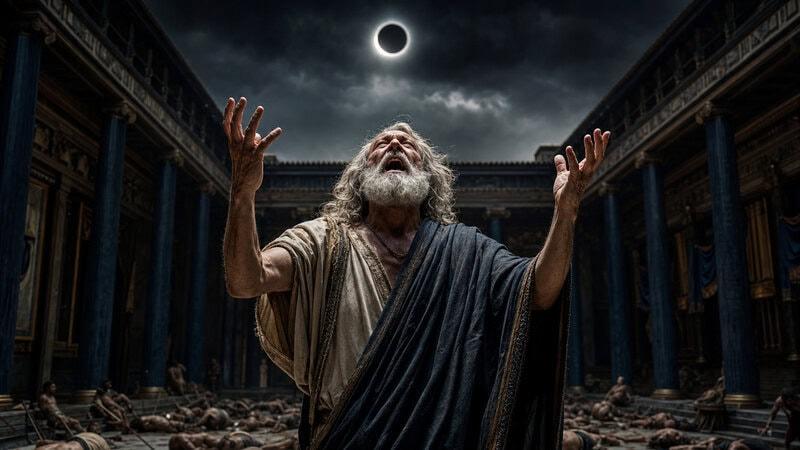

The suitors are dead. Odysseus stands in his own blood-soaked hall, arrows spent, the bodies of more than a hundred men cooling on the floor around him — and in the chaos just before the killing begins, a prophet named Theoclymenus throws back his head and screams that the sun has vanished from the sky, that darkness is swallowing the walls, the faces of the men, the world itself. The suitors laugh at him. They will not be laughing for long.
A Poem That Has Outlasted Empires

That scene, buried in Book 20 of Homer’s Odyssey, has unsettled careful readers for centuries. Is Theoclymenus’s vision of a darkened sun a piece of poetic machinery — death dressed in astronomical robes — or is it something stranger? In 2008, two astrophysicists decided to find out. They fed the poem’s scattered celestial details into modern planetary software, ran the math backward through three millennia of orbital mechanics, and arrived at a specific date: April 16, 1178 BCE. On that day, they reported, a total solar eclipse swept across the Ionian Sea, its path of totality passing near the island of Ithaca.
The claim has been debated, contested, and quietly marveled at ever since. But before we can weigh it properly, we need to understand what the Odyssey actually is — and why a poem composed in the ancient world still has the power to make astronomers reach for their calculators.
The Odyssey is a Greek epic of more than twelve thousand lines, attributed to the poet Homer and likely composed orally across generations before being written down around the 8th century BCE — making its recorded form roughly 2,700 years old. It follows Odysseus, the cunning king of Ithaca (known to Latin speakers as Ulysses), as he fights for ten years in the Trojan War and then spends another decade trying to sail home, battling Cyclopes, enchantresses, the wrath of the sea-god Poseidon, and his own considerable capacity for disaster. Alongside the Iliad, it forms one of the twin pillars on which Western literature rests. Virgil imitated it. Dante walked through it. James Joyce rebuilt it scene by scene in Dublin. The word odyssey has entered virtually every language on earth as shorthand for a long, punishing, transformative journey.
What makes the poem so persistently fascinating to historians, archaeologists, and now astronomers is the texture of its world. The sailing routes feel navigable. The grief feels true. The social customs of Bronze Age palace culture are rendered with an intimacy that suggests somebody, somewhere in the chain of oral transmission, actually knew what they were describing. So a question quietly insists on being asked: how much of this is real?
The Trojan War: From Legend to Archaeological Record

For most of European history, the Trojan War was considered pure myth — a magnificent story, certainly, but no more historically grounded than the labors of Hercules. That assumption began to crack in the 1870s, when the obsessive German businessman Heinrich Schliemann excavated a mound at Hisarlik in northwestern Turkey and found, beneath layers of accumulated ruin, a real Bronze Age city destroyed by fire. Modern archaeology has since confirmed that the site — ancient Troy — shows multiple destruction events, with the layers designated Troy VI and VIIa revealing evidence of violent collapse dated roughly to between 1180 and 1190 BCE. That range aligns with uncomfortable precision against the traditional Greek date for the fall of Troy.
The evidence grew more compelling when scholars deciphered the Linear B tablets from Mycenaean palace archives — the administrative records of the very civilization Homer describes. Among the place names referenced in those clay tablets is Wilusa, almost certainly the same word as Ilios, Homer’s name for Troy. The Greeks of the Bronze Age not only knew the site existed; they were writing about it in their bureaucratic correspondence.
The scholarly consensus today is carefully nuanced. The Trojan War as Homer narrates it — gods intervening on the battlefield, a wooden horse, a war launched over a stolen queen — is mythologized far beyond any recoverable historical event. But the poems almost certainly preserve a kernel of genuine memory: Bronze Age raids, naval expeditions, and the catastrophic end of Mycenaean civilization around 1200 BCE, a period historians call the Bronze Age Collapse, when nearly every major palace culture in the Eastern Mediterranean fell within a single generation, for reasons that still generate fierce academic debate.
This archaeological context matters enormously for evaluating the eclipse question. It establishes that Homer was not simply inventing from imagination. He was working — consciously or not — with historical material that had been passed down, reshaped, and resung across centuries of oral tradition. The poem is not pure fantasy. It is a cultural archive, and like all archives, it may contain data its compilers did not know they were preserving.
The Eclipse Passage: Five Clues Hidden in Plain Sight

Return to that scene in Book 20. Theoclymenus is a prophet who has traveled with Odysseus, a man described as possessing genuine second sight. When he interrupts the suitors’ feast with his vision of darkness and dripping blood, the narrative frames it unmistakably as a divine warning. The suitors’ laughter is the laughter of men who cannot read the sky. Within hours, Odysseus has strung his great bow and the hall is a slaughterhouse.
Classical scholars have long and reasonably interpreted this passage as literary metaphor. Darkness equals death. The extinguishing of the sun mirrors the extinguishing of the suitors’ lives. It is a technique as old as poetry itself, and it requires no astronomical explanation to be fully meaningful. Homer was a poet, not a meteorologist.
But astrophysicists Marcelo Magnasco and Constantino Baikouzis, publishing in the Proceedings of the National Academy of Sciences in 2008, argued that Homer was also, perhaps without knowing it, something like a recorder. They identified not one but five separate celestial indicators scattered across the Odyssey‘s final weeks of narrative: the position of Venus as a morning star, the timing of the Pleiades and the constellation Boötes near the horizon, a new moon coinciding with the night of the massacre, and the eclipse itself. Taken individually, each detail could be formulaic or accidental. Taken together, the researchers argued, they converge on a single date within the plausible historical window — one they calculated had less than a one-in-a-million chance of arising from random alignment.
Running their analysis backward through three thousand years of orbital data — the movements of planets are among the most precisely calculable facts in all of science — they landed on April 16, 1178 BCE. On that date, a total solar eclipse was indeed visible across the Ionian Sea, with its path of totality passing near Ithaca.
That date also places the events of the Odyssey squarely inside the Bronze Age Collapse — making Odysseus’s homecoming, if there is any historical truth to it at all, not just a personal adventure but a survivor’s return to a world coming apart at every seam.
What Skeptics Say — and Why the Debate Matters Either Way

Not everyone is persuaded, and the objections are serious. The ancient Greek calendar was lunisolar and notoriously complex; pinning specific modern dates to its festivals and cycles requires assumptions that can quietly bias the result. Oral poets working in the Homeric tradition used formulaic astronomical imagery — rising stars, darkened suns, morning planets — as stock devices that fit the meter and carried emotional weight, not necessarily observational precision. Critics further note that deciding which textual details count as genuine astronomical clues, and which are poetic convention, involves interpretive choices that the mathematics itself cannot make. Selection bias is a real risk when you are sifting eight thousand lines of ancient verse for a pattern you are already hoping to find.
Classical scholar Gregory Nagy’s foundational work on Homeric oral tradition offers a different but complementary lens. Bards operating within the oral tradition worked inside tight formulaic constraints — repeated phrases, stock scenes, strict metrical patterns — that paradoxically served as a preservation mechanism. A detail that fit the meter survived. A sailing route that bards had always sung was sung again. This means the poems could genuinely carry accurate geographic and even astronomical material across centuries without any single poet consciously knowing they were doing so. The archive preserves without intending to.
Whether or not the eclipse of 1178 BCE is the origin of Theoclymenus’s vision, the debate itself illuminates something extraordinary about what the Odyssey is and does. It is a text dense enough, precise enough, and internally consistent enough that modern scientists can press instruments against it and receive something that looks, at least momentarily, like a signal. That is not nothing. That is, in fact, remarkable.
The Odyssey as a Technology of Memory

There is a temptation, when engaging with questions about whether Homer’s Odyssey encodes real history, to treat the answer as binary: either it happened or it didn’t. Either Odysseus was a real man who watched a real eclipse, or the whole thing is beautiful fiction and the astronomers are finding faces in clouds. But this binary is almost certainly the wrong frame.
What the Odyssey represents is something our own culture has largely lost the habit of making: a form of knowledge transmission so robust, so deeply embedded in rhythm and repetition and communal performance, that it could carry specific information — place names, sailing directions, social protocols, perhaps even celestial events — across five centuries of pre-literate culture without a single written word. The poem that was eventually transcribed around 700 BCE was the product of countless singers, countless nights, countless small adjustments and faithful repetitions. And it arrived at us still containing things that archaeologists can dig up and astronomers can calculate.
Understanding this changes how we read the poem. The Odyssey is not a historical record pretending to be art, nor art that accidentally stumbled onto history. It is something more interesting: a living archive, shaped by imagination and constrained by memory, that carries the residue of a real world even when it cannot help doing so. Every century presses its own instruments against it — literary theory, archaeology, orbital mechanics. Each time, the poem presses back.
Why the Question Still Matters

The suitors die on what may or may not have been a day when the sun went dark over the Ionian Sea. A prophet screams into a hall full of laughing men that the world has gone black. The poem has been read since then as adventure story, as psychological portrait, as theological allegory, as ethnographic record, and now as potential astronomical document. None of these readings cancels the others. All of them are true simultaneously, which is the definition of a great work.
Whatever the truth of the eclipse — and we may never know it with certainty — that layered resilience is its own kind of historical evidence. A text this alive, this precise in its textures, this endlessly productive of new questions, was not assembled from nothing. It grew from a world that actually existed, full of people who watched the sky and fought wars and spent years trying to get home. We cannot fully see that world. But occasionally, in the gap between a prophet’s cry and the returning light, we catch a glimpse of it — and the glimpse is enough to keep us reading.

 English
 Arabic
 French
 Spanish
 Portuguese
 Deutsch
 Turkish
 Dutch
Dutch
 Italiano
 Russian
 Romaian
 Greek
Greek