


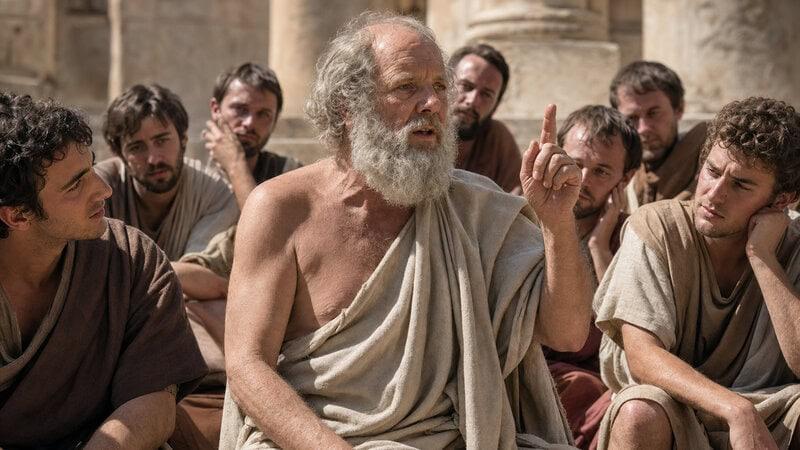

Around 370 BC, in the bright, dusty heat of an Athenian afternoon, Socrates pulled his students close and warned them about a dangerous new technology that was quietly hollowing out the human mind. The technology was writing — and the argument he made that day would be recycled, almost word for word, against the printing press, the pocket calculator, the search engine, and, now, ChatGPT.
The Philosopher Who Saw the Future in a Reed Pen

The scene survives in Plato’s Phaedrus, one of the most vividly written of all the dialogues. Socrates recounts a myth set in ancient Egypt: the god Theuth — inventor of numbers, geometry, and letters — presents his gift of writing to King Thamus, expecting praise. Thamus refuses it. Writing, the king argues, will produce “forgetfulness in the minds of those who learn to use it,” because people will stop exercising their memories and instead trust external marks on papyrus. They will have the appearance of knowledge without the substance of it — pupils who can recite but cannot think.
The parallel to today’s ChatGPT debate is almost eerie. Novelist Dave Eggers stood before OpenAI staff and argued that their product was silencing an entire generation — stripping young writers of the productive struggle that builds genuine voice and craft. The accusation is structurally identical to Thamus rejecting Theuth’s reed pen: a new machine does cognitive work so efficiently that it robs the learner of the very friction that produces mastery. Two thousand four hundred years apart, aimed at entirely different tools, the charge is the same.
This is not a coincidence. It is a pattern — and tracing it carefully changes how we should think about AI anxiety right now.
Socrates’ Core Argument: Outsourcing Memory Is Losing the Self

It would be a mistake to dismiss Socrates as a technophobe who simply feared change. His concern was philosophical, not nostalgic. For Socrates, memory was not mere storage — it was the engine of genuine wisdom. To truly know something, you had to have wrestled it into your own mind, turned it over, tested it against competing ideas, and lived with it. A person who had only read a fact could perform knowledge in conversation without actually possessing it. He called this the “semblance of wisdom” — a phrase that maps with uncomfortable precision onto the experience of prompting ChatGPT to draft an essay you then submit as your own thinking.
The deepest irony in the history of technology anxiety lives right here: Socrates never wrote a single word himself. His entire philosophy survives only because Plato — his student — wrote it down. The technology Socrates feared is the sole reason we can still hear his warning. Scholars have savored this irony for centuries, and it cuts both ways: it does not refute Socrates’ concern, but it does complicate any simple story about cognitive tools being purely corrosive to thought.
What Socrates planted was a seed. Every time a new memory-extending technology appeared in history, that seed germinated again — the same anxieties, the same accusations, the same debates about what the mind loses when it delegates work to a machine.
The Printing Press and the First Mass Panic About Outsourced Thought

When Johannes Gutenberg’s press began spreading across Europe in the 1450s, the reaction among educated elites followed a script that would become familiar. In 1492, the German abbot Johannes Trithemius wrote In Praise of Scribes, arguing that monks who copied manuscripts by hand absorbed meaning through the physical labor of writing. Printed books, produced mechanically, were spiritually inferior and would deteriorate quickly, unlike durable vellum. The medium, Trithemius insisted, was inseparable from the message.
By the late 16th century, Swiss naturalist Conrad Gessner was cataloguing what he described as an “overwhelming and harmful abundance of books” — a sentence that could be dropped into any contemporary essay about AI-generated content floods without raising an eyebrow. Educated Europeans genuinely debated whether the proliferation of cheap print would make readers shallow, credulous, and intellectually passive. These were not fringe anxieties; they were the concerns of serious scholars watching their world reorganize at speed.
They were not entirely wrong, and they were not entirely right. The press did change reading — it made it faster, more solitary, and more consumer-like in certain respects. But it also democratized literacy across social classes, made science a genuinely collaborative and cumulative enterprise for the first time, and produced a flowering of literature that included Shakespeare. The fearful predictions and the utopian ones were both, as is usually the case, about half correct.
Calculators, Encyclopedias, and the Recurring Crutch Accusation

The pattern accelerated as technology itself accelerated. When pocket calculators entered schools in the 1970s, educators and parents launched a debate that was, in almost every structural detail, a replay of Socrates on writing. Students who let machines do arithmetic, the critics warned, would never develop genuine number sense — they would produce answers without understanding what those answers meant. School boards argued, op-eds multiplied, and the calculator debate became a cultural flashpoint before “culture war” was even a common phrase.
Reference works went through multiple versions of the same trial. Diderot’s great Encyclopédie in the 18th century, Britannica in the 20th, Wikipedia in the 21st — each was accused in its era of producing dilettantes who could cite facts without understanding them. That phrase — citing facts without understanding them — is the “semblance of wisdom” argument in modern dress, and it has never really gone away.
What cognitive science has since added to the picture is important context. Researchers studying memory now use the term “transactive memory” to describe the well-documented, deeply adaptive human habit of storing knowledge in external systems — books, other people, written records, devices — rather than exclusively inside individual skulls. The evidence suggests the brain was never designed to work in isolation. Humans have always been, in a meaningful sense, hybrid minds: biological brains coupled to external tools. Each new tool changes which internal capacities we prioritize and which we allow to rest.
What Makes ChatGPT Different — and Why the Fear Feels Bigger This Time
Here is where honest historical analysis has to pause and acknowledge something genuinely important: the pattern is real, and so is the possibility that some technological transitions cross a qualitative line rather than simply a quantitative one.
Every previous “memory machine” in this long history stored information, organized it, or retrieved it. Writing preserved words. The printing press reproduced them at scale. The encyclopedia indexed them. The search engine located them. ChatGPT does something categorically different: it generates language, argument, and the appearance of reasoning. It does not hold thought the way a book holds thought. It performs thought — or something indistinguishable from it at a glance — on demand, in seconds, in your voice if you ask it to.
That is precisely why Dave Eggers’ warning to OpenAI staff feels pointed in a way that goes beyond nostalgia. Earlier tools extended a human’s reach — you could remember more, find more, calculate faster. A large language model can bypass the act of expression itself. The struggle to find your own words, which is also the struggle to find your own thought, can be skipped entirely. Whether that skip matters as much as critics fear is genuinely uncertain. But it represents a new threshold, not merely a faster version of the old ones.
The scale and speed of adoption sharpens the urgency. ChatGPT reached 100 million users within two months of its launch, compressing the social adjustment period that previous technologies enjoyed across decades into a matter of months. Societies have always needed time to develop norms, pedagogy, and critical frameworks around powerful new tools. That time is, this round, extraordinarily short.
The Critics Who Got It Right — and the Lesson They Left
Looking back across this long history of technology anxiety, a useful sorting emerges. The critics who proved most accurate were not the ones who asked “will this technology harm us?” in the broadest possible terms. They were the ones who asked the narrower, harder question: what specific capacities will atrophy, and what will we consciously choose to build in their place?
Gessner’s worry about information overload looks prescient in the social media age. The calculator critics were right that certain students never developed intuitive number sense — even if they were wrong that calculators should therefore be banned from classrooms. Trithemius was wrong about printed books being spiritually hollow, but he was onto something real about how speed of reproduction changes what readers value in a text. The handwritten manuscript carried weight, literally and figuratively, that the mechanically produced pamphlet did not.
Cognitive historian Merlin Donald’s research on what he calls “external symbolic storage” offers a useful frame: humans have always extended their minds outward into tools and symbols, and each extension rewires which internal capacities we prioritize. The alphabet rewired memory. Print rewired the relationship between individual readers and shared knowledge. Calculators rewired how we think about numerical fluency. ChatGPT will rewire something too. The question worth asking — with the precision the best historical critics brought — is which capacities we decide are non-negotiable, worth preserving even when a machine could spare us the effort.
Socrates Was Right to Ask the Question — That Is the Point
Return, finally, to that afternoon in Athens. Socrates sits with his students, telling a story about an Egyptian god and a skeptical king, making an argument against writing — an argument that survives only because it was written down. The irony does not cancel the argument. It illuminates the real lesson hiding inside two and a half millennia of technology anxiety.
The lesson is not that critics are always wrong, nor that new tools always prove harmless in the end. It is that the interrogation itself matters. Every generation that has stood at one of these thresholds — the scroll, the codex, the press, the calculator, the search engine — and asked hard questions about what the new tool does to human minds has shaped, through that very asking, how the technology got used. Those questions forced educators to think carefully about what arithmetic instruction was actually for. They forced librarians to articulate the difference between information and understanding. They are now forcing schools, writers, and policymakers to confront what human expression is for, what makes it valuable, and what would genuinely be lost if it were fully automated.
ChatGPT is not the end of human thought. The long history of fears surrounding tools that seem to threaten human cognition suggests we are more adaptive, and more stubborn in our humanity, than each wave of alarm predicts. But Socrates’ question — what do we lose when we let a machine remember, and now speak, for us? — has never been more worth sitting with. Slowly. In your own words. Without asking an algorithm for the answer.

 English
 Arabic
 French
 Spanish
 Portuguese
 Deutsch
 Turkish
 Dutch
Dutch
 Italiano
 Russian
 Romaian
 Portuguese (Brazil)