


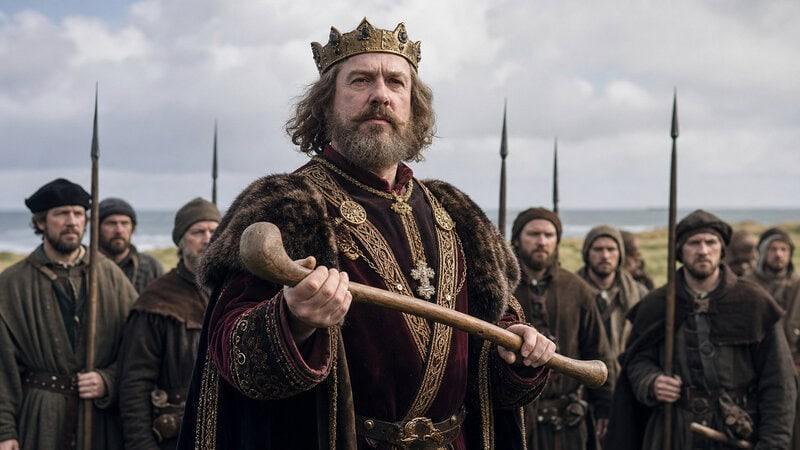

On a bitter afternoon somewhere along the East Lothian coast in 1457, a shepherd drew back a roughly shaped wooden club and sent a leather ball stuffed with feathers skittering across the wind-scoured turf — and in doing so, broke the law. King James II of Scotland had just issued a formal parliamentary decree: golf was banned, a dangerous distraction from the archery practice upon which the kingdom’s defence depended. The shepherd, in all likelihood, did not care.
The Banned Game: Scotland’s First Golf Controversy

The Act of the Scottish Parliament passed in 1457 is the oldest recorded reference to golf in Scottish history, and it is, fittingly, an act of prohibition. The language was blunt: golf and football were to be “cryit doun and nocht usit” — cried down and not practised — because young men were choosing to chase balls across coastal pastures rather than sharpen their archery, the military foundation of Scottish power. It is the kind of law that tells you everything about its own futility. You do not ban something that nobody is doing.
The ban was repeated in 1471. Then again in 1491. Three separate parliaments under three separate kings found it necessary to outlaw the same game, which is as clear a picture of enforcement failure as history offers. Golf was so deeply embedded in the communities of the Scottish coastline — among fishermen, craftsmen, clergy, and noblemen alike — that no royal decree could dislodge it. The game had found its landscape and would not be moved.
That landscape was the East Lothian links: a narrow coastal strip of wind-sculpted turf, sandy soil, and natural hollows scraped out by centuries of rabbit warrens and sea wind. It required no architect, no designer, no investment. The land simply was a golf course, and the people who lived beside it knew it. By the time the third ban was issued in 1491, the game had been played on this stretch of coast for generations. Then came the reversal that history seems almost too pleased with itself to deliver: by 1502, King James IV — grandson of the very monarch who first outlawed the sport — was purchasing golf clubs and balls from a Perth bow-maker, his royal household accounts recording the expenditure with the same casualness a modern golfer might tap a sleeve of balls into an online basket. The king had capitulated. Golf had won.
The Scottish Renaissance: The Era That Gave the World Its Game

To understand why golf took such stubborn root in this particular corner of Europe at this particular moment, it helps to understand what Scotland was becoming in the century between roughly 1450 and 1600. This was the Scottish Renaissance — a sustained period of cultural ambition in which the Scottish crown patronised poets, architects, and scholars, funded the first Scottish printing press, and built institutions designed to signal a confident, outward-looking kingdom. James IV, the same monarch who broke his family’s golf ban, also commissioned expansion of Holyrood Palace and supported the founding of Scotland’s early universities. The country was, in the deepest sense, making itself.
It is in this context that golf’s emergence looks less like an accident of geography and more like a product of its age. The Scottish Renaissance was defined by a spirit of restless inquiry — the idea that received wisdom could be questioned, improved upon, reinvented. Golf embodied exactly that impulse on a small, practical scale. The featherie ball, stitched from leather and packed with boiled feathers, was a piece of Renaissance-era craft engineering: a designed object, refined through experiment and iteration. The shaped wooden club, the concept of a target hole, the evolving etiquette of play — each was a small invention, developed by anonymous craftsmen and players along the East Lothian coast across generations.
There was also something genuinely unusual about golf’s social reach. Most Renaissance pursuits — the patronage of painters, the commissioning of architecture, the writing of court poetry — were confined to the wealthy and the powerful. Golf was not. From its earliest documented years, the game crossed class lines with an ease that almost nothing else in 15th-century Scotland managed. The fisherman and the earl were, on the links, engaged in the same activity, subject to the same wind, hunting for the same lost ball in the same rough grass. It was, arguably, the most democratic sport that Renaissance Europe produced.
East Lothian: The Cradle of the Game

Spread a map of East Lothian on a table and trace the coastline between Edinburgh and North Berwick, and what you are looking at is essentially a roll-call of golf history. Musselburgh Links, one of the oldest surviving courses in the world, sits at the western edge. Gullane, Muirfield, and North Berwick stretch eastward along the same coastal corridor. Within this twenty-mile arc, the game was born, formalised, and sent outward to the rest of the world.
The links terrain that produced all of these courses shares the same geological biography: ground that was once below the tideline, gradually exposed by centuries of coastal change, too sandy and wind-battered for productive agriculture, but covered with the kind of firm, close-cropped turf that makes striking a ball across it both possible and, as several centuries of players have confirmed, deeply compelling. This was common ground in the legal as well as the literal sense — land that belonged to the community rather than any private landowner, which is part of why golf could spread so freely among all social classes. Nobody owned the links. Everybody used them.
The formal codification of golf arrived in 1744, when the Honourable Company of Edinburgh Golfers drew up the first written rules of the game at Leith, a few miles west of Edinburgh. Thirteen rules, covering everything from how to play from a tee to what to do when your ball landed in water. The Scottish Renaissance, in its broadest cultural sense, had long since given way to the Reformation and its aftermath — but the Renaissance impulse of taking a living practice and giving it rigorous, transmissible form produced, in those thirteen rules, something that would travel to every continent on earth.
Four miles west of North Berwick, roughly twenty miles east of Edinburgh, sits The Renaissance Club. Its position places it almost exactly at the geographical heart of this history. That is not coincidence. It is inheritance.
The Renaissance Club: A Modern Course on Ancient Ground

There is a particular kind of audacity in naming a golf club after a historical era, because the name becomes a promise the course must then keep. The Renaissance Club keeps it. Designed by an American architect and opened on East Lothian links land near the village of Archerfield, the course engages in a conversation between the contemporary and the ancient that is itself a kind of Renaissance act — a return to first principles, filtered through a modern eye.
The name carries at least two meanings simultaneously. It gestures toward the historical Scottish Renaissance in which golf was born and refined, and it suggests something more personal: a renewal, a rediscovery, the act of coming back to something essential. Both readings fit. A course that sits in the same coastal corridor as the oldest golf in recorded history, designed according to links principles that would not have seemed foreign to a 15th-century player, is performing its own version of that Renaissance impulse — recovering and reinventing something that the centuries might have obscured.
The design philosophy is itself broadly sympathetic to links tradition: minimal earthmoving, fairways that follow the natural contours of the land, greens shaped by the ground rather than imposed upon it. At the Renaissance Club, that philosophy meets terrain that barely needed intervention. The sandy soil, the coastal exposure, the natural undulation — the land already knew what it wanted to be. The architect’s task was largely one of revelation rather than construction, which is as close as modern golf design gets to the way the original East Lothian courses came into being.
The Scottish Open and Global Recognition

The club’s arrival on the global stage confirmed that the name was carrying real weight. The Renaissance Club has hosted the Genesis Scottish Open, one of the most significant events on the joint European and PGA Tour calendar, bringing world-ranking professionals to a course that sits in the same geography where James IV once cheerfully broke his own family’s ban on the sport. The Scottish Open has been played at the club on multiple occasions, each time drawing a field that reflects how thoroughly golf’s centre of gravity has shifted since the East Lothian fishermen first ignored their king.
When television cameras pan across those links fairways toward the Firth of Forth, they transmit images that would have been recognisable in their essential geography to any player from the 15th century — the same sea, the same coastal light, the same wind pressing across the same kind of ground. The professionals competing for the title are wielding titanium drivers and playing with multilayer urethane balls tracked by launch monitors, but the wind does not care about any of that. It arrives off the Forth exactly as it always has, and the strategic problem it poses — how to keep a ball low, how to use the ground, how to accept that this game will not always yield to power — is the same problem that has defined links golf since before the first written rule was drafted.
From Featherie Balls to Tour Events: Golf’s Unbroken Thread

Golf’s equipment has been in a state of continuous revolution since the first featherie ball left a Scottish workshop, but many of those revolutions have roots in this corner of Scotland. The gutta-percha ball arrived in the 1840s, made from the dried sap of a Malayan tree and discovered — reportedly by accident — to fly more consistently once it had been scuffed and marked by use. It was a characteristically pragmatic finding: perfection located in the imperfect. The rubber-wound ball of the early 20th century followed. The craftsmen and club-makers who served East Lothian’s growing golfing population were, across four centuries, the quiet research and development arm of a sport that did not yet know it would spread to every continent.
What carried the game beyond Scotland was not equipment alone but structure: those thirteen rules of 1744, the formal clubs and competitions that followed, the infrastructure of a codified sport that could be exported as clearly as a set of written instructions. The same culture that valued rigour, institutions, and the written transmission of knowledge eventually gave the sport the framework it needed to travel. Golf is now played in more than 200 countries. The thread runs, without a break, back to the East Lothian links and the defiant players who refused to put down their clubs because a king told them to.
There is something worth pausing over in the fact that the Renaissance Club sits at the near end of that thread. An American architect designed the course. Professionals from every continent have competed on it. Millions of television viewers have watched it. And yet the ground underfoot is the same links land, shaped by the same sea winds, that produced the oldest golf in recorded history. The sport has accumulated five and a half centuries of elaboration — technology, money, global media, carbon-fibre shafts — and underneath all of it, unchanged, is that East Lothian turf.
Why It Matters: The Renaissance Spirit Golf Never Lost
The Renaissance, as a historical concept, describes something specific: a period in which a culture recovers lost or neglected excellence, strips away what has accumulated over it, and returns to first principles with fresh energy. What makes the concept durable is that it recurs. Golf has re-enacted it repeatedly. The links revival movements of the late 20th century — the deliberate return to natural turf, minimal construction, courses shaped by landscape rather than imposed upon it — were Renaissance acts. The interest in hickory golf, which draws players back to the equipment and conditions of the sport’s earliest formal decades, is a Renaissance act. Every time the game reaches backward to find what made it compelling in the first place, it performs the same gesture that defined the historical era in which it was born.
The Renaissance Club, then, is one of the most historically resonant addresses in world golf — not because it is the oldest course or makes any claim to antiquity it does not possess, but because its name, its location, and its design philosophy place it in conscious relationship with the full arc of the sport’s history. It sits where golf began. It is named for the era that produced the game. It has hosted the tournaments that define the sport’s present. That is a rare kind of coherence, and coherence of that order is worth understanding rather than simply admiring.
Picture a player standing on one of its fairways as the round draws toward its close, the Firth of Forth glittering to the north, Edinburgh’s skyline a faint blue suggestion on the western horizon. They are occupying almost exactly the same visual field as a 15th-century golfer who had just cheerfully ignored a king’s decree — who had looked at a strip of wind-battered coastal ground and decided that the most important thing to do with it was strike a feather-stuffed ball across it as skillfully as possible. The clothes are different. The ball is different. The club is unrecognisably advanced. But the impulse — stubborn, joyful, slightly irrational, entirely irresistible — is identical. Every round of golf played anywhere in the world carries that impulse forward. It is, in a small and genuine way, an act of Scottish Renaissance: a defiant insistence that this particular game is worth any ban, any obstacle, any number of lost balls in the rough.

 English
 Arabic
 French
 Spanish
 Portuguese
 Deutsch
 Dutch
Dutch
 Italiano
 Russian
 Romaian
 Portuguese (Brazil)
 Greek
Greek