


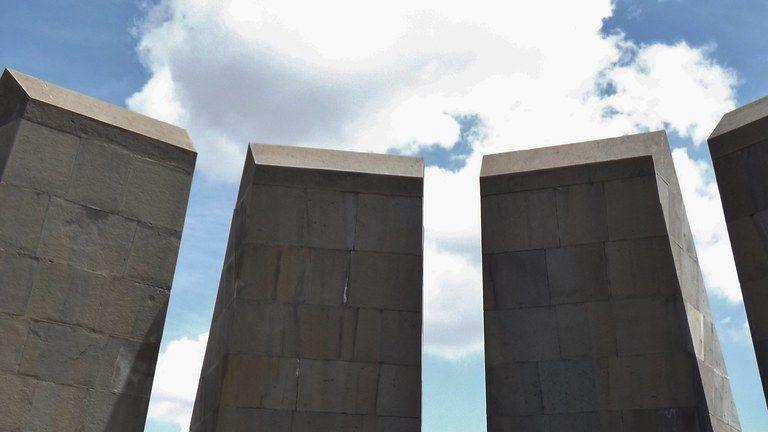

Before the sun rose over Constantinople on April 24, 1915, soldiers and police were already moving through the Armenian quarter, knocking on doors, pulling men from their beds. By morning, roughly 250 of the community’s most prominent figures — poets, priests, physicians, newspaper editors, teachers — had been loaded into vehicles and driven away. Almost none of them would ever be seen again.
The Night That Silenced a People’s Voice

The city looked ordinary by daylight. Shopkeepers opened their stalls. Ferries crossed the Bosphorus. But the Armenian intellectual class of Constantinople had been quietly erased in a single night — a surgical strike against the very people who might have organized resistance, borne witness, or carried word to the outside world. The logic was as brutal as it was calculated: destroy the voice first, then the body follows with no one left to speak.
That single night in April would eventually force a Polish-Jewish lawyer to invent a new word for an old crime. It would ignite a century-long battle over historical truth. And it would establish a template for how states commit mass murder while engineering their own innocence — a template that has haunted international law ever since.
The Dying Empire and the Conditions for Catastrophe

To understand the Armenian Genocide of 1915-16, you have to understand the empire that was collapsing around it. The Ottoman state in the early twentieth century was hemorrhaging territory after a series of humiliating military defeats — including the Balkan Wars of 1912-13, which stripped the empire of most of its remaining European holdings and sent hundreds of thousands of Muslim refugees streaming into Anatolia. The psychological and political trauma of those losses was profound. Into this atmosphere of crisis and wounded pride stepped the Committee of Union and Progress — the Young Turks — an ultranationalist faction that had seized effective control of the government and harbored an intoxicating, murderous vision: a purely Turkish Anatolia, cleansed of the Christian minorities who had lived there for millennia.
The Armenians were Christian in a Muslim-majority empire. They were economically prominent in many cities, educated, and networked across international borders. For centuries they had occupied an uneasy but functional place within Ottoman society. Wartime propaganda now recast all of this as treachery. Armenian communities near the Russian front were portrayed as a fifth column — potential collaborators with the enemy. The accusation was largely fabricated; most Armenians were loyal Ottoman subjects, and Armenian leaders had publicly pledged their communities’ cooperation with the war effort. But the charge didn’t need to be true. It needed to be useful.
The cover of World War I was not incidental to any of this. The genocide’s architects understood that the world’s attention was fixed on the trenches of France and the Eastern Front. Enver, Talat, and Cemal Pashas — the ruling triumvirate who drove the campaign — made their move precisely when the international community had neither the bandwidth nor the will to intervene. The war provided both the pretext and the camouflage.
1915-1916: How the Killing Unfolded

The machinery of destruction moved in deliberate phases. After the April 24 arrests came the systematic disarming of Armenian men already serving in the Ottoman military — removing the one group capable of mounting organized armed resistance. Labor battalions were formed from these soldiers; most were worked to death or executed outright. Then came the deportation orders, sweeping across entire provinces and villages from Anatolia to Cilicia. Whole communities were told they were being relocated for security reasons and given hours to gather what they could carry. They were marched into the Syrian desert instead.
The death marches are among the most harrowing episodes in modern history. Columns of women, children, and elderly — the men had already been taken and killed — were forced to walk hundreds of miles in brutal summer heat, denied adequate food and water, guarded by soldiers and irregular paramilitaries known as the Special Organization who murdered stragglers without hesitation. Those who survived the march often found no sanctuary at the end of it. Desert encampments at places like Deir ez-Zor in modern-day Syria became sites of organized mass starvation and further killing.
The methods varied by location and commander. Mass shootings at ravines and riverbeds. Bodies thrown into the Euphrates. Villages burned with residents still inside. The breadth and coordination of the violence — documented across hundreds of miles of territory, carried out by multiple government agencies simultaneously — is precisely what historians classify as a state-organized campaign of extermination, not the chaotic byproduct of wartime disorder. The orders flowed from the center; the execution was methodical.
By the time the killing subsided — extending in episodic waves toward 1923 — approximately 1.5 million Armenians had been killed. A civilization that had existed in Anatolia for roughly three thousand years had been effectively destroyed within a decade.
Witnesses Who Tried to Tell the World

The genocide was not a secret. That is one of the most important and most uncomfortable facts about it.
Henry Morgenthau Sr., the United States Ambassador to Constantinople, watched the deportations begin and sent urgent, specific cables to Washington describing what was happening in precise terms. He personally confronted Talat Pasha, one of the chief architects of the killing, and in his 1918 memoir recorded a chilling exchange in which Talat indicated the government had already accomplished what it intended with the Armenians. Morgenthau’s dispatches were received. They were read. They were not acted upon.
American and European newspapers ran accounts of the massacres in real time. The New York Times documented the slaughter of Armenian civilians as it was unfolding — meaning the genocide did not hide from the world so much as the world chose to look away. German military officers stationed in the Ottoman Empire, serving as advisers to an allied government, filed detailed reports home describing the atrocities. Those reports were filed and largely ignored, creating a damning paper trail inside a government that chose complicity through inaction.
Survivors who fled to Syria, Lebanon, France, and the United States carried their testimony with them across borders and decades. These accounts would become the living archive of what happened — testimony that denialists would spend the next century attempting to discredit, distort, or simply outlast by waiting for witnesses to die.
The Word Born From the Ashes

In the early 1920s, a young Polish-Jewish law student named Raphael Lemkin asked his professor a question that would define his life’s work: why had the men responsible for massacring the Armenians faced no meaningful legal consequences? The answer he received was precise and devastating. There was no crime on the books, his professor explained, because there was no word for what they had done. A crime without a name was a crime that could not be prosecuted.
Lemkin spent the next two decades working toward that word. In 1944, with the Nazi Holocaust unfolding around him and his own family being murdered in Poland, he coined genocide — fusing the Greek genos (race or tribe) with the Latin cide (killing). He drew explicitly on two cases as his primary models: the Armenian massacres and the ongoing slaughter of European Jews.
The direct line from 1915 to international law is worth pausing on. The Armenian Genocide did not only kill approximately 1.5 million people — it produced the conceptual and legal framework the world now uses to name and prosecute mass atrocity. The 1948 UN Convention on the Prevention and Punishment of the Crime of Genocide, which Lemkin fought tenaciously to bring into existence, stands on the foundation of those Armenian deaths. And yet the bitter irony endures: the crime that helped produce the word genocide remains one of the most politically contested applications of that term in international affairs.
A Century of Denial — and Why It Matters

Turkey’s official position has not changed in any fundamental way across more than a hundred years. The mass deaths, the government maintains, resulted from wartime chaos, disease, famine, and inter-communal violence — not a state-organized campaign of extermination. Ottoman Armenians died, Turkish officials acknowledge, but so did vast numbers of Muslim Turks, and the context was a desperate multifront war, not a genocide. Turkish governments have also argued that the available historical record is incomplete or has been selectively interpreted by biased parties.
Historians and genocide scholars at institutions dedicated to studying mass atrocity reject this framing comprehensively. The documentation is too extensive, the coordination too systematic, and the intent too legible in the perpetrators’ own communications — including telegrams from Talat Pasha himself — for the deaths to be dismissed as collateral tragedy. The International Association of Genocide Scholars, the body of academic specialists most qualified to assess the question, has formally affirmed the designation. What makes the denial particularly significant, scholars argue, is not simply that it is historically wrong — it is that it works. Lemkin identified the pattern explicitly: if perpetrators control the historical narrative long enough, impunity becomes permanent, and the next generation of mass murderers absorbs the lesson accordingly.
Geopolitics kept Western governments from pushing back for decades. Turkey was a founding NATO member, strategically indispensable throughout the Cold War — home to Incirlik Air Base and a long border with the Soviet Union — and recognition of the Armenian Genocide was a diplomatic grenade no administration wanted to throw. The United States danced around the word for generations, offering carefully worded commemorations that acknowledged Armenian suffering without naming what caused it.
That changed formally in April 2021, when President Biden recognized the Armenian Genocide — the first U.S. president to use the term in an official presidential statement. Dozens of countries and the European Parliament had already done so. Scholars who study the genocide’s origins and international repercussions note that the recognition landscape has shifted substantially in the early twenty-first century, even as Turkey and a small number of governments continue to reject the designation and press other nations to do the same.
Memory, Recognition, and an Argument That Is Not Over
Every April 24, communities gather in Los Angeles, Beirut, Paris, and Yerevan. Candles are lit. Names are read aloud. The date is observed globally by the roughly ten million members of the Armenian diaspora — a diaspora that exists, in significant part, because the genocide created it, scattering survivors and their descendants across four continents and stripping them of a homeland.
Recognition cannot undo the killing. No declaration restores a single life, rebuilds a single village, or returns a single manuscript burned in 1915. But genocide scholars make a specific and serious argument for why it matters regardless: recognition closes what Lemkin called the impunity loop. When perpetrators are seen to have escaped consequence — when the crime is not only committed but successfully renamed as something lesser and more defensible — the lesson transmitted to future leaders contemplating mass violence is devastating and concrete. The architects of later genocides studied the Armenian case. Adolf Hitler’s often-cited remark in August 1939 — asking who today remembers the Armenians, in the context of his plans for Poland — remains disputed as to its precise wording and source, but the underlying logic it describes was real: impunity invites repetition.
The erasure, meanwhile, has not stopped with historical argument. Armenian churches, monasteries, khachkars, and inscriptions across eastern Turkey — the physical memory of a civilization — face ongoing neglect, repurposing for other uses, and in some documented cases deliberate destruction or appropriation. The landscape of historic Armenia is being slowly and systematically rewritten, which is its own form of denial extended into the present tense and conducted in stone rather than words.
What happened in the Ottoman Empire beginning on that April night in 1915 is not a closed chapter in a history textbook. It is an active argument about truth, about state power, about who gets to name what happened and who is left holding the silence when naming is denied. More than a century later, that argument is being fought in legislatures, in classrooms, in international courts, and in the crumbling stones of abandoned sanctuaries in Anatolia. The historical verdict is not in serious scholarly dispute. The political one is still being contested — and the outcome carries consequences that extend far beyond the Armenians who died, and far beyond 1915.

 English
 Arabic
 Spanish
 Portuguese
 Deutsch
 Turkish
 Dutch
Dutch
 Italiano
 Russian
 Romaian
 Portuguese (Brazil)
 Greek
Greek