


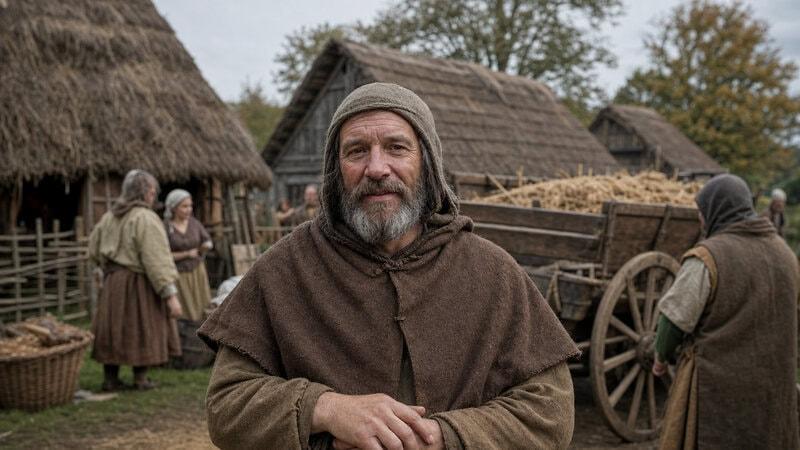

The grain is stored. The last cart has been dragged in from the field, the threshing is done, and across a small English village in late October of 1280, something remarkable happens — almost everyone stops working. Not because they are sick, not because a storm is coming, but because the Church calendar says so, and the Church calendar is the law of the land, the rhythm of the universe, and the schedule posted on every soul’s internal wall.
A Surprising Gap in the Workday Record

Drop this number into a modern office conversation and watch the reaction: medieval peasants in much of Western Europe worked an estimated 150 to 180 days per year. The average American full-time worker logs roughly 240 to 260 days annually. That gap — 60 to 100 days of additional labor every single year — is not a rounding error. It is the difference between a life that has breathing room baked into its structure and one that treats rest as a luxury to be earned.
Before the romanticizing begins, let the full picture in. Peasant life in the medieval period was brutal, short, and precarious in ways that no amount of holiday feasting fully offset. Famine was not a historical abstraction but a recurring visitor. Plague arrived without warning. A bad harvest could reduce an entire village to starvation before spring. This is not a story about a golden age. It is a story about a genuinely different relationship with time — and what happened when we lost it.
Setting the Stage: A Thousand Years of “Medieval”

The Middle Ages stretched from roughly 476 A.D. — the year the Western Roman Empire collapsed under its own weight and the pressure of migrating peoples — to the early Renaissance, conventionally placed somewhere between 1400 and 1450. Nearly a thousand years. The sheer span of it is part of why the era gets flattened into a single cliché of mud, plague, and ignorance, when the reality is that daily life across those centuries varied as dramatically as life in America between 1776 and today.
An early medieval village scratching subsistence from post-Roman rubble looked nothing like a prosperous 14th-century market town buzzing with guild craftsmen, wool merchants, and traveling scholars. And yet, across all those centuries and landscapes, certain structural features held surprisingly steady: the feudal hierarchy, the dominance of the Catholic Church, and the iron logic of agrarian seasons. These three forces together created a labor rhythm that persisted from Frankish France to Anglo-Saxon England to the plains of Castile.
As Britannica’s overview of the Middle Ages notes, medieval European society organized itself into a strict social pyramid. At the top, lords and nobility held land and legal power. Just below, the clergy held spiritual authority — and, crucially, the calendar. At the base, comprising somewhere between 85 and 90 percent of the entire population, were the peasants: serfs legally bound to their lord’s land, and free farmers with slightly more flexibility but the same mud on their boots.
The Church as Enforcer of Rest

Imagine a workplace where an authority with genuine power over your eternal soul mandated 40 to 60 obligatory holidays per year, on top of every Sunday off. That is approximately what the medieval Catholic Church delivered to the peasant workforce of Western Europe — and it is one of the most consistently surprising findings that historians of the period have documented.
Sundays were inviolable. Beyond that, the feast days of the saints carpeted the calendar in required rest. Candlemas in February, Easter across multiple days in spring, the Feast of the Assumption in August, Michaelmas in September, All Saints’ Day in November, and the twelve days of Christmas stretching from December 25th into early January — these were not optional. Local priests enforced them. Guild customs enforced them. Neighbors enforced them, through the social pressure of a community where everyone’s business was everyone else’s business. Working on a major feast day carried spiritual consequences that a 13th-century villager took considerably more seriously than a modern employee takes a stern memo.
The texture of these days is what textbooks tend to drain out. Candlemas meant candles and processions through frost-hardened streets. Midsummer meant bonfires on the village green and young men leaping through the flames. Michaelmas meant the settling of accounts, the hiring of servants for the coming year, and the roasting of geese. Christmas was not a single morning of gift-giving but a rolling festival that kept the ale flowing and the dancing going for nearly two weeks. For long stretches of the year, communal life looked more like a traveling festival than a labor camp.
Historians have noted the central paradox: the same institution that preached vigilantly against the sin of sloth had structurally guaranteed more collective downtime than any modern secular labor law achieves. The Church was not trying to give workers a break. It was trying to honor God. The workers received the break as a consequence.
Seasons, Sunup, and the Logic of Medieval Labor

Even within the working days, the rhythm bore almost no resemblance to the modern eight-hour shift. What genuinely surprises people familiar with contemporary work culture is the concept historians call “task-orientation” — work measured not by hours clocked but by tasks completed. Once the strip of field was plowed, the obligation for that day was done. Once the hay was cut and stacked before the rain came, the peasant was free. The mechanical clock, in any governing sense, simply did not exist for most of this period, and even after clocks appeared in town squares in the 13th and 14th centuries, they reshaped urban trades long before they reached the village field.
Agrarian work had three intense peaks: spring plowing and planting, summer weeding and hay-making, and the autumn harvest, when every able body in the village worked dawn to dusk in a race against weather and rot. These were genuinely punishing stretches. But they were surrounded by months of dramatically reduced labor. Winter shrank the workday to a fraction of its summer length — not because anyone mandated rest, but because darkness arrived early and there was, quite simply, less to do when the fields were frozen and the animals were sheltered.
Historian Juliet Schor, drawing on medieval English records in her book The Overworked American, estimated that peasants may have worked as few as 1,440 hours per year. The average American worker today logs roughly 1,800 hours annually. That gap — approximately 360 hours, or nine full 40-hour work weeks — represents a structural difference that no amount of personal productivity optimization closes.
The essential caveat belongs in the same paragraph: drought, flood, or an early frost could collapse this entire balance into crisis. When the harvest failed, the leisure of winter became the hunger of winter. The calendar of rest existed inside a framework of genuine existential risk that most modern workers, thankfully, cannot fully imagine.
What They Actually Did With the Time

Life during “off” periods was not idle in any passive sense — but it was decoupled from the lord’s fields, which is the meaningful distinction. Peasants mended tools, brewed ale (a dietary staple, often safer than available water), wove cloth, tended kitchen gardens that supplemented the grain ration, and repaired thatch. These were labor-intensive activities, but they were labor done on one’s own terms, for one’s own household, at one’s own pace.
Communal leisure was genuinely rich. Village greens hosted archery practice — legally required of English men during various periods and conveniently also enjoyable — alongside wrestling matches, early forms of football violent enough to alarm local authorities, and mystery plays staged by guilds that dramatized biblical stories with a theatrical flair mixing the sacred and the comic. This was public entertainment that cost nothing and drew everyone.
Here an important qualification is required. Women’s labor rarely paused with the liturgical calendar. Childcare, cooking, textile work, and the care of livestock and kitchen gardens continued regardless of what the feast day was. The shorter medieval working year is most accurately described as a shorter working year for men laboring in the lord’s fields. Women inhabited a different, largely continuous labor reality, and any honest accounting of medieval peasant life must hold both truths simultaneously.
Pilgrimage added another layer entirely. Traveling to a shrine — Canterbury, Walsingham, or Santiago de Compostela — was spiritually encouraged and functionally a journey away from the manor for days or weeks at a time. Chaucer captured exactly what this meant when he put his pilgrims on the road in The Canterbury Tales: a socially sanctioned adventure that blended devotion, tourism, storytelling, and escape into something that bears a family resemblance to a modern road trip, except with worse roads and a genuine belief that the destination might heal your illness.
How Capitalism and the Reformation Changed the Clock

The transformation from medieval to modern labor rhythms did not happen overnight, and understanding it matters as much as understanding the medieval baseline itself. The compression of leisure time traces most clearly to the 14th through 16th centuries, as proto-capitalist merchants and early manufacturers began paying daily wages and discovered a direct financial incentive to maximize the hours in those days. A feast day, to a wool merchant paying weavers by the piece, was not a gift from God but a loss on the ledger.
The Protestant Reformation accelerated the shift in ways its architects did not fully anticipate. When Luther and Calvin attacked the veneration of saints as theologically corrupt, one practical consequence was the removal of feast days from the calendar in newly Protestant regions. Dozens of obligatory rest days simply disappeared, replaced by a theology that recast disciplined, regular work as a divine calling and idle celebration as something adjacent to sin. The medieval peasant’s festival calendar was reframed as papist excess and systematically dismantled across northern Europe.
The Industrial Revolution finished what the reformers began. Factory discipline cared nothing for sunrise and sunset. Gas lighting and later electric light erased the natural boundary that darkness had always imposed on the working day. Child labor, piece-rate wages, and the relentless logic of the machine created the 300-plus workday year that labor movements then spent the 19th and early 20th centuries slowly and painfully contesting — fighting for the eight-hour day, the weekend, the abolition of child labor, and the annual leave that medieval serfs had received, involuntarily and imperfectly, from the Church.
The irony is almost too neat to be real, but it is real: the 40-hour workweek and two weeks of paid vacation that feel like hard-won modern achievements still leave the average American working significantly more days per year than a 13th-century English peasant who had never heard of a labor union.
What This History Actually Tells Us
Hold the full picture before drawing conclusions. Medieval peasants lived, on average, into their mid-30s, though that figure is heavily weighted by high rates of childhood mortality; those who survived to adulthood often lived considerably longer. They faced legal subjugation so complete that a serf could not leave the manor, marry, or pass on property without the lord’s permission. When plague arrived — and it arrived repeatedly, carrying off roughly a third of Europe’s population in the 14th century alone — no festival calendar offered protection. No honest engagement with the medieval era can skip past these facts in pursuit of a comfortable contrast with modern stress culture.
The real revelation is structural, not nostalgic. The assumption that relentless, year-round productivity is natural — that the always-on work culture of the 21st century reflects some timeless human reality — turns out to be historically recent, approximately 500 years old, and the product of specific theological, economic, and technological choices made at identifiable moments in history. It is not the way things have always been. It is the way things became, for traceable reasons, in a particular slice of time.
That is a genuinely significant data point. It means the alternative is not utopian fantasy but, in a demonstrable sense, the historical baseline from which modern industrial society departed.
Which leaves a question worth sitting with: if a society organized around oxen, hand tools, and candlelight could raise Notre-Dame cathedral, codify common law, produce Chaucer’s Canterbury Tales, and establish universities that still exist today — all while working an estimated 150 days a year — what does that say about what we have chosen to optimize for, and what we have quietly agreed to give up?
Back in that October village of 1280, the fire has been lit. The ale has been poured from a clay jug into a clay cup. Outside, the fields are bare and the nights are long and the next hard work is months away. It is not paradise — the roof leaks, the winter will be cold, and no one has forgotten last year’s thin harvest. But the evening belongs to no one except the people sitting in it. For a few months, at least, time is genuinely, structurally theirs. That is not a small thing. We built an entire civilization trying to get it back.

 English
 Arabic
 French
 Spanish
 Deutsch
 Turkish
 Dutch
Dutch
 Italiano
 Russian
 Romaian
 Portuguese (Brazil)
 Greek
Greek