


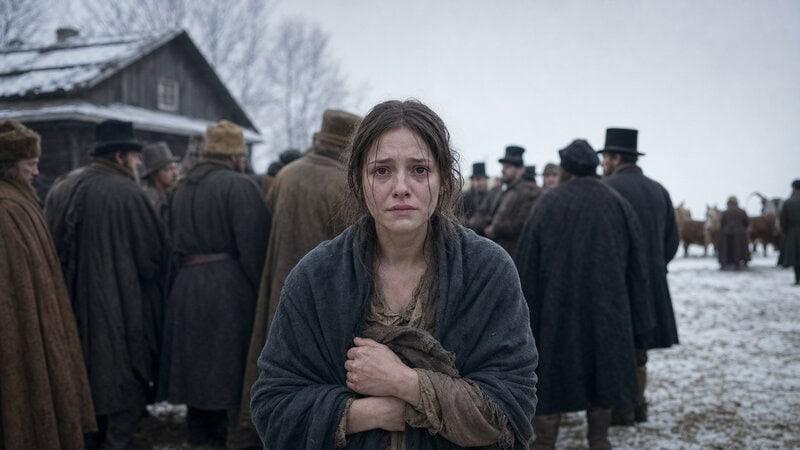

On a winter morning somewhere in provincial Russia in the 1830s, a woman watched strangers bid on her children. She was listed in the estate inventory between a set of oak furniture and twelve head of cattle. Her name, her age, her domestic skills — seamstress, perhaps, or laundress — noted in careful ink beside a price. The gavel fell. A family ceased to exist. And every person in that room considered themselves part of a civilized Christian nation.
The Auction Block in the Snow

What makes this scene so difficult to absorb is not its cruelty alone — history is full of cruelty — but its proximity. The 1830s. That is the decade of Chopin’s nocturnes, of the early railroad, of newspapers and gas-lit parlors. People who witnessed those Russian estate auctions lived long enough to read about Abraham Lincoln. The world that permitted serfdom was not the distant medieval world of popular imagination. It was, in many of its comforts and pretensions, recognizably modern.
And yet tens of millions of human beings were legally classified as bound laborers. They were itemized in wills, transferred as wedding gifts, lost at card tables by indebted aristocrats. The legal word was serf, not slave — and European elites clung to that distinction the way a drowning man clings to a plank, because the distinction flattered them. The central question serfdom forces us to ask is not simply what the law said, but what life actually felt like for the people the law described as something less than fully free.
What Is a Serf? The Medieval Foundation Everyone Gets Wrong
A serf, at its core, is a member of a servile feudal class — a subsistence farmer legally bound to a hereditary plot of land and subject to the authority of a lord. That definition sounds tidy. The reality was considerably messier, and considerably more varied across time and geography.
The common misconception is that serfdom and slavery are simply the same institution wearing different hats. They are not identical — but the differences matter less than most people assume, and in the Russian case they nearly vanished altogether. Serfdom refers to a condition of servitude, typically within feudal society, in which serfs worked the land under obligations to a landlord — but unlike enslaved people in ancient Rome or the antebellum American South, serfs in many European systems were nominally tied to the land rather than to a specific person. You could not, in the original medieval theory, sell a serf the way you sold a chair. You sold the estate, and the serfs came with it.
This distinction had genuine meaning in some times and places. It gave serfs a form of rootedness — a theoretical right to remain on the land their families had worked for generations. In practice, the distinction eroded, sometimes gradually and sometimes catastrophically, depending on how much political power landlords could extract from weak or compliant governments.
The origins of European serfdom lie in the wreckage of the Roman Empire. As Roman administrative order collapsed across the fifth and sixth centuries, the safety it had provided — roads, legions, law — dissolved with it. Desperate peasants struck bargains with local strongmen: protection in exchange for labor and a portion of the harvest. It was a rational transaction made under irrational duress. Once made, it proved nearly impossible to unmake, because the children of those peasants inherited the bargain automatically. Serfdom was, from its beginning, a self-replicating system — a hereditary caste dressed in the language of agricultural contract.
It is worth distinguishing serfdom from two related but separate institutions. Feudalism was the broader political and military hierarchy of which serfdom formed the agricultural base — not every person within the feudal order was a serf, and not every serf existed within a fully articulated feudal structure. Villeinage, the English variant, carried its own specific legal character: villein serfs held land at the lord’s will and owed labor services, but English common law courts gradually extended protections to them that the manorial system did not, creating a slow legal pressure toward emancipation that had no Russian equivalent. These distinctions matter because serfdom was never a single uniform institution. It was a family of related arrangements whose shared feature was hereditary agricultural bondage — and understanding the variations helps explain why some forms ended earlier and more peacefully than others.
Daily Life in the Mud: What Being a Serf Actually Felt Like

To understand the lived texture of serfdom, set aside the legal abstractions and imagine the body. A serf’s day began before dawn and ended after dark. The first obligation was corvée — compulsory unpaid labor on the lord’s fields. In Russia by the 18th century, corvée could consume three days a week or more, and on some estates effectively more than half of a serf’s working hours. The remaining time was spent on the family’s own strip of land, trying to grow enough to feed children through the winter after paying rents, fees, and obligations that cascaded downward from the estate house like a waterfall of debt.
The legal indignities compounded the physical ones. Serfs in most systems required a lord’s permission to marry — and the lord often extracted a fee for granting it, a payment sometimes called merchet in the English tradition. They could not move freely, could not choose their occupation, and could not in many cases inherit land or goods without paying a death fee to the lord for the privilege of remaining on land their parent had died working. Their children were born into the same condition, without ceremony or choice, as naturally as they were born into a particular eye color.
What serfs did technically retain was a fragile legal personhood — a recognition, however thin, that they were human beings with some customary rights rather than pure objects. They could not, in most medieval European systems, be killed arbitrarily by their lords. They retained a family unit, at least in principle. These distinctions mattered philosophically and sometimes practically. But philosophy offers cold comfort when the harvest fails and the lord’s bailiff is at the door.
The psychological dimension is perhaps the hardest to recover from the historical record. Serf communities developed dense internal cultures: oral traditions, religious practice, mutual aid networks, and occasional acts of collective resistance ranging from deliberate work slowdowns to outright rebellion. The great Pugachev Uprising of 1773-1775 in Russia, in which Cossack leader Yemelyan Pugachev led a mass revolt that briefly captured significant territory and terrified the Russian nobility, demonstrated that serf endurance had limits. These episodes of resistance are worth noting not merely as dramatic incidents but as evidence that serfs were active historical agents navigating an unjust system rather than passive sufferers simply absorbing it.
How Russia Turned the Clock Backward While Western Europe Moved On
Here is the great paradox of serfdom’s history: by the 15th and 16th centuries, serfdom was weakening across much of Western Europe. The Black Death had devastated the peasant labor force and, counterintuitively, improved the bargaining position of those who survived. English villeinage was fading. French serfdom, known as mainmorte, was in slow retreat. The arc of Western European history, however haltingly, bent toward loosening feudal bonds.
Russia moved in the opposite direction. Historians sometimes call this the “second serfdom” — the paradoxical tightening of feudal labor obligations across Eastern Europe precisely during the period when Western Europe was relaxing them. In Poland, Prussia, and Hungary as well as Russia, landlords responded to expanding grain markets by intensifying demands on peasant labor rather than transitioning to wage work. The market, in other words, made Eastern European serfdom worse rather than better, because forced labor was cheaper than free labor when you controlled the legislature.
Russia’s version was the most extreme. The great legal code of 1649 — the Sobornoye Ulozheniye — formally bound Russian peasants to the land in perpetuity, eliminating the statute of limitations on recovering runaway serfs and making the condition fully hereditary. It was not an accident or an oversight. It was a political bargain. The Tsars needed the military loyalty of the Russian nobility. Russia was vast, its frontiers were dangerous, and maintaining a fighting aristocracy required keeping that aristocracy wealthy and compliant. The currency the Tsars used to pay for loyalty was peasant labor. Serfs became the medium of exchange in a transaction between throne and aristocracy, and once the deal was made, neither side had any incentive to unwind it.
Over the following century, Russian serfdom mutated into something that strained the definition of the word beyond recovery. Russian serfs could be sold, gifted, gambled away at cards, and punished by exile to Siberia. The theoretical attachment to the land — the one legal thread that had distinguished a serf from a slave — had become a polite fiction maintained largely for the comfort of those who held the power. By the early 19th century, roughly one-third of Russia’s entire population consisted of privately owned serfs.
Serf vs. Slave: A Distinction That Barely Held

The defenders of Russian serfdom, when pressed, always retreated to the same ground: serfs were not slaves. They had legal personhood. They could not, technically, be killed outright by their masters without consequence. These were the distinctions that allowed the Russian nobility, and European observers who should have known better, to maintain a sense of civilizational superiority over the American slaveholder — even while reading newspaper advertisements that listed serfs by name, age, and professional skill, exactly as American slave auction notices did.
Seamstresses. Cooks. Musicians. Men skilled in carpentry or leatherwork. Women experienced in childcare or weaving. The language of the advertisements was the language of commodity. The transaction was the transaction of ownership. The one meaningful legal remnant — the theoretical prohibition on murder — was enforced with such inconsistency that it functioned more as a social norm for the respectable than as a protection for the vulnerable. Many serfs died under corporal punishment. Few masters faced meaningful legal consequences.
The serf-not-slave label was not simply a legal technicality. It was a moral technology — a way of organizing conscience so that the people who profited from the system could continue to think of themselves as decent. Philosophers and legal scholars sometimes use the term “status laundering” for this kind of operation: attaching a different name to a relationship in order to obscure what the relationship actually is. History is full of such technologies. They rarely survive close examination.
The comparison with American chattel slavery also illuminates a structural difference worth acknowledging honestly: American slavery was organized around race in ways that Russian serfdom was not. Russian serfs and their lords shared ethnicity, language, and Orthodox faith, which created different — not lesser, but different — social dynamics and different justificatory ideologies. Russian serfdom was defended through the language of paternalism and Christian obligation rather than racial hierarchy. Both ideologies served the same economic function. Neither bears scrutiny.
1861: The Emancipation That Freed No One Completely

Tsar Alexander II announced the emancipation of Russia’s serfs in February 1861, two years before Lincoln issued the Emancipation Proclamation and four years before the Thirteenth Amendment abolished American slavery. Alexander’s motivations were not primarily moral. The Crimean War of the 1853-1856 period had exposed Russia’s military and economic backwardness in humiliating detail, and reformers within the government argued — correctly — that a modernizing nation could not be built on a foundation of bound agricultural labor. There was also the persistent, gnawing fear of revolt from below. Better to free the serfs from above, the argument ran, than to be freed from them by violence.
The emancipation that followed was genuine in some respects and a bitter irony in others. Serfs gained the legal right to marry without permission, to move, to own property, to exist as citizens rather than as inventory. These were not nothing. For people who had lived without them, they were profound.
But the freed serfs were required to pay redemption payments — installment debts to the state for the land they had worked for generations, land farmed by their parents and grandparents and great-grandparents before them. The payments were structured over 49 years. They were not finally cancelled until 1907, and only then because the upheaval of the 1905 Revolution made continued collection politically untenable. For the millions of peasants making those payments across five decades, the practical experience of freedom was filtered through the same poverty, the same communal land restrictions enforced through the village commune or mir, the same geography they had always known. The chains had changed material, from legal status to debt, but the weight remained familiar.
The unresolved grievances of the emancipated serf class did not dissipate. They accumulated. Mixed with famine, military catastrophe, and political dysfunction, they became the combustible material that the Russian Revolution of 1917 finally ignited. Lenin’s Bolsheviks understood this: the promise of land to the peasantry was one of the revolution’s most powerful recruiting tools precisely because it spoke to a dispossession that the 1861 emancipation had never truly remedied. Serfdom’s abolition did not end serfdom’s consequences. It merely transformed the form they took.
Why Serfdom Still Echoes — And Why It Matters Now
It would be convenient to file serfdom under medieval history and move on. The inconvenient truth is that variants of the system persisted well into the twentieth century — in parts of imperial Japan, in Ottoman-controlled Europe, in colonial Latin America, and in areas of South Asia and Africa where debt bondage locked agricultural laborers into inherited obligation across generations. The specific legal frameworks differed. The human experience had a troubling consistency.
Scholars of modern forced labor and human trafficking draw direct genealogical lines from historical serfdom to contemporary systems of debt bondage and contract labor exploitation. The mechanism is the same: create a debt large enough that it cannot be repaid, attach it to a person’s body and sometimes their children’s bodies, and the result — whatever you call it legally — functions as a form of ownership. The word matters less than the lock.
There is also the question of structural legacy. Historians and economists studying land inequality, institutional trust, and rural poverty in Russia and Eastern Europe have found patterns that trace backward across centuries. Research in the field of historical persistence — examining how past institutions shape present outcomes — suggests that regions with the heaviest serfdom burdens tend to show deeper institutional mistrust, weaker civic participation, and more persistent concentrations of land ownership today. Hereditary servitude does not end cleanly when a law changes. It leaves an imprint on institutions, on informal norms, and on the quiet assumptions communities carry about who is entitled to what and whether authorities can be trusted.
This is not a counsel of determinism. Institutions can change, and cultures can change faster than pessimists predict. But change is easier when the history is clearly seen rather than softened into comfortable distance.
Return, then, to the auction in the snow. The woman in the estate inventory, listed between the furniture and the cattle. We do not know her name — the record that preserved her existence as a commodity did not think her name worth preserving in the way that mattered. We know she existed. We know what happened to her was legal, documented, and unremarkable to the people conducting the transaction. We know it was part of a system that bound tens of millions of human lives across a country that considered itself part of European civilization. The label placed on that system — serf, not slave, something more palatable than either — tells us less about the system than about the people who needed a comfortable word for an uncomfortable thing. History’s work, and ours, is to look past the label at the life it obscured.

 English
 Arabic
 French
 Spanish
 Portuguese
 Deutsch
 Turkish
 Dutch
Dutch
 Italiano
 Russian
 Romaian
 Greek
Greek