


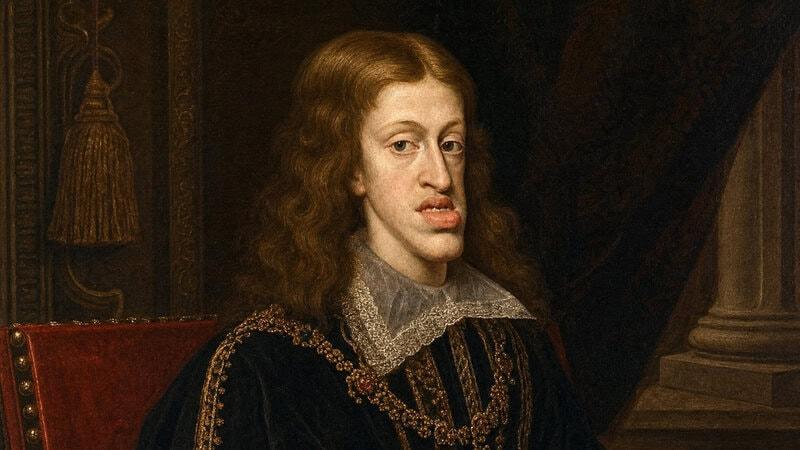

He could not chew. He could barely speak. His tongue was so large it made him drool, his jaw jutted so far forward that his teeth never met, and by the time he died in 1700 at the age of 38, the most powerful royal house in European history had quite literally written its own obituary across his face.
The Jaw That Launched a Thousand Diagnoses

Charles II of Spain — known to his subjects as El Hechizado, “The Bewitched” — was the terminal product of nearly two centuries of Habsburg inbreeding. A 2019 study published in the journal Heredity calculated his inbreeding coefficient at 0.254, a figure so extreme it exceeded what you would expect from a union between full biological siblings. He was, genetically speaking, a dynasty consuming itself. He died without an heir, and the vacuum his death created pulled all of Europe into a catastrophic war that lasted more than a decade.
Yet the Habsburgs had not always been synonymous with ruin. For six hundred years, the House of Habsburg stood as the dominant force in European politics — rulers of empires stretching from the cobblestoned squares of Vienna to the silver mines of Peru. Their story is one of breathtaking ambition, genuine administrative sophistication, and a single slow-motion catastrophe hiding inside every royal wedding portrait: the more aggressively they married to protect their power, the more visibly that power rotted from within. The Habsburg jaw — that protruding, unmistakable lower mandible appearing across generations of royal portraits — was not merely a medical curiosity. It was a confession written in bone.
A Minor Noble Family That Swallowed a Continent

Nothing about the dynasty’s origins suggested world domination. The family name derives from Habichtsburg — Hawk’s Castle — a modest fortification built around 1020 in what is now the Swiss canton of Aargau. They were German-speaking minor nobles, one unremarkable family among dozens jostling for relevance in the fractured landscape of medieval Central Europe.
The decisive turning point came in 1273, when Rudolf I was elected Holy Roman Emperor — not because he was obviously powerful, but precisely because he seemed manageable to the princes who chose him. Rudolf promptly proved them wrong. He seized the Duchy of Austria from the Bohemian king Ottokar II in 1278 and planted the Habsburg flag in Vienna, establishing the power base the family would hold for the next seven centuries. From that moment forward, the Habsburgs understood something most rival dynasties grasped too late: territory could be conquered, but influence could be engineered through marriage.
Their instrument was the negotiated alliance sealed at the altar. The Latin phrase most associated with the dynasty — Bella gerant alii, tu felix Austria nube, “Let others wage war; you, happy Austria, marry” — captured the strategy with rueful precision. Where other houses spent fortunes on armies, the Habsburgs spent political capital on wedding negotiations, assembling a dynastic network that functioned like a corporate merger strategy conducted across generations. By 1438, the family had secured a near-permanent grip on the title of Holy Roman Emperor, making themselves the gravitational center of European political life for the next three and a half centuries.
When One Family Ruled the World

The apex arrived with Charles V, who inherited his accumulated titles between 1516 and 1519 and found himself simultaneously King of Spain, Holy Roman Emperor, and sovereign over the newly conquered Americas. His was the first empire in history over which the sun genuinely never set — Spain and its New World territories caught the morning light as Austria fell into evening shadow. He ruled over the Spanish Netherlands, Austria, Bohemia, Hungary, Naples, Sicily, Sardinia, and a vast colonial empire stretching across the Americas, an accumulation assembled almost entirely through inheritance and strategic marriage rather than prolonged military conquest.
What made the dynasty genuinely remarkable — and often underappreciated — was how it governed this impossible patchwork. The Habsburgs did not attempt to homogenize their subjects. Czechs remained Czech, Hungarians remained Hungarian, Flemish merchants conducted business in Flemish. Local laws, languages, and customs survived beneath the Habsburg crown in an arrangement that amounted to pragmatic multi-ethnic governance centuries before that phrase entered the political vocabulary. They were empire-builders who understood, at least for a time, that the empire held together precisely because it did not demand sameness.
But the seed of ruin was already germinating inside the triumph. To keep all that wealth, territory, and Catholic legitimacy within the family, the Habsburgs began marrying relatives with accelerating frequency. Uncles took nieces as brides. First cousins married first cousins. With each generation, the gene pool grew shallower, the family tree more circular, and the faces in the royal portraits more distinctive in ways that no court painter could entirely disguise.
The Family Tree That Became a Family Circle

Study enough Habsburg portraits — and Diego Velázquez painted enough of them to constitute something close to a medical archive — and a pattern emerges with unsettling clarity. The protruding lower jaw, the thick lower lip, the enlarged tongue: features that appear subtly in earlier generations grow pronounced, then severe, then extreme as the decades advance. This was the Habsburg jaw, the clinical condition known as mandibular prognathism, and it was the dynasty’s own genetics announcing itself on the faces of its rulers for any observer willing to read the evidence.
The genealogical mechanics were straightforward and, in retrospect, grimly inevitable. Philip I married Joanna of Castile. Their son Charles V married his first cousin Isabella of Portugal. Charles’s son Philip II married his niece Anna of Austria. With each closed loop in the family tree, genetic diversity contracted. Traits that might have remained recessive in a more outbred population were instead expressed — repeatedly, visibly, and with mounting consequences. The 2019 Heredity study that calculated Charles II’s inbreeding coefficient traced this compression across sixteen generations and examined records spanning more than six thousand individuals, making the Spanish Habsburg line one of the most thoroughly documented cases of dynastic consanguinity in history.
Most perversely, the Habsburg jaw came to function as a marker of noble identity. Court painters were expected to render it faithfully; the features appeared in official portraits as symbols of legitimate lineage rather than as genetic warning signs. A family had transformed a disorder into a status symbol, and nobody with the standing to object had any incentive to do so.
Charles II: The Man Who Ended the Spanish Line

Charles II was born in 1661 and was not expected to survive infancy. He did — stubbornly, improbably, for 38 years — but his life was a sustained indictment of the system that produced him. He reportedly could not walk unassisted until he was eight years old, could not speak clearly until he was ten, and struggled throughout his reign to chew solid food. His physical and cognitive difficulties were so severe that contemporaries, with no framework for understanding hereditary disease, attributed them to witchcraft — hence the nickname history has preserved. He was a king who presided over a contracting Spanish empire while his own body contracted around him.
When he died in 1700 without an heir, the consequences were immediate and continental. The War of the Spanish Succession erupted across Europe and dragged on until 1714, drawing in France, Britain, the Dutch Republic, Austria, and Portugal in a conflict that killed hundreds of thousands of soldiers and civilians. The very inbreeding that was meant to secure Habsburg dominance had instead guaranteed that when the line finally ended, it ended violently and with consequences that reshaped the map of Europe. The Spanish branch of the Habsburgs was finished. The Austrian line — somewhat less inbred, considerably more viable — absorbed the shock and carried the dynasty forward. A 1736 marriage between Maria Theresa’s father, Emperor Charles VI, and Elisabeth Christine of Brunswick-Wolfenbüttel had already introduced new genetic material into the Austrian line; later, the marriage of Maria Theresa herself to Francis I of the House of Lorraine eventually produced the hybrid designation Habsburg-Lorraine, opening the bloodline precisely as the Spanish branch had refused to do.
The Long Retreat: From Empire to Exile

The Austrian Habsburgs proved far more durable than their Spanish cousins, but the eighteenth and nineteenth centuries were a sustained exercise in managed retreat. Maria Theresa’s reign from 1740 to 1780 stands as a genuine high point: she modernized administration, centralized governance across a sprawling territorial patchwork, and held the empire together against sustained Prussian aggression through formidable political intelligence. But the Napoleonic era stripped the dynasty of its oldest institutional possession. The Holy Roman Empire — a structure that had provided Habsburg authority with its deepest legitimacy for centuries — was dissolved in 1806 as Napoleon reorganized Central Europe according to his own design. Franz II, the last Holy Roman Emperor, preemptively declared himself Emperor of Austria in 1804, ensuring the dynasty retained an imperial title even as the older one evaporated.
The monarchy reinvented itself once more as the Austro-Hungarian Empire in 1867, a dual structure designed to manage the explosive nationalism building across a dozen ethnic communities — Czechs, Slovaks, Poles, Croats, Slovenes, Hungarians, and others — through bureaucratic compromise and carefully calibrated power-sharing. It was a politically ingenious arrangement, and for a generation it held. But the empire’s internal ethnic contradictions had become structural, and no administrative formula could contain them indefinitely.
The explosion came on June 28, 1914, in Sarajevo, when Archduke Franz Ferdinand — heir to the Habsburg throne — was assassinated by Gavrilo Princip, a Bosnian Serb nationalist. The war that followed was one the empire’s fractured, multi-ethnic structure was constitutionally unable to survive. Czechs had little appetite for dying to preserve Austrian imperial ambitions. Croats and Serbs found themselves on opposite sides of a conflict that felt to many of its conscripts like a dynastic quarrel conducted with industrial weapons and paid for in peasant lives. By November 1918, the Habsburg Monarchy was finished. The last emperor, Karl I, refused on principle to sign a formal abdication — a gesture of stubborn dynastic dignity that changed nothing practical — and went into exile, closing six centuries of European imperial history with a packed suitcase rather than a signed document.
What the Habsburgs Left Behind — and What Their Faces Still Tell Us
The legacy is genuinely complicated and genuinely significant. The Habsburg dynasty shaped the borders of modern Central Europe, established traditions of multi-ethnic state administration that influenced later concepts of federalism and minority rights, and left behind some of the continent’s most extraordinary architecture — the Hofburg in Vienna, the Escorial outside Madrid, the cathedral squares of Prague and Seville. The very idea of different peoples sharing legal and institutional frameworks rather than being compelled to assimilate into a single dominant culture owes something real to the long Habsburg experiment in heterogeneous empire, however imperfectly that experiment was conducted.
The genetic story has its own afterlife in university lecture halls. The Habsburg jaw is now standard material in genetics education, the portraits of Charles II and his ancestors used as striking visual evidence of what happens when a closed breeding population systematically eliminates diversity across generations. A dynasty that lived and died by strategic marriage has become, with considerable irony, one of history’s most powerful illustrations of why strategic marriage has hard biological limits.
The Habsburgs themselves have not disappeared. Karl von Habsburg, great-great-grandson of the last emperor Karl I, is an active public figure who served as a Member of the European Parliament — a Habsburg representing a multinational European institution, which carries its own quiet historical resonance. The dynasty outlasted its empire by more than a century, and its bloodline has finally opened to the outside world in precisely the way its most powerful members always refused to permit.
The central irony of the whole extraordinary story is clean and almost classical in its symmetry: the House of Habsburg built the most powerful dynasty in European history by marrying strategically, then slowly destroyed itself by marrying too strategically. A family that assembled empires spanning continents could not conquer its own obsession with keeping the bloodline pure — and the evidence of that failure is there in every portrait, written in bone, legible to anyone who knows how to read it.

 English
 Arabic
 Spanish
 Portuguese
 Deutsch
 Turkish
 Dutch
Dutch
 Italiano
 Russian
 Romaian
 Portuguese (Brazil)
 Greek
Greek