


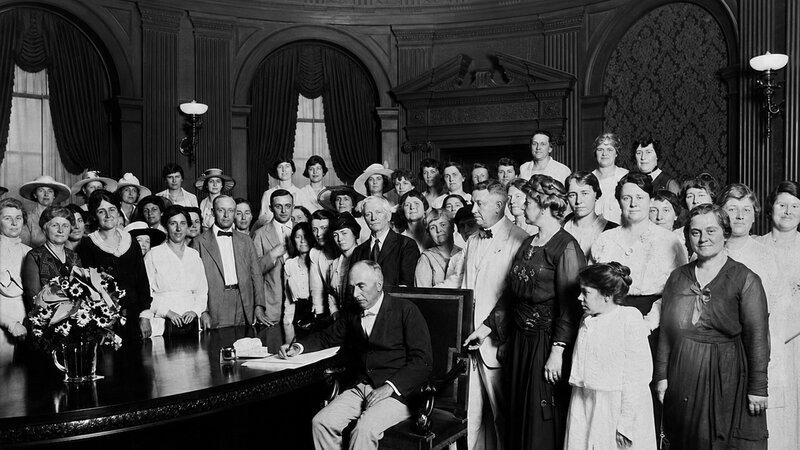

On August 18, 1920, inside a sweltering Nashville statehouse where ceiling fans did almost nothing against the August heat, a 24-year-old legislator named Harry T. Burn reached into his breast pocket, felt the folded letter his mother had sent him, and said a single word that changed the country forever.
One Syllable, Seventy-Two Years in the Making
The galleries were packed. Women wearing yellow roses — the suffragist color — pressed against the railings above, while opponents with red anti-suffrage roses filled the floor below. The Tennessee House of Representatives had already deadlocked 48 to 48 on the question of ratifying the Nineteenth Amendment, and under parliamentary rules a tie meant defeat. Another vote was called. When the clerk reached Harry Burn’s name, every eye in the room found the youngest member of the General Assembly — a Republican from conservative McMinn County, a red rose pinned to his lapel, a man who seemed to have telegraphed exactly how he would vote.
He said aye.
The room erupted so violently that Burn later had to flee through a third-floor window and hide in the Capitol attic to escape the fury of anti-suffrage delegates. But the deed was done. Tennessee became the 36th and deciding state to ratify the amendment, and the Nineteenth Amendment to the United States Constitution — the law declaring that no U.S. citizen could be denied the right to vote on account of sex — was now the law of the land. Some 26 million American women were suddenly, irrevocably voters. And the animating question remains one of history’s most gripping: how did a constitutional amendment 72 years in the making come down to one young man’s decision in an overheated state chamber?
What the 19th Amendment Did — and When
The text of the amendment is almost startlingly plain: “The right of citizens of the United States to vote shall not be denied or abridged by the United States or by any State on account of sex.” Fourteen words of operative law. A seismic redistribution of democratic power.
Understanding when the 19th Amendment passed requires a short lesson in constitutional mechanics, because the honest answer involves two distinct dates. Congress — the House and the Senate together — must first approve a constitutional amendment by a two-thirds supermajority. Then three-quarters of the states must ratify it. Both steps represent, in different ways, “passing” the amendment.
- June 4, 1919: Congress approved the suffrage amendment when the Senate finally joined a House that had already voted in favor.
- August 18, 1920: Ratification was completed when Tennessee’s House voted and Harry Burn said aye, making Tennessee the required 36th state.
- August 26, 1920: Secretary of State Bainbridge Colby signed the official proclamation certifying ratification — quietly, at his home, early in the morning, without ceremony. This date is now observed as Women’s Equality Day.
So when people ask when was the 19th Amendment passed, both June 4, 1919 and August 18, 1920 are defensible answers, depending on which finish line you mean. August 26, 1920 is when it formally and officially took effect.
The amendment is often called the Susan B. Anthony Amendment, a name that does what good history should: it tethers a legal text to the human beings who fought for it. Anthony spent half a century advancing this cause and died in 1906, fourteen years before it arrived.
Seventy-Two Years: The Long March of Women’s Suffrage

The story of women’s suffrage in America begins not in 1919 or 1920, but in the summer of 1848, in a Methodist chapel in Seneca Falls, New York. There, Elizabeth Cady Stanton drafted the Declaration of Sentiments — a document that deliberately echoed the Declaration of Independence, substituting “men and women” for “men” and cataloguing the grievances women suffered under a government that taxed them, jailed them, and educated them without ever granting them a voice at the ballot box. The struggle predates the Civil War. It predates the transcontinental railroad. It is, in other words, among the oldest unfinished arguments in American democratic history.
The movement’s first great fracture came after the Civil War. The Fifteenth Amendment, ratified in 1870, enfranchised Black men — a genuine moral achievement — but explicitly left women out. Many suffragists, including Stanton herself, reacted with a combination of bitterness and, in some cases, openly racist rhetoric, arguing that educated white women deserved the vote before formerly enslaved Black men. This is not a footnote in the movement’s history; it is a wound at its center, one that shaped the alliances, the blind spots, and the ultimate incompleteness of what was achieved in 1920.
In the decades that followed, tactics evolved with urgency. Polite petitions gave way to something more confrontational. In 1913, suffragists organized a massive parade down Pennsylvania Avenue the day before Woodrow Wilson’s first inauguration — deliberate political theater that drew enormous crowds and enormous hostility. Women picketed the White House carrying banners that read “Mr. President, How Long Must Women Wait for Liberty?” They were arrested. In federal prison, some went on hunger strikes and were force-fed. They called themselves the Silent Sentinels, and their silence was louder than anything Congress wanted to hear.
The emotional weight of this era is difficult to overstate. Women who had stood in that Seneca Falls chapel in 1848 — who had risked their reputations and their marriages to demand the most basic right of democratic citizenship — died without ever casting a vote. By 1920, the crusade had passed to their daughters and granddaughters, who carried both the cause and the grief forward.
Congress Acts — Then Nearly Fumbles It

In 1918, the House of Representatives passed the suffrage amendment by a vote of 257 to 136, clearing the required two-thirds supermajority. Then the Senate defeated it. Those defeats sent suffragists back to the lobbying trenches, furious and exhausted but not finished.
Woodrow Wilson’s role in all of this is complicated in the way that history’s prominent figures often are. He had initially been cool to suffrage, viewing it as a distraction from his wartime agenda. But sustained political pressure and moral argument eventually shifted his public position. In September 1918 he took the almost unprecedented step of addressing the Senate in person to urge passage of the amendment, framing women’s suffrage as a necessary wartime measure and a show of democratic good faith to the world. The Senate voted it down anyway — and then again in February 1919.
In May 1919 the House passed the amendment a second time. On June 4, 1919, the Senate finally followed. After decades of failure, Congress had cleared its constitutional hurdle. But ratification by 36 states still lay ahead, and suffragists knew they were racing a clock: they needed those 36 states before the 1920 presidential election, or millions of women would miss another cycle of democracy.
They mapped every state legislature like a military campaign. They tracked which governors were sympathetic, which sessions were scheduled, which legislators could be moved. Thirty-five states ratified with relative speed, some enthusiastically, some grudgingly. Then the race arrived at its last, most dangerous stop.
Tennessee: The Last Battlefield

By the summer of 1920, Tennessee was the decisive state. Other holdouts were either not in legislative session in time or so firmly opposed that they were not worth the effort. Nashville’s statehouse was, in effect, the entire country’s arena, and everyone who understood that flooded into the city.
Contemporaries described what followed as the “War of the Roses.” Suffragists wore yellow; anti-suffragists wore red. The lobbies of the Hermitage Hotel became a pressure cooker of persuasion, bribery allegations, and whiskey — remarkable quantities of whiskey, given that Prohibition was technically the law of the land. Competing delegations pulled legislators into private rooms and made their cases with whatever currency was available: principle, patronage, or something darker.
The anti-suffrage forces — sometimes called the “Red Rose Brigade” — were not simply traditionalists defending a sentimental notion of womanhood. They were backed by railroad companies, liquor interests, and manufacturing concerns, all of whom had calculated that newly enfranchised women would push for progressive reform. This was not symbolic resistance. It was economic. It was about power.
The Tennessee Senate passed the amendment without catastrophe. The House was a different story. The first tally produced that deadlocked 48-to-48 tie, and under parliamentary rules a tie meant the amendment failed. For a terrible moment, August 18, 1920 looked like the day suffrage would die in America — at least until the next legislative cycle, at the earliest.
Harry Burn, His Mother’s Letter, and the Vote That Echoed

Harry T. Burn was 24 years old, the youngest member of the Tennessee General Assembly. He represented a conservative district. He had every political incentive to vote no, and his red rose suggested he would. What his lapel did not reveal was the letter folded inside his breast pocket.
His mother, Febb Burn, was a farm woman from McMinn County. She had written to her son with the plain authority that mothers have always deployed: be a good boy, she told him, and vote for ratification. She had never been able to vote in her own life. She trusted him to change that.
When his name was called and he voted aye, the chamber became something close to a riot. Anti-suffrage delegates raged. Burn slipped out a window and hid in the attic. The following day, he rose on the House floor to explain himself, and what he said reframed the entire debate in terms so direct they were almost unanswerable: he believed in a mother’s right to a voice in the government that could send her son to war. Not a radical argument. Not a theoretical one. Just the basic democratic logic that had been denied for 72 years.
You can read more about the amendment’s full history and its place in American constitutional law — but the human story, the one that actually turned the vote, fits in a breast pocket.
What August 18, 1920 Actually Meant — and What It Didn’t
August 18, 1920 is the date the 19th Amendment was ratified by the required number of states. The formal certification came eight days later, on August 26, 1920, when Secretary of State Bainbridge Colby signed the proclamation at his home, early in the morning, without public ceremony. One of democracy’s great expansions was completed with the quiet scratch of a pen at a private residence.
The practical effect was enormous. Some 26 million American women were enfranchised in time for the November 1920 presidential election between Warren G. Harding and James M. Cox. The potential electorate nearly doubled overnight. The country that went to the polls that November was a genuinely different country than the one that had voted four years earlier.
But history demands honesty about what the amendment did not do. Across the South, Black women — along with Black men — continued to be systematically denied the vote through poll taxes, literacy tests, grandfather clauses, and the constant threat of violence. The Nineteenth Amendment’s protections were real on paper and routinely nullified in practice for millions of Americans. That failure is not a caveat to the amendment’s history; it is a central part of it, a reckoning that would not substantially arrive until the Voting Rights Act of 1965, 45 years later.
In November 1920, in McMinn County, Tennessee, a farm woman named Febb Burn walked to her polling place and cast a vote. Her son had kept his promise. She had waited her whole life for this moment. The nation — fractured and imperfect and still fighting over exactly whose promises it intended to honor — had nonetheless moved, by one vote, one letter, one syllable, closer to what it claimed to be.

 English
 Arabic
 French
 Spanish
 Portuguese
 Deutsch
 Dutch
Dutch
 Italiano
 Russian
 Romaian
 Portuguese (Brazil)
 Greek
Greek