


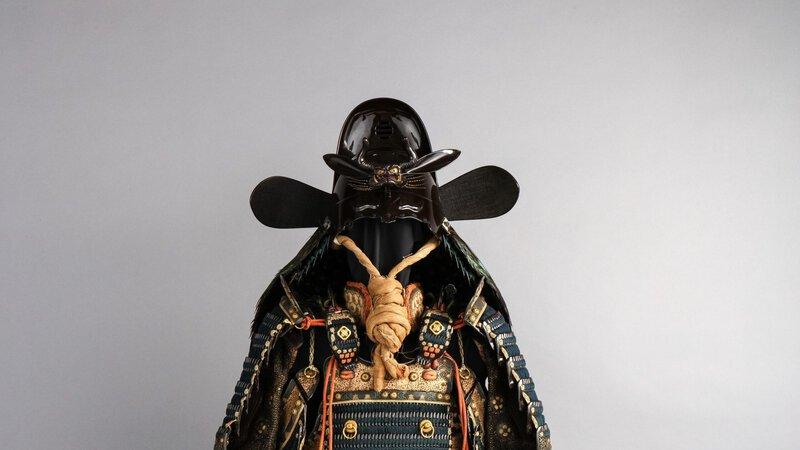

In a candlelit workshop in feudal Japan, a master armorer threads a silk cord through what might be the thousandth tiny iron plate of a single breastplate — his hands calloused from years of this same motion, his eyes steady, because somewhere a samurai’s life will one day depend on every knot he ties.
The Invisible Labor Inside Every Suit

A complete suit of samurai armor could demand up to three months of near-continuous labor, coordinated across multiple specialist craftsmen working in careful sequence. We remember the warriors who wore these suits into legend. We almost never remember the men who made them possible.
That imbalance runs quietly beneath the entire history of feudal Japan’s military culture. Swordsmiths were celebrated — their blades discussed in poetry and court record. The armor-makers, whose craft was no less demanding and no less technically extraordinary, largely vanished into the background of the chronicles, unnamed servants of a warrior class that dressed itself in their genius every time it rode to war.
What those artisans produced was not merely protective gear. It was simultaneously among the most advanced personal defense technology of the medieval world and among the most refined art objects Japan ever created — lacquered, gilded, color-laced constructions that gleam in museum cases centuries later, still carrying the fingerprints of people whose names we have mostly lost.
What Samurai Armor Actually Was

To understand samurai armor, it helps to shed the image of a solid metal shell. Japanese armor was never that. It was a modular system of interlocking components — the helmet (kabuto), the face mask (menpō), the chest piece (dō), the great shoulder guards (ō-sode), and carefully articulated protection for the arms, thighs, and shins — each piece engineered to work in concert, each removable and replaceable.
The defining characteristic of Japanese armor design lies in a component most people have never heard of: the sane. These were hundreds — sometimes more than two thousand — of tiny individual iron and leather plates, each one cut by hand to precise tolerances, drilled, lacquered, and then bound together in overlapping horizontal rows, like the scales of a fish or the tiles of a roof. The sane plates gave Japanese armor something European plate armor largely sacrificed: fluid, responsive movement.
The comparison to European armor is instructive. Medieval European plate armor was fundamentally rigid at its core — protection achieved by enclosing the body in shaped steel. Japanese armor achieved protection through layered flexibility. A samurai in full armor could draw a bow, move across broken ground, and twist in the saddle, because the sane-plate construction shifted with his body rather than fighting it. The engineering logic was shaped by the specific demands of Japanese warfare: mounted archery, close infantry combat, and terrain that rarely offered the flat, open fields where heavily armored European cavalry excelled.
Three Months, Many Hands: The Craft Behind the Plates

The production of a single suit began long before any armorer picked up a needle or a lacquer brush. Smelters worked raw iron into usable material. Specialist smiths hammered and shaped that material into the raw stock of the sane plates. Cutters then worked each plate individually — filing edges, drilling the cord holes that would eventually bind them together, checking tolerances that had to remain consistent across hundreds of subtly varied pieces.
Alongside the iron components, armor-makers relied heavily on nerigawa — leather straps and structural components used in the construction of samurai armor. Nerigawa was extraordinarily tough, used for structural backing panels, straps, and certain plate components. It absorbed impact energy, reduced the armor’s total weight compared to an all-iron construction, and remained resilient in the damp Japanese climate. It was humble material doing critical work, which perhaps explains why it rarely receives a starring role in the romance of the samurai.
Then came lacquering — and this alone could consume weeks. Each sane plate received multiple coats of urushi, Japan’s indigenous lacquer drawn from the sap of the Toxicodendron vernicifluum tree. Urushi cures not by drying but through a chemical reaction requiring careful humidity control, meaning each coat had to be laid in thin layers and left to cure before the next could be applied. The resulting surface was harder than modern synthetic paint, resistant to rust, moisture, and physical shock — a technological achievement that conservation scientists continue to study.
Finally came the odoshi — the silk or leather cords that laced the individual plates into their overlapping rows. The color of this lacing was never purely decorative. On the battlefield, lacing patterns and colors identified units, clans, and ranks. A warrior’s lacing was his uniform, his insignia, and his status claim, legible across the chaos of combat to friend and enemy alike. A suit might also receive gold leaf over the lacquered surfaces, completing a transformation from raw iron and animal hide into an object of deliberate and functional beauty.
The Dō and Its Centuries of Evolution

At the center of any suit stood the dō — the cuirass, which evolved over centuries into increasingly sophisticated forms. The earliest precursors appeared in the Kofun period (roughly 300-538 CE) as relatively simple iron plate constructions. By the Heian period (794-1185 CE), the characteristic laminar construction had matured into the iconic ō-yoroi style — a boxy, heavily lacquered suit hung from the shoulders rather than fitted tightly to the torso, deliberately designed to allow the upper body to rotate freely for mounted archery.
The ō-yoroi dominated samurai armor design through the Kamakura period and into the early medieval era. It was a suit built for a specific warrior: a mounted aristocratic archer, fighting at a distance, commanding from horseback. Its silhouette — wide-shouldered, deeply lacquered, hung with the enormous rectangular ō-sode that functioned almost as a secondary shield — is the image most people carry when they imagine feudal Japan.
But war changes, and armor changes with it. The Sengoku period (1467-1615), Japan’s era of near-continuous civil war, transformed Japanese warfare in ways the Heian aristocracy could never have imagined. Mass infantry armies replaced small formations of elite mounted archers. Battles involved large numbers of foot soldiers who needed armor that was cheaper to produce, lighter to wear, and faster to put on. The dō-maru, which wrapped around the body and fastened at the back rather than hanging from the shoulders, emerged as the practical answer. Later still, the tōsei-gusoku — sometimes translated as “modern armor” — arrived as a streamlined, close-fitting successor engineered for the realities of mass infantry combat.
Throughout all these changes, the dō‘s surface remained a canvas. Armored chests were embossed with Buddhist iconography, clan mon (crests), dragon reliefs, and celestial imagery. Some warriors deliberately preserved the dents left by enemy arrows — transforming damage into declaration. Protection and proclamation were never entirely separate functions in the Japanese armoring tradition.
The Artisans: Remembered by Their Work, Not Their Names

The closest Japan’s armor-making tradition came to formal recognition was through the Myochin school, a lineage of armor-makers whose masters occasionally signed their finished work — a rare and meaningful gesture in a craft culture where most makers were expected to remain invisible. The Myochin workshops operated under samurai patronage in cities including Kyoto and later Edo, passing techniques through oral instruction and apprenticeships that could last decades before a student was trusted to work unsupervised on a commission.
Armor-making guilds — za — were organized structures with hierarchies, territorial arrangements, patron relationships with specific warrior clans, and bodies of technical knowledge carefully protected from outsiders. And yet the contrast with swordsmiths remains telling. Swordsmiths were treated in Japanese culture as figures of near-spiritual significance; the forging of a blade was understood as a ritual act. Armor-makers, despite the equal or greater complexity of their craft, occupied a lower register of cultural prestige. Their names rarely appear in the chronicles that celebrate the battles their creations survived.
The spiritual dimension was not absent from armor-making entirely. Construction was accompanied by Shinto ritual, with prayers offered at significant stages of production. A completed suit was blessed before delivery to its owner. The finished armor was understood to carry its own tamashii — spirit — a quality that made it more than a tool and demanded it be treated accordingly. Armor was stored carefully, maintained regularly, and often passed through generations of a family as an heirloom charged with the accumulated honor of everyone who had worn it.
When Bullets Changed the Equation
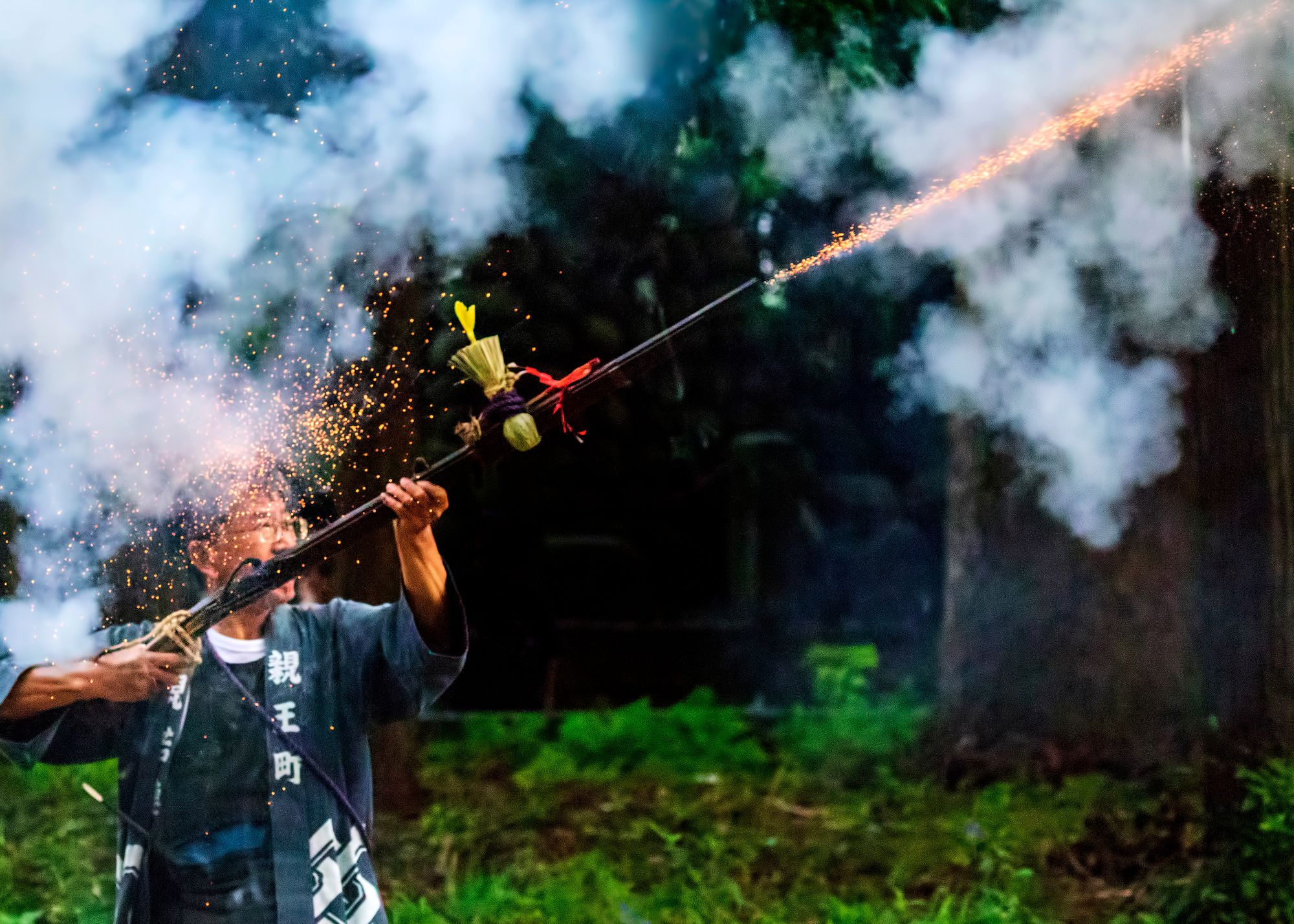
In 1543, Portuguese traders introduced the arquebus to Japan via the island of Tanegashima. Within years, Japanese craftsmen were manufacturing firearms domestically. Within decades, major warlords were fielding arquebusiers in coordinated battlefield formations — and the armor-makers were forced to fundamentally reconsider everything they knew.
The articulated sane-plate construction that made earlier armor so flexible was also, against a bullet, a liability. Multiple thin plates bound with lacquered cord could not reliably stop a lead ball the way a thicker, more solid iron surface could. The response was the tameshi-gusoku — literally “bullet-tested armor.” Suits were deliberately shot with firearms before sale, and the dents left by the bullets were preserved rather than repaired, displayed as proof that the armor had passed its test. Damage became a selling point — a revealing inversion that showed how completely the logic of warfare had shifted.
Armor grew heavier and simpler in construction, less laced and more solid. The elaborate lacework and colorful odoshi of the earlier tradition did not disappear, but they receded from the front line into ceremonial contexts, into suits made for display rather than combat.
What Survives, What Was Lost, and Why It Still Matters
The enforced peace of the Edo period (1603-1868) finished what the arquebus had started. With roughly two and a half centuries of stability imposed by the Tokugawa shogunate, battlefield armor became ceremonial object. Production continued, but the urgency that had driven innovation was gone. Techniques that had existed to solve life-or-death engineering problems gradually became ritual, and when the Meiji Restoration dismantled the samurai class, many of those techniques died with the last practitioners who held them.
What remains is extraordinary. Significant numbers of complete suits survive in Japanese museum and shrine collections, each one a document of engineering decisions made under mortal pressure, each one still carrying, in its lacquer sheen and color-faded lacing, the evidence of hands that worked for months to keep someone alive. Modern conservation scientists continue to reverse-engineer the urushi formulas those craftsmen used, because the full technical knowledge behind the finest surviving examples has not yet been recovered.
The influence of Japanese armor’s design principles extends beyond museum cases. The modular construction philosophy — protection achieved through interconnected independent components rather than a single rigid shell — echoes in approaches to modern body armor design. And the visual language of the full suit — the swept helmet, the angular shoulder guards, the lacquered chest — has become one of the most recognized silhouettes in global popular culture, appearing in cinema, video games, and international fashion.
Back in that candlelit workshop, the armorer sets down his needle, pulls the final knot tight, and steps back from the finished suit. He will never wear it into battle. His name will almost certainly not appear in the chronicle that records what happens when the warrior who owns this suit rides out in it. But without him — without the months of his labor, the work of the lacquerer before him, the effort of the smelter and the cutter and the leather-worker before that — there is no warrior ready for the field, no victory to record, and no legend to pass down.
That is the story samurai armor has always been quietly telling: not just the story of the people who wore it, but the story of the people who made it possible — and whose knowledge we are still, centuries later, working to fully understand.

 English
 Arabic
 French
 Spanish
 Portuguese
 Deutsch
 Turkish
 Dutch
Dutch
 Italiano
 Russian
 Romaian
 Portuguese (Brazil)