


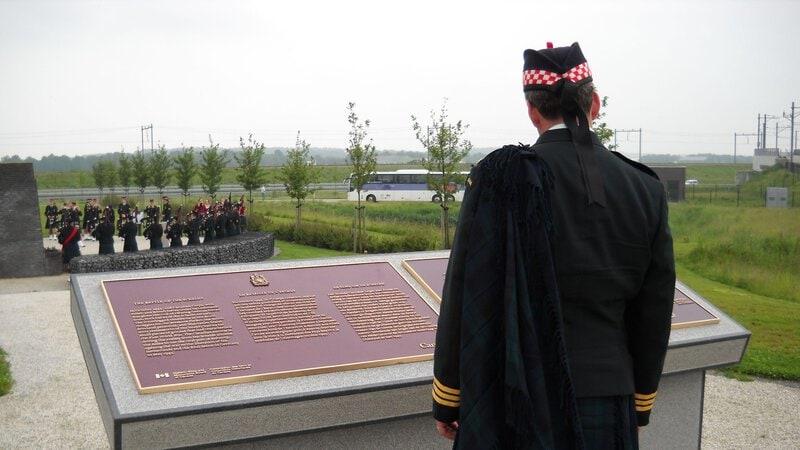

Dawn broke grey and bitter over the Dutch lowlands on October 31, 1944, and the men of the Canadian and British infantry battalions began moving across the Walcheren Causeway in single file — a narrow strip of road barely wide enough for two men to walk abreast, flanked on both sides by flooded black water, with German guns zeroed in from fortified positions at the far end. There was no cover. There was nowhere to run. The men at the front knew that to advance was to die, and they advanced anyway.
A Port Nobody Could Use

Two months before those soldiers stepped onto the causeway, the liberation of Paris had filled newsreel screens around the world with jubilant crowds and tumbling bottles of champagne. The war in the west seemed to be sprinting toward its conclusion. Yet by early autumn 1944, Allied armies were quietly strangling on their own success.
The problem was ancient and unglamorous: supply lines. Since D-Day in June, everything the Allied armies needed — fuel, ammunition, food, medical supplies, replacement parts — had been trucked or flown hundreds of miles from the invasion beaches in Normandy. The distances were now absurd. General George Patton’s Third Army, famous for its speed and aggression, was grinding to a halt not because of German resistance but because its tanks had run out of petrol. The entire Western Front was being throttled by logistics.
Then, on September 4, 1944, the Belgian port of Antwerp fell to the British 11th Armoured Division — and fell almost entirely intact. The German garrison had retreated so quickly that they had not managed to demolish the docks. Here was the largest port in continental Europe, capable of handling an almost incomprehensible volume of cargo, sitting undamaged in Allied hands. It should have changed everything.
It changed nothing. Not yet. Because to reach Antwerp, ships had to sail roughly sixty miles up the Scheldt estuary — and Germany still held both banks of that estuary, and its heavily fortified island of Walcheren at the mouth. The port was a prize locked behind a wall. Allied commanders had the key but had not yet reached the lock.
Field Marshal Bernard Montgomery, commanding Allied ground forces, chose in those critical weeks to chase a bolder prize. Operation Market Garden — the audacious airborne assault on the bridges of the Netherlands — launched on September 17 and consumed Allied attention, resources, and narrative energy entirely. The Scheldt was left to wait. Military historians have since argued that this delay was one of the most consequential strategic miscalculations of the entire Western campaign. Every day the estuary remained in German hands, Allied soldiers elsewhere went hungry and waited for artillery shells that were not coming. The Scheldt was not a sideshow. It was the supply chain the war depended on.
The Battle of the Scheldt: Fighting Through the Flood

When the assault finally came, it was given to the Canadian First Army — already bloodied, consistently underestimated — supported by British forces and directed operationally by Lieutenant-General Guy Simonds. The Battle of the Scheldt ran from early October to November 8, 1944, across terrain that seemed designed by geography itself to maximize suffering: flooded polders, fortified islands rising barely above the waterline, and the remorseless open ground of the causeway.
The campaign divided into three brutal, distinct fights. First, Canadian infantry cleared the South Beveland peninsula in grinding, field-to-field combat across waterlogged ground that swallowed boots, bogged down vehicles, and turned every approach into a potential ambush. Then came Walcheren island — and here, in one of the war’s most unusual operational decisions, the Allies chose to flood their ally’s own land. RAF bombers attacked the sea dykes at Westkapelle and other points in October 1944, deliberately breaching them and inundating the island’s interior with seawater. It was a calculated act of destruction visited upon Dutch soil and Dutch farms, carried out to neutralize German gun emplacements that commanded the estuary approaches. The Germans, dug into concrete bunkers and fortified positions, suddenly found themselves defending an island that was becoming a swamp.
The assault on Walcheren was amphibious — Royal Marine Commandos landing from the sea at Flushing and Westkapelle while Canadian infantry pushed overland across the South Beveland causeway, men wading through floodwater to close on bunkers still spitting fire. The fighting was close, confused, and savage. And then there was the Walcheren Causeway itself.
That narrow strip became one of the war’s most concentrated horrors. With no room to maneuver and no cover to take, soldiers advanced in the knowledge that the men ahead of them were being cut down and that they would be expected to fill the gap. Multiple assaults were beaten back. Eventually, through sheer persistence and at tremendous cost, the causeway was secured. The estuary fell. On November 28, 1944, the first Allied supply convoy reached Antwerp’s docks, delivering around ten thousand tons of cargo. Within weeks, the port was handling more tonnage than any other Allied facility in Europe. The Western Front began to breathe again.
Why History Looked Away

The question of why the Battle of the Scheldt slipped so comprehensively from popular memory has several answers, and they reinforce each other uncomfortably.
Operation Market Garden preceded it by weeks and towered over it in the public narrative. The airborne assault on Arnhem — the bridge too far, the gamble that failed spectacularly — had drama, famous commanders, and a doomed British garrison holding out in a burning city. It produced a bestselling book and a major Hollywood film. The Scheldt had flooded polders and a causeway. No single image anchored it in memory the way a burning bridge does.
The soldiers who bore the heaviest cost were overwhelmingly Canadian. Canada’s extraordinary contribution to the Second World War — from D-Day to the Italian campaign to the liberation of the Netherlands — has been persistently crowded out of popular history by American and British storylines, in both Hollywood productions and mainstream historical narrative. The Scheldt is perhaps the sharpest example of that erasure.
Dutch national memory, too, was complicated. The occupation had not been a simple story of resistance and heroism — collaboration existed alongside courage, and the deliberate Allied flooding of Walcheren, which destroyed farmland and displaced tens of thousands of civilians, made straightforward commemoration awkward. A battle that required acknowledging that Allied bombers wrecked Dutch land to save Dutch liberty did not lend itself to clean memorialization.
And so for decades, the battle lived in regimental histories, specialist monographs, and the quiet memorials in Zeeland’s small towns — honored by those who knew, invisible to nearly everyone else.
Three Lives in the Flood: How Cinema Finally Told the Story

In 2020, a Dutch film arrived that did what decades of history education had not. De Slag om de Schelde — released internationally as The Forgotten Battle on Netflix — approached the campaign through three interlocking perspectives: a British glider pilot, a young soldier serving reluctantly in the German army, and a Dutch woman working with the resistance in occupied Zeeland.
Director Matthijs van Heijningen Jr. made a deliberate and significant choice in refusing to produce a simple Allied-heroes film. The German soldier’s arc forces viewers to sit with moral ambiguity rather than comfortable villain-framing — a man caught inside a machinery of war he did not choose, fighting for a cause he does not fully believe in, trying to survive. The film is set against the broader chaos of autumn 1944, touching on the aftermath of Operation Market Garden and the desperate civilian experience of an occupied, flooding country edging toward the catastrophic Hunger Winter that would kill tens of thousands of Dutch people in the months ahead.
Shot on the actual landscape where the battle occurred — the filmmakers’ own country, their own national wound — the production carries a quality that imported war films rarely achieve: a sense of genuine reckoning. The Netherlands was finally placing its own forgotten corner of the war on screen at scale, acknowledging the full, uncomfortable tangle of sacrifice, complicity, occupation, and liberation that the Scheldt campaign embodied.
Audiences responded. Viewers discovering the film on Netflix found themselves not only gripped by the story but genuinely astonished that they had never encountered the battle it depicted. For many, it was a first introduction to one of the most consequential campaigns of the entire Western war. Critics noted that the film’s ambition matched its subject — this was not a small story told small. Those looking for a fuller assessment of where the film succeeds and where it falls short will find detailed critical analysis worth reading.
The Real Cost: Putting Numbers to the Mud

The statistics of the Battle of the Scheldt deserve to sit still for a moment, because they are genuinely staggering and genuinely unknown to most people who consider themselves seriously interested in the Second World War.
- The Canadian Army alone suffered approximately 6,300 casualties — killed, wounded, or captured — in just over a month of fighting.
- Total Allied casualties across the full campaign are estimated at around 13,000.
- German losses were severe; over 41,000 prisoners were taken when the estuary finally fell.
- Tens of thousands of Dutch civilians were displaced by the deliberate flooding of Walcheren, and farmland submerged by salt water did not fully recover for years afterward.
One comparison stands out with particular force: the Battle of the Scheldt lasted longer and cost more Canadian lives than the Normandy landings on D-Day. D-Day has its own national museum on the beach in France. It has annual ceremonies attended by heads of state. It holds a permanent, luminous place in the world’s memory of the war. The Scheldt has Zeeland’s quiet memorials, and until recently, a silence that most of the world never noticed.
What This Battle Still Has to Teach
The strategic lesson of the Scheldt is one that every generation relearns at cost: logistics win wars. Not the bold thrust, not the famous bridge, not the liberation of the celebrated city — but the grinding, unglamorous, essential work of securing the supply chain. The soldiers who took the Walcheren Causeway yard by bloody yard did not capture anything that would make a stirring photograph. They secured the port that fed the armies that ended the Reich. That matters more than almost any other single action in the autumn of 1944.
The Scheldt also complicates the tidy moral geography that popular culture prefers to draw around the Second World War. The battle required Allied commanders to flood a friendly nation’s farmland, displace its civilians, and ask exhausted soldiers to walk into fire on a strip of road with nowhere to hide. The Dutch civilians of Walcheren paid an enormous price for their own liberation. Those contradictions are not footnotes — they are the substance of the campaign, and engaging with them honestly is what makes the story worth telling.
As the last veterans of the Second World War pass away, the gap between the battles popular culture remembers and the battles that actually decided the outcome grows wider and more consequential. The Scheldt sits near the top of that second list. The true story behind the campaign is one of extraordinary human cost paid for a strategic objective that was entirely invisible to the watching world — and that invisibility persisted for three-quarters of a century.
The muddy causeway at Walcheren, the salt-drowned polders of Zeeland, the Canadian names carved into memorials that most visitors never find — they mark the place where Europe’s largest port was finally unlocked and the clock on Nazi Germany began running down in earnest. That story is too important, and too human, to remain forgotten any longer.

 English
 Arabic
 French
 Spanish
 Deutsch
 Turkish
 Dutch
Dutch
 Italiano
 Russian
 Romaian
 Portuguese (Brazil)
 Greek
Greek