


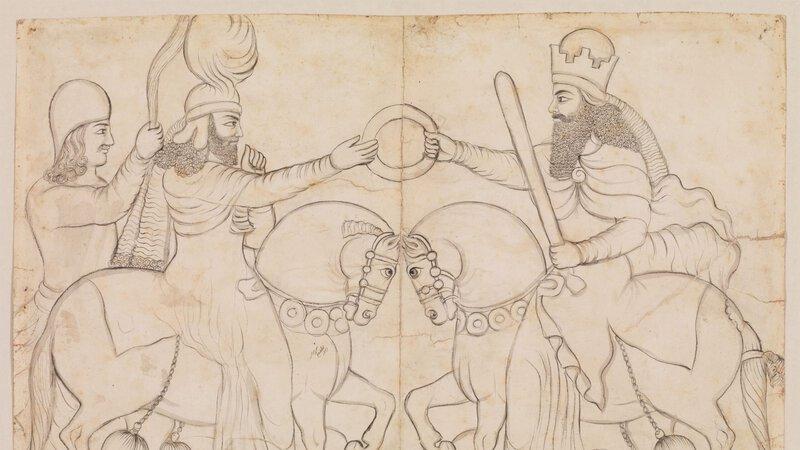

One evening in the sixth century CE, an ambassador arrived at the court of the Persian king Khosrow I carrying a wooden board, sixty-four squares, and a challenge: decode this game, or admit that Indian wisdom surpasses your own. By morning, according to the chronicles, the king’s scholars had not only mastered chess — they had invented a new game, backgammon, and sent it back as a counter-challenge. It is a small story, almost too neat to be true, but it captures something essential about the civilization that produced it. The Sasanian Empire did not merely receive the world’s ideas. It transformed them.
A Rebel Lord and the Birth of an Empire

The empire begins with a man who may have been a minor temple guardian, a regional strongman, or both — history is not entirely sure. What is certain is that Ardeshir I, governor of the province of Persis in what is now southwestern Iran, spent the years between roughly 208 and 224 CE fighting his way upward through a collapsing Parthian world. The Arsacid dynasty, which had held Persia for nearly five centuries, had grown brittle. Ardeshir moved through its cracks like water through stone. At the Battle of Hormozdgan in 224 CE, he defeated and killed the last Parthian king, Artabanus IV, and declared himself Shahanshah — King of Kings.
The new dynasty called itself the House of Sasan and claimed descent from the ancient Achaemenid line, the same royal blood that had produced Cyrus the Great and Darius. Historians debate how genuine that genealogy was. But the political genius of the claim was undeniable: it wrapped a new and fragile regime in the authority of a legendary past, giving Ardeshir not just a crown but a cosmic mandate. The Sasanian dynasty that he founded would last until 651 CE — more than four centuries, more than thirty kings, and an imperial footprint that stretched from modern Iraq and Iran through the Caucasus and Armenia, with influence reaching toward Central Asia and the shores of the Arabian Peninsula. This was not a regional power. This was Rome’s only true peer.
To understand Persia before Islam, you have to understand the Sasanians — and to understand the Sasanians, you have to start with that rebel lord and the dynasty he built on a lineage that may have been more myth than blood.
The State Religion That Rewired a Civilization

Zoroastrianism had existed in Persia for centuries before the Sasanians, but Ardeshir I and his successors did something new with it: they made it infrastructure. The Magi, the Zoroastrian priestly class, became a bureaucratic arm of the crown. Fire temples spread across the empire — sacred flames that were never permitted to die, tended for generations, serving simultaneously as places of worship, community anchors, and early welfare institutions that distributed grain and aid to the poor.
The theological stakes were higher than they might appear. Zoroastrian cosmology articulated a universe locked in struggle between a force of good and a force of evil, moving toward a final judgment, an apocalyptic renewal, and the arrival of a world-saving figure. These ideas did not stay inside Persian borders. Scholars of religion have traced their influence into Jewish apocalyptic writing that took shape during and after the Babylonian exile — a period when Persian rulers governed the world in which Jewish scripture was being written and rewritten. Through that channel, Zoroastrian theological structures flowed into Christianity and, later, into Islam. The concepts of heaven and hell, of a cosmic moral reckoning, of history moving toward a decisive end — these carry Persian fingerprints.
Yet the same empire that enforced Zoroastrian orthodoxy also housed one of the ancient world’s most intellectually open cultures. Sasanian court culture translated Greek philosophy, Indian mathematics, and Syriac medicine into Middle Persian. The tension between doctrinal rigidity and intellectual hunger is not a contradiction — it is the source of the empire’s extraordinary fertility.
Gundeshapur — The Ancient World’s Most Advanced Center of Learning

In the southwestern Persian city of Gundeshapur, something unprecedented was happening. The Academy there, founded in embryonic form under Shapur I in the third century and reaching its full development under Khosrow I in the sixth, had become the most sophisticated center of medicine and learning in the ancient world — an institution that combined the functions of a royal library, a teaching school, and a clinical hospital under a single roof.
What made Gundeshapur remarkable was not just its resources but its collisions. When the Byzantine Emperor Justinian closed Plato’s Academy in Athens in 529 CE, the Greek philosophers who fled eastward found a welcome at the Sasanian court. They arrived alongside Syriac Christian scholars who had been translating Greek medical texts for generations, Indian physicians trained in Ayurvedic traditions, and Jewish doctors and astronomers. Khosrow I, a ruler with a documented appetite for foreign knowledge, brought them together deliberately.
The hospital — the bimaristan — attached to the Academy operated on something like a ward system, with physicians rotating through clinical practice, keeping written records of cases and outcomes, and training the next generation through direct observation. These are institutional features that would not appear in European medical practice for centuries. When the Abbasid caliphs founded Baghdad in the eighth century and set about building what we call the Islamic Golden Age, they did not construct their medical establishment from nothing. They recruited Gundeshapur’s physicians — by name, by family, by school. The most celebrated medical dynasty of early Islamic Baghdad, the Bukhtishu family, came directly from Gundeshapur. The Islamic Golden Age of medicine drew its first breath not in an Arab city but in a Sasanian one that history has largely forgotten to credit.
War With Rome — Four Centuries of Collision

No account of the Sasanian Empire is complete without the Roman wars, which were not a single conflict but a continuous, grinding, occasionally catastrophic rivalry that shaped both empires across four hundred years. The frontier shifted constantly along the Euphrates and through Armenia and Mesopotamia. Cities changed hands. Armies were destroyed and rebuilt. Neither side ever delivered a knockout blow — which is itself one of the most important facts about the ancient world that popular history tends to understate.
The single most dramatic moment came at the Battle of Edessa in 260 CE, when Shapur I defeated and captured the Roman Emperor Valerian — the only Roman emperor taken alive in battle in the entire history of the empire. Shapur had the victory commemorated in monumental rock reliefs at Naqsh-e Rostam, near the ancient Persian heartland, where Valerian is shown on his knees or in submission before the mounted king. The image was carved into living rock on a scale visible to every traveler passing through the region: permanent stone propaganda broadcasting Persian supremacy to a multilingual empire and to Rome itself.
The wars reached their final, exhausting climax under Khosrow II in the early seventh century. Between 603 and 628 CE, Sasanian armies drove deep into Byzantine territory, capturing Jerusalem in 614, seizing Egypt, and reaching the gates of Constantinople. It was the most dramatic Persian expansion since the Achaemenids. It was also ruinous. The Byzantine Emperor Heraclius counter-attacked, penetrating deep into Persian territory and forcing a humiliating peace. Both empires emerged from this final war bled white — which goes a long way toward explaining why Arab armies, fighting with the momentum of a new faith, were able to dismantle the Sasanian state with such speed in the following decade. The Sasanians were not conquered by a stronger enemy so much as by a exhausted one who had already broken itself against Rome.
Art, Silk, and the Aesthetic Empire

Sasanian visual culture was never confined to stone. The empire’s silk textiles — bearing hunting kings, mythological birds, and paired animals arranged in the rondel patterns that became a hallmark of the style — traveled the Silk Road in every direction. So coveted were these fabrics that centuries after the empire’s fall, Sasanian silk was being used as liturgical wrapping for the relics of Christian saints in European churches. The aesthetic had outlived the political entity that created it by hundreds of years.
In architecture, the Sasanian contribution was structural and lasting. The iwan, a vaulted open hall fronted by a monumental arch, became a defining form of Islamic sacred and civic architecture. The squinch — the device that allows a circular dome to rest on a square room — was refined in Sasanian palace construction and passed directly into the architectural vocabulary of the mosque. When you look at the great mosques of Isfahan or the courtyard layouts of early Islamic palaces, you are looking at spaces whose spatial logic was worked out first in Sasanian Persia.
The material culture of the Sasanians — their metalwork, their carved silver plates depicting royal hunts, their embossed glass — represents one of the most coherent and influential aesthetic programs of the ancient world. Art, for the Sasanians, was never decoration alone. It was propaganda, diplomacy, and theology pressed into a single visual language broadcast across a multilingual empire and carried by merchants, diplomats, and refugees to every corner of Eurasia.
The Blueprint Islam Inherited

In 651 CE, the last Sasanian king, Yazdegerd III, was killed while fleeing the Arab armies that had dismantled his empire battle by battle over the preceding decade. Standard historical narrative frames this as an ending. It was not. It was a merger — arguably the most consequential cultural merger in the history of the medieval world.
The Arab armies who crossed into Persia did not arrive in an empty landscape. They walked into a fully functioning imperial machine: a trained bureaucracy, a system of state registers and administrative records, a court ceremonial with centuries of refinement, and a class of educated administrators who knew how to run a continental empire. Many of those administrators converted to Islam and kept their jobs. The scribal and administrative practices they brought with them shaped the early caliphate’s governance from the inside.
The Sasanian Empire’s influence on Islamic civilization went deeper than bureaucracy. Persian became the language of high culture, poetry, and courtly life across much of the Islamic world. The royal titulature, the palace aesthetics, the spatial organization of power — all carried Sasanian DNA. The physicians of Gundeshapur became the physicians of the caliphs. The architectural forms of Sasanian palaces became the architectural forms of Islamic governance. Even the shahnameh tradition — the great Persian national epic compiled by Ferdowsi around 1000 CE — drew on Sasanian dynastic mythology as its central spine, ensuring that the empire’s self-image survived inside the literary culture of the civilization that had replaced it.
The Sasanian world did not vanish in 651. It shape-shifted. Within a century of the conquest, Persian literature, science, architecture, and administrative genius had re-emerged under Islamic patronage, forming what scholars recognize as a twin spine running through the Islamic Golden Age. To describe that age as purely Arab in origin is to misread the inheritance. It was built on a Persian foundation that the Sasanian dynasty had been laying for four hundred years.
Why the Sasanians Were Forgotten — and Why That Matters
There is a reason most educated readers know Rome and Greece far better than they know the empire that matched Rome for four centuries and rivaled it intellectually. The Sasanians left no direct political successor to champion their memory. Arab chronicles, understandably, emphasized the clean break of the Islamic revelation. European historians, working from a framework in which civilization flowed from Athens to Rome to Christendom, had no template for a Persian empire that fit neither side of that story. The Sasanians fell between the categories and were quietly written out of the popular account of how the world was made.
Recovering the Sasanian world is not an academic exercise in reclaiming minor details. It is the corrective lens without which the Islamic Golden Age seems to appear from nowhere, the Silk Road seems to be merely a trade route rather than a civilizational nervous system, and medieval European medicine seems to have learned everything from a handful of recovered Greek texts rather than from a living Persian tradition passed through Arabic translation. The Sasanians are the missing chapter in how the medieval world — East and West — actually worked.
Return, then, to that evening in Khosrow I’s court, and the chessboard laid before him as a challenge. His scholars decoded the game in a night — and then invented backgammon and sent it back. That is the Sasanian method in miniature: receive the world’s best thinking, master it faster than anyone expects, transform it into something new, and release it back into circulation bearing your own mark. The Sasanian Empire lasted more than four centuries — longer than the Western Roman Empire — and its ideas are still moving through the world. We have simply forgotten to read the label.

 English
 Arabic
 French
 Spanish
 Portuguese
 Deutsch
 Turkish
 Dutch
Dutch
 Italiano
 Romaian
 Portuguese (Brazil)
 Greek
Greek