


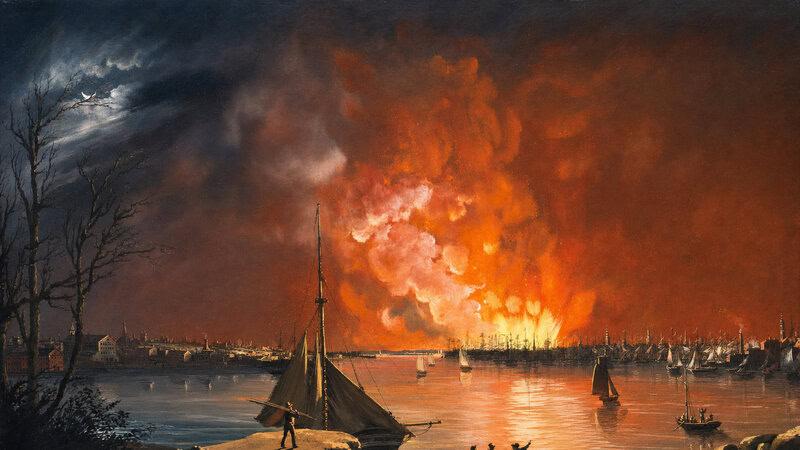

On the freezing night of December 16, 1835, a watchman spotted something wrong at a warehouse on Merchant Street in lower Manhattan — a flicker, then a roar — and within the hour, the wealthiest commercial district in America had become an inferno visible, by some accounts, as far away as Philadelphia. It was not the first time New York had burned. It would not be the last time the city rebuilt.
A City Built to Burn: Colonial New York’s Tinderbox Years

To understand why New York burned so catastrophically — twice in sixty years — you have to understand what the city was made of. Colonial New York was a dense, wind-whipped island of wooden Dutch and English structures crammed together along narrow lanes that followed the logic of old cow paths and property disputes rather than any sensible urban plan. Fire codes existed on paper. Enforcement was another matter entirely. The volunteer bucket brigades that served as the city’s fire department were brave, community-minded, and chronically overwhelmed.
The materials packed into those close-pressed buildings made the situation worse. Chandler shops stuffed with tallow, ropewalks coiled with hemp, warehouses holding barrels of turpentine and rendered oil — lower Manhattan’s commercial heart was essentially a slow-motion disaster waiting for a spark. Smaller blazes were so routine in 18th-century New York that they barely rated more than a line in the Gazette. The city had learned to accept a certain level of burning as the price of doing business on a crowded island. That complacency made what happened in September 1776 all the more catastrophic.
The Great Fire of 1776: War, Suspicion, and a City Consumed

British forces had occupied New York City for less than a week when, near midnight on September 21, 1776, fire broke out near Whitehall Slip at the southern tip of Manhattan. A stiff wind blew in from the south. The flames moved north with terrifying speed, jumping from wooden structure to wooden structure along streets too narrow to slow them. By dawn, the Great Fire of 1776 had burned roughly a fifth of New York City to the ground — Trinity Church reduced to a gutted shell, and thousands of Loyalist civilians suddenly homeless inside their own occupied city.
The British commanders immediately suspected American sabotage. George Washington had retreated from the island just days before, and some within the Continental Army had in fact advocated burning New York rather than leaving it intact for British use. Washington himself had been refused permission to do so by the Continental Congress. Whether anyone acted on that impulse anyway has never been proven. Several men were seized near the fire and summarily executed without trial. The cause was never definitively established, and the Great Fire of 1776 remains one of the enduring mysteries of the Revolutionary era, its origins still debated by historians today.
What is not debated is the aftermath. The British used the burned district as a makeshift encampment — a maze of canvas shelters and salvaged timber that soldiers and displaced civilians called Canvas Town — for the duration of the war. Serious rebuilding was impossible under occupation. When the war ended in 1783 and American forces retook the city, they inherited not a thriving colonial port but a scarred, partially ruined settlement with a ghost-wound at its core. That wound, paradoxically, became an opportunity.
When postwar planners confronted the burned district, they began thinking seriously about street widths, firebreaks, and organized urban form for the first time. Those conversations planted seeds that would eventually flower in the 1811 Commissioners’ Plan — the visionary grid that imposed rational order on the chaotic tangle of colonial-era streets and gave Manhattan the street network that largely defines it today.
Fifty-Nine Years of Growth — and a Second Disaster Waiting to Happen

Between 1783 and 1835, New York transformed beyond recognition. A war-damaged colonial port of roughly 25,000 souls became a booming commercial capital of more than 270,000, the largest city in the young United States and the busiest port on the Atlantic seaboard. That growth was extraordinary. It was also reckless, because it outpaced every safety system the city possessed.
The district that would burn in 1835 was the wealthiest commercial corridor in America — a dense grid of counting houses, wholesale dry-goods warehouses, and merchant firms doing millions of dollars in annual trade, their buildings packed shoulder-to-shoulder with no meaningful firebreaks between them. Fire reformers had warned about exactly this kind of fuel-packed density for years. City leaders had largely failed to act. When a large warehouse located dangerously close to some of New York City’s most prominent commercial buildings caught fire on Merchant Street, the result was, in retrospect, inevitable.
The Great Fire of 1835: Seventeen Blocks of Hell

What made that December night truly devastating was not just the fire — it was the cold. The winter of 1835 brought one of the most brutal cold snaps in New York’s recorded history, with temperatures plunging so far below freezing that the East River partially iced along its edges. Fire brigades aimed their hoses and watched the water freeze solid before it reached the flames. Hydrant lines seized up. The river, the last practical reservoir, was half-locked behind ice too thick to break quickly.
The fire jumped Broad Street, then Exchange Place, consuming block after block with a speed that stunned even veterans of smaller New York blazes. The glow was visible for miles. Sparks rained down on rooftops a quarter-mile distant, starting secondary fires that stretched the already overwhelmed fire companies to their breaking point. Merchants sprinted into burning buildings to drag out ledgers and bolts of cloth. Volunteers from as far as Philadelphia and Newark arrived to help, only to find themselves largely helpless against both the blaze and the cold.
In desperation, fire commanders ordered buildings dynamited in the fire’s path — rubble firebreaks blasted out of the city’s own fabric. That drastic measure, more than anything else, finally stopped the advance. By the time the last embers were beaten out, roughly 17 city blocks and as many as 700 buildings had been destroyed, and lower Manhattan was a smoking field of ruin.
The human toll went far beyond burned buildings. The fire consumed the wealthiest commercial district in the country at a moment when the insurance industry was catastrophically underfunded. Insurer after insurer collapsed in the days that followed, unable to pay claims that dwarfed their reserves. The financial shockwave rippled outward across the young American economy, contributing to the credit crisis and bank failures that culminated in the Panic of 1837. A single night of fire in lower Manhattan helped tip the entire country into depression.
From Ashes, a Modern City: What the Fires Built

The two great fires of New York’s early history share more than geography. Each one, in destroying what existed, forced the city to construct something better — or at least something more deliberate — in its place.
The 1835 fire produced reforms that were immediate and concrete. The patchwork of volunteer fire companies that had failed so visibly on Merchant Street was eventually replaced by a professional, paid fire department — a shift that made New York a national model for urban fire protection. Commercial districts were required to use brick and iron construction rather than wood. And the city finally committed to a major water-infrastructure project: the Croton Aqueduct, completed in 1842, which brought clean, abundant water to Manhattan and gave firefighters the hydrant pressure they had so desperately lacked on Merchant Street. The insurance industry, shattered by the 1835 losses, rebuilt itself on sounder actuarial foundations that spread across the country as a new national standard for risk management.
Both fires also accelerated something subtler: the northward march of the city itself. Residents and businesses displaced from lower Manhattan pushed development up the island faster than it otherwise would have gone, filling in neighborhoods that would eventually become Midtown and beyond. New York’s famous vertical ambition has roots, in part, in the recurring necessity of rebuilding from the ground up.
Why These Fires Still Shape the City You See Today

Walk through lower Manhattan now and you are walking through the consequences of fire. The wide commercial streets were widened after flames proved that narrow colonial lanes were death traps. The cast-iron and brick facades that line blocks near what was once the burned district reflect post-1835 construction mandates. The hydrant system underfoot and the professional fire department that responds within minutes are not accidents of civic progress — they are deliberate responses to catastrophe, decisions forced by disaster and carried out by a city that had twice watched its commercial heart reduced to ash.
It is important not to romanticize any of this. The colonial families who found themselves homeless in a British-occupied city in September 1776 did not experience their displacement as urban renewal. The merchants ruined overnight in December 1835 — the small traders, the clerks, the insurance underwriters who lost everything — did not comfort themselves with thoughts of better building codes to come. Fire is not metaphor when it is happening to you. It is loss, plain and absolute.
But cities are shaped by what they survive as much as by what they plan, and New York has always survived. The watchman who spotted that first flicker on Merchant Street in 1835 could not have known he was watching a turning point — that the reforms forced by that night would help build the infrastructure of a world city, or that the skyline rising from those ashes would one day be the most recognized on earth. He just knew the city was burning. New York, as it always has, figured out the rest.

 English
 French
 Spanish
 Portuguese
 Deutsch
 Turkish
 Dutch
Dutch
 Italiano
 Russian
 Romaian
 Portuguese (Brazil)
 Greek
Greek