


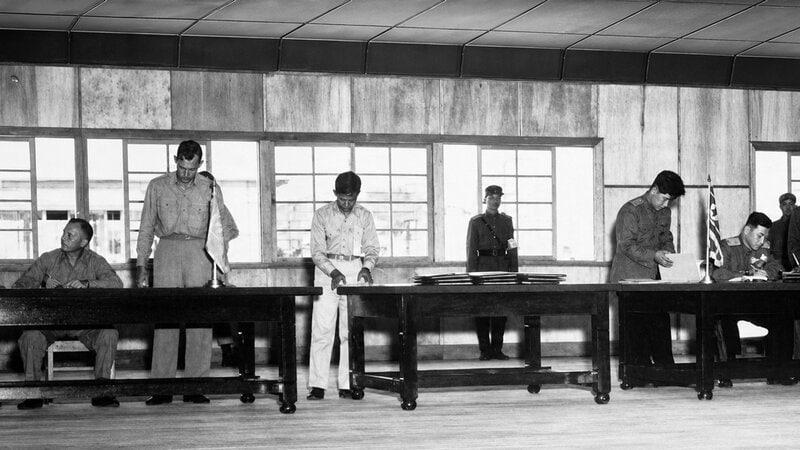

On the morning of July 27, 1953, the guns along the 38th parallel fell silent — and the Korean War did not end. It paused. Soldiers on both sides exhaled, some wept, some simply sat down in the mud and stared at the hills they had been killing over for three years. But no head of state signed a peace treaty that day. No war was officially concluded. And more than seventy years later, that pause is still all there is.
A Cease-Fire Is Not a Peace Treaty

This is the detail that most people — even well-read people — get wrong about one of the twentieth century’s most consequential conflicts: North and South Korea remain, in strict legal terms, at war. The armistice of 1953 was an agreement among military commanders to stop shooting. It was not a peace settlement, it carried no permanent legal force, and it was never ratified by all the parties whose land it divided. The Korean War’s unfinished status is not a historical footnote. It is a live geopolitical condition that shapes nuclear diplomacy, US troop deployments, and the daily reality of life on a divided peninsula right now.
Declassified US Army Signal Corps footage shot during the conflict captured this war in raw, unvarnished detail — artillery barrages, frostbitten infantrymen, the strange quiet between firefights. Those images still carry the weight of something unresolved. Understanding them requires understanding why the Korean War never truly ended, and why a conflict the world was already beginning to forget while the cameras were still rolling continues to matter so urgently today.
June 25, 1950: The Morning the Peninsula Exploded

Before dawn on June 25, 1950, North Korean forces crossed the 38th parallel in overwhelming numbers. The South Korean military, outgunned and outmanned, collapsed within hours. The capital, Seoul, fell in three days. What followed was not a regional skirmish but one of the defining proxy confrontations of the Cold War — Soviet weapons and doctrine arming the North, Chinese manpower eventually entering the fight in massive numbers, and a US-led United Nations coalition scrambling to hold a perimeter at the southern tip of the peninsula near Pusan before launching a dramatic counteroffensive.
The territorial swings in that first year alone were almost incomprehensible in their violence and speed. UN forces, energized by General Douglas MacArthur’s amphibious landing at Inchon in September 1950, drove North Korean troops back almost to the Chinese border at the Yalu River. Then China entered the war in November 1950, and the front crashed back south again, past Seoul, before stabilizing roughly where it had started — at the 38th parallel. Millions of lives were upended. Entire cities changed hands multiple times.
The documentary The Korean War: The First Year, drawn from Defense Visual Information Distribution Service archives, compresses this dizzying back-and-forth into a format that lets viewers feel the war’s savage momentum in something approaching real time. It is essential viewing for anyone trying to grasp what the armistice was actually pausing. For broader grounding in the conflict’s causes and Cold War context, the Korean War overview from Khan Academy traces how a civil conflict on a distant peninsula became a defining test of US containment policy.
What Signal Corps Footage Actually Shows

The US Army Signal Corps sent cameramen into the field with a mandate to document the war as it was happening. What they captured is unlike almost anything that emerged from the more managed newsreel culture of World War II. The footage shows mud — extraordinary quantities of it — and men improvising treatment for frostbite in temperatures that could drop to minus twenty degrees Fahrenheit in the Korean winter. It shows the blank, thousand-yard expressions of soldiers who have been awake for days. It shows artillery firing at targets no one on camera can see, and the aftermath of what that artillery does to landscape and to bodies.
Some of this material remained classified or simply uncatalogued for decades, and the visual history of the Korean War is, in a meaningful sense, still being recovered. One example of what has surfaced is Signal Corps combat footage from the Korean War, captured in 1951, which presents the conflict at a level of immediacy that written accounts struggle to replicate. Watching it, you understand something that histories of the war often fail to convey: this was not a clean, managed Cold War abstraction. It was a grinding, brutal, intensely personal catastrophe for everyone caught inside it.
The archival gap matters for a specific reason. The Korean War produced far fewer iconic images than World War II or Vietnam. There is no Korean War equivalent of the flag-raising at Iwo Jima or Nick Ut’s 1972 photograph of a napalm-burned child fleeing a South Vietnamese strike — images that burned themselves into cultural memory and made forgetting politically difficult. Without those visual anchors, the war slipped more easily from public consciousness, and the Signal Corps footage that does exist has never received the wide circulation it deserves.
The Forgotten War: How a Conflict Gets Erased From Memory

The Korean War earned its grim nickname through a specific historical accident of timing and framing. It was sandwiched between World War II — a conflict with a clear moral narrative, a decisive victory, and decades of cultural celebration — and Vietnam, a war so traumatic that American society spent generations processing it through film, literature, and political argument. The Korean War occupied an awkward middle position. It was not a triumphant victory. It was not a shattering defeat. It was a stalemate, ending roughly where it began, at a cost that defies easy categorization.
The human cost alone demands more than footnote status in the national memory. Approximately 36,000 American military personnel died in the conflict. South Korean military deaths numbered in the hundreds of thousands, and estimates of total Korean civilian casualties — North and South combined — run into the millions when accounting for the full span of the war’s destruction. A nation was permanently divided. Families were separated and, in many cases, remain separated to this day, forbidden from crossing a border that bisects their country.
The Cold War framing made forgetting easier. Because the conflict was officially described as a “police action” rather than a declared war, and because its outcome was containment rather than victory, politicians had little incentive to memorialize it loudly. The public took its cues from that institutional silence. The result is a war whose unresolved status barely registers in mainstream awareness — which has real consequences, because a war people do not remember is a war whose dangers they cannot properly assess. The PBS LearningMedia Retro Report on the Korean War examines this legacy of selective memory directly, connecting the war’s forgotten status to the ongoing political tensions that flow from it.
July 27, 1953: What the Armistice Actually Said — and Didn’t Say

The document signed at Panmunjom on July 27, 1953 was precise and deliberately limited in its scope. It established a Military Demarcation Line running roughly along the 38th parallel. It created a Demilitarized Zone — a buffer strip approximately 2.5 miles wide on each side of that line. It arranged for the exchange of prisoners of war. And it was signed by military commanders: the commander of United Nations forces, the commander of North Korean forces, and a representative of the Chinese People’s Volunteer Army.
What it was not, and what it explicitly did not claim to be, was a peace treaty. No heads of state signed it. More significantly, South Korean President Syngman Rhee refused to sign it at all — a signal, from the very first moment, that the armistice lacked unanimous political legitimacy among the parties whose territory it was dividing. Rhee wanted to continue fighting toward reunification on South Korean terms. The armistice denied him that, and he let his refusal stand on the record.
The document included a provision calling for a political conference within 90 days, at which the parties would negotiate a permanent peace settlement. That conference convened in Geneva in 1954. It collapsed without resolution. The 90-day provision became a stalemate that has now lasted more than seven decades. The question of whether the Korean War ended has a precise legal answer: no. An armistice is a mutual agreement to stop shooting. It has no standing as a permanent peace settlement, and no such settlement has ever been reached.
The DMZ: A Living Scar Where the War Still Breathes

Drive north from Seoul for about an hour and you reach the Demilitarized Zone — 160 miles long, roughly 2.5 miles wide on each side of the Military Demarcation Line, and one of the most heavily fortified borders on Earth. Guard posts. Tank traps. Minefields laid so long ago that records of their locations have been partially lost. Loudspeakers that have, at various points in the past seventy years, blasted propaganda across the wire at all hours of the night.
The DMZ is patrolled under armistice rules, not peacetime rules. That distinction matters operationally. Every incident — a defection, a standoff, a shot fired — is processed through a legal framework that still presupposes active belligerency. The Neutral Nations Supervisory Commission, established by the armistice to monitor compliance, technically still exists, its administrative machinery operating in the village of Panmunjom as a bureaucratic remnant of 1953 that no one has ever formally dissolved.
The Korean peninsula remains one of the last places on Earth where Cold War geopolitics operate in something close to their original, undiluted form: a nuclear-armed North Korea, US troops stationed in South Korea under a mutual defense treaty, and a Chinese strategic interest in peninsular stability that shapes every diplomatic calculation. The frozen quality of the situation is not an accident or an oversight. It is the direct result of a conflict that was never formally resolved.
Why Unfinished Wars Have Consequences
North Korea’s nuclear weapons program is not separate from Korean War history. Pyongyang explicitly frames its nuclear arsenal as a deterrent in a conflict it considers legally ongoing. From that perspective — however troubling the logic — the weapons are not an aberration. They are a response to a war that never ended, developed by a government that observed the fates of non-nuclear states that found themselves in conflict with major powers. The armistice did not create the conditions for peace. It created the conditions for a frozen hostility in which both sides have spent decades preparing for a resumption of fighting that the armistice was only ever meant to delay.
Every diplomatic initiative since 1953 — and there have been many, some generating genuine cautious optimism — has shared the same structural fragility: negotiations conducted without a foundational legal framework tend to collapse back to the armistice baseline rather than building toward something permanent. There is no peace to protect, and so there is nothing for diplomacy to defend when it runs into difficulty.
The Signal Corps cameramen who rolled film during the war were documenting a conflict they likely assumed history would eventually close with a treaty. They filmed the mud and the cold and the blank faces of men waiting for something to be resolved. Somewhere in those declassified reels, a young soldier squints into a Korean winter that he assumed history would properly conclude. It never did. The footage survives. The war, legally speaking, survives with it. Learning that history — sitting with its unresolved weight — is not an act of nostalgia. It is an obligation to the present.

 English
 Arabic
 French
 Portuguese
 Deutsch
 Turkish
 Dutch
Dutch
 Italiano
 Russian
 Romaian
 Portuguese (Brazil)
 Greek
Greek