



On a grey morning in 1311, somewhere above the rooftops of Lincoln, England, a cathedral spire creaked into position and, by a margin of roughly three feet, quietly ended a reign that had lasted nearly four thousand years — no fanfare, no ceremony, no conquering army; just mathematics, stone, and the slow audacity of medieval masons.
A Tomb Built to Touch the Sky

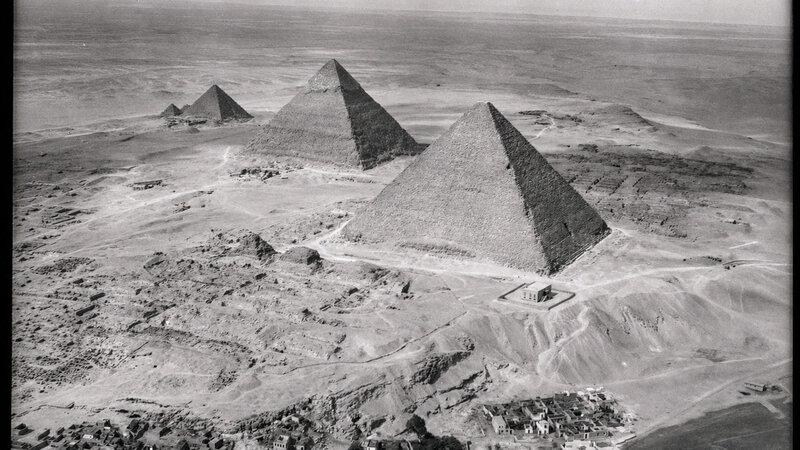
Wind the clock back to around 2589 BC. A new pharaoh, Khufu, has inherited the throne of Egypt and, with the ink barely dry on his reign, he orders something that will anchor his soul to eternity. The result — the Great Pyramid of Giza — would cover more than 13 acres at its base, rise to an original height of 146.6 metres (481 feet), and stand as the tallest structure human hands had ever raised. Nothing before it came close. Nothing after it would challenge it for roughly 38 centuries.
The theological logic was precise. In Egyptian belief, the pyramid’s apex — capped with a gilded pyramidion that caught the first and last light of every day — served as a symbolic bridge between the human world and the divine realm of Ra. Height was not vanity. Height was religion. Every additional course of stone was a verse in a prayer carved into the landscape itself. The sides rose at an angle of 51 degrees 52 minutes, each face stretching more than 755 feet along its base, and the whole structure aligned to true north within a fraction of a degree — an accuracy that still gives modern surveyors pause.
When the last stone was set, Khufu’s architects had produced something that existed entirely outside the normal grammar of human achievement. They had not simply built a large building. They had redefined what large meant.
2.3 Million Stones: How on Earth Did They Do It?

This is where the story turns into one of the great engineering mysteries of the ancient world — and one of its great misconceptions. The pyramid contains an estimated 2.3 million stone blocks, averaging around 2.5 tonnes each. They were quarried, shaped, transported, and lifted without steel, without wheeled vehicles of the kind we use today, and without mechanised power. The question of how has occupied archaeologists for centuries, and the answers, when they finally began emerging, were more human than anyone expected.
The leading evidence points to a combination of ramp systems and a sophisticated supply chain that used the Nile itself as a highway. Excavations at Wadi al-Jarf uncovered the world’s oldest known papyri — logbooks written by a harbour official named Merer that recorded, in crisp bureaucratic detail, the delivery of limestone blocks by boat along a canal connected to the Nile. The pyramid was not a monument built by brute force alone; it was built by a system, one of the most sophisticated logistics operations the ancient world had ever seen. As the National Geographic overview of the Giza pyramids makes clear, the organisational complexity behind the construction rivals the monument itself in its ambition.
And the workers? Popular myth has long insisted on slaves, chained and miserable. The archaeology tells a different story. Graffiti discovered inside the pyramid’s relieving chambers shows work gangs who gave themselves names — groups calling themselves “Friends of Khufu” with what reads, across four and a half thousand years, as genuine team pride. These were skilled labourers, fed well, treated for injuries, and buried with honour near the pyramid when they died. They were not victims of history. They were its craftsmen.
The pace they maintained staggers the imagination. To complete the pyramid in roughly 20 years, workers needed to place — on average — one block every two minutes of every working day. The Smithsonian’s overview of ancient Egyptian pyramid construction captures this logistical scale well: it was less like building a building and more like running a small city devoted entirely to a single, perpetual task.
3,800 Years at the Top: What the World Did While the Pyramid Reigned

Here is where the numbers stop being numbers and start being something closer to vertigo. According to the Egyptian Monuments Authority, the Great Pyramid held the title of the world’s tallest human-made structure for approximately 3,800 years — a span so long that trying to feel its full weight is like trying to hold an ocean in both hands.
Consider what passed beneath the pyramid’s shadow while it held its record. Greece rose, argued with itself, and fell. Alexander the Great conquered the known world and died young. Julius Caesar sailed to Egypt. The Western Roman Empire collapsed. The Prophet Muhammad was born, preached, and died. Charlemagne was crowned. The Black Death tore through Europe and killed a third of its population. The Crusades began, ground on for two centuries, and ended. Through all of it — every war, every plague, every shift in the tectonic plates of civilisation — the pyramid stood tallest.
There is a particular irony embedded in this record. Of the original Seven Wonders of the Ancient World, the Great Pyramid is the only one still standing. The Colossus of Rhodes is gone. The Hanging Gardens of Babylon vanished so completely that historians still debate whether they existed. The Lighthouse of Alexandria was toppled by earthquakes. The pyramid outlasted every rival monument, watched them crumble, and kept its title anyway.
By the medieval period, much of the pyramid’s original smooth white Tura limestone casing had been stripped away — quarried to build mosques and palaces in Cairo — meaning the structure had already lost several feet of its original height and its gleaming exterior. It stood a little rougher, a little shorter than Khufu had intended. It still held the record. Even diminished, nothing else on earth came close.
The Cathedral That Stole the Crown — by Three Feet

Which brings us back to Lincoln, and to 1311, and to the thin margin by which history changed hands. Lincoln Cathedral’s central spire, when completed, reached approximately 160 metres — edging past the pyramid’s original 146.6 metres by roughly the height of a tall man. After nearly four millennia, the usurper’s victory was measured in something you could cover with one outstretched arm.
Consider the absurdity of that for a moment. One of the most dramatic record breaks in the history of human construction — the end of the longest unbroken architectural reign we know of — was won by a margin so thin it feels less like triumph and more like a polite clearing of the throat.
The story did not end tidily. Lincoln’s central spire collapsed in a storm in 1549, briefly returning the theoretical record to an uncomfortable ambiguity. After that, a succession of European cathedrals traded the title back and forth before modern steel and concrete permanently retired the pyramid from the conversation. The Eiffel Tower, completed in 1889, rose 300 metres. The Burj Khalifa, opened in 2010, stands at 828 metres. The pyramid was not just beaten; it was eventually lapped.
But there is something worth pausing on in the way the pyramid lost its title. It never competed. It was not built to be tall in the way that Lincoln’s architects wanted their spire to be tall — as a visual declaration, a civic statement of ambition aimed at the heavens. The pyramid was built to be eternal. The height record was always a human label placed, somewhat arbitrarily, on something that existed in an entirely different dimension of intent.
Facts That Change How You See It

Among the details about the Great Pyramid that tend to quietly reorder people’s assumptions, a few stand out as particularly striking once you know them:
- It has eight sides, not four. Each of the pyramid’s four faces has a subtle concavity — a slight inward curve — that is invisible from ground level but becomes apparent from the air during certain light conditions, particularly around the spring and autumn equinoxes. The effect divides each face in two, producing eight sides in total. The precision of the concavity suggests it was deliberate, though its exact purpose remains debated among researchers.
- The interior temperature is remarkably stable. Inside the King’s Chamber, the temperature holds at roughly 20°C (68°F) throughout the year, regardless of the desert heat outside. The thermal mass of millions of tonnes of limestone provides significant insulation, though the consistency of the effect across all seasons continues to interest researchers in passive architecture.
- The base is extraordinarily level. Across an area of more than 13 acres, the four corners of the pyramid differ in elevation by less than 2.1 centimetres. This is an engineering tolerance that would satisfy many modern construction projects — achieved with copper tools and wooden measuring instruments.
- It is almost entirely solid. Despite its 2.3 million stone blocks, the internal chambers and passages of the pyramid occupy less than one percent of its total volume. It is, in essence, a mountain of effort built around a whisper of empty space — a few rooms, a few corridors, and then millions of tonnes of limestone pressing in from every direction.
- Scans have revealed hidden voids. The ScanPyramids project, using muon radiography — a non-invasive technique that maps density variations the way an X-ray maps bone — confirmed the existence of a large previously unknown void above the Grand Gallery in 2017. What it contains, and whether additional chambers exist, remains an open and actively investigated question.
Why the Pyramid Still Wins — Even After Losing

Every structure that has ever surpassed the Great Pyramid was explicitly designed to be tall. The whole point, for Lincoln’s cathedral chapter, for Gustave Eiffel, for the architects of every supertall tower that followed, was height itself — height as statement, as spectacle, as competition. The pyramid was designed to be eternal. On that metric, assessed honestly, it has beaten everything ever built.
We live now in an age of skyscrapers that hold their world height records for perhaps a decade before something taller breaks ground somewhere else. Khufu’s engineers, working with copper chisels, wooden sledges, and a logistical intelligence we are still reverse-engineering, produced something that dominated for roughly 190 human generations. No modern building will ever come close to that kind of staying power. The economics alone make it impossible. The ambition required is of a kind that simply does not exist in the same form anymore — an ambition less about self-expression and more about an absolute refusal to be forgotten.
The pyramid still stands on the Giza plateau. The Sahara wind still scours its limestone core, rounding edges that were once razor-sharp. Every year, millions of people travel from everywhere on earth to stand at its base and crane their necks upward. They do not come because it is the tallest thing in the world. They come because it is, somehow, the most permanent proof that humans once decided — with full seriousness, with every resource at their command — to make something that would last forever. And for nearly four thousand years, by any measure that matters, they very nearly succeeded.

 English
 Arabic
 French
 Spanish
 Portuguese
 Deutsch
 Turkish
 Dutch
Dutch
 Italiano
 Romaian
 Portuguese (Brazil)
 Greek
Greek