


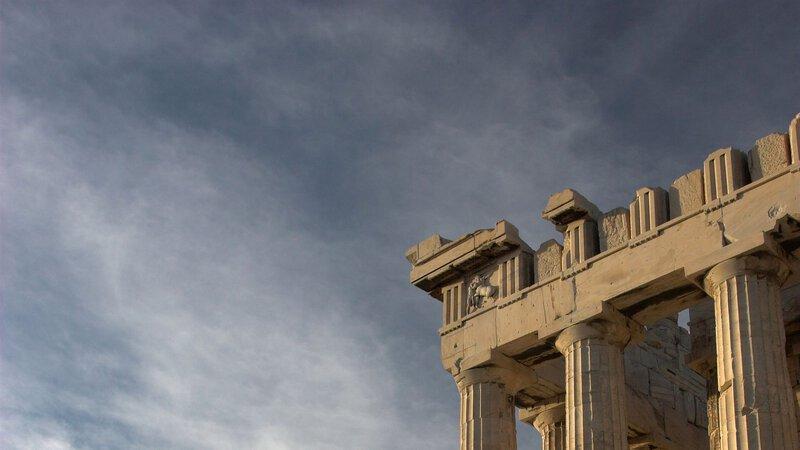

On the evening of September 26, 1687, a Venetian mortar shell arced over the city of Athens, punched through the roof of the Parthenon, and detonated the Ottoman gunpowder stored inside. In roughly ninety seconds, an explosion that lit up the harbor sky undid two thousand years of survival — and created the ruin that millions of tourists photograph today, most of them assuming that time and neglect had done the work.
Born in Triumph: Athens in the Fifth Century BC

The story begins not with destruction but with an almost impossible ambition. After the Greek city-states repelled the Persian invasions — conflicts that had brought enemy soldiers to the foot of the Acropolis itself, and that had left the earlier sanctuary on that hill in ashes — Athens decided to build something that would declare, in marble, that it had survived and prevailed. The result was the Parthenon, raised on the high rock of the Acropolis between approximately 447 and 432 BC under the leadership of the statesman Pericles, at the height of Athenian imperial power and cultural confidence.
The architects Iktinos and Kallikrates worked under the supervision of the sculptor Pheidias, and together they produced a building so obsessively refined that it borders on the irrational. The columns lean slightly inward toward a common point high above the roof. The platform on which the temple stands curves gently upward toward its center rather than lying flat. The columns themselves swell subtly at their midpoints — a technique called entasis — to prevent them from appearing hollow or concave to the human eye. None of these corrections announce themselves to a casual visitor. They exist purely to make the building feel geometrically perfect, a manipulation of stone so subtle that architects and engineers did not fully document and decode it until the nineteenth century.
Inside the temple stood what may have been the most spectacular object in the ancient world: Pheidias’s colossal statue of Athena Parthenos — Athena the Virgin, the goddess to whom the building was dedicated. Standing nearly twelve meters tall, she was sheathed in ivory and gold, her helmet crested, her shield resting against a carved serpent, her presence filling the dim interior with reflected light. The marble quarried for the building came from Mount Pentelicus, visible from the Acropolis on a clear day. The sculpted friezes running around the exterior depicted gods, giants, mythological battles, and — in a remarkable, even provocative gesture for the time — the people of Athens themselves, processing in honor of their goddess. This was a city writing its own mythology in stone, at the precise moment of its greatest power.
Two Thousand Years of Quiet Reinvention

Here is the part of the Parthenon’s history that most people never hear: for most of its existence, it was not a ruin at all. It was a functioning building that simply changed its god.
The Romans came, conquered, and largely admired what they found, with at least one emperor — Nero — reportedly having a portrait of himself placed inside. Then, sometime in the late fifth or early sixth century AD, the Parthenon was converted into a Christian church dedicated — with a certain continuity — to the Virgin Mary. The interior was altered to suit Christian liturgy: an apse was added to the east end, the great doorway was relocated, and the colossal statue of Athena was removed. At some point lost to history, the statue disappeared entirely, likely broken up or melted down. But the physical shell of the building — its columns, its roof, its sculpted metopes and friezes — remained almost entirely intact. Worshippers entered through the west end. Prayers rose where sacrifices had once been offered.
When the Ottoman Empire took Athens in 1458, the Parthenon changed hands again. A minaret was added to one corner, and the building became a mosque. The acoustics that had once carried Greek hymns now carried the call to prayer. And still the columns stood. Still the carved horsemen of the Panathenaic frieze rode in perpetual procession around the exterior walls. For a visitor standing on the Acropolis in 1680 — just seven years before the catastrophe — they would have seen something that looked, structurally, remarkably close to what Pericles had commissioned. Battered by centuries of weather, repurposed, and redecorated, but fundamentally whole.
This is the central irony that the monument’s ruined state conceals: what we experience as ancient wreckage was, for nearly all of recorded history, a building in use. The Parthenon outlasted empires, religions, and centuries of conquest with its structure essentially intact. It took a single evening to change that.
The Explosion of 1687: How the Ruin Was Made

The Venetian general Francesco Morosini was besieging the Ottoman-held Acropolis in the autumn of 1687, part of a broader conflict between Venice and the Ottoman Empire known as the Great Turkish War. The Ottomans, recognizing that their enemy might hesitate to bombard a monument of such antiquity and fame, had moved their gunpowder magazine inside the Parthenon. It was a logical calculation. It proved catastrophically wrong.
A mortar round — accounts differ on whether it was aimed deliberately at the building or struck by chance — ignited the powder store. The explosion was catastrophic. The entire central structure of the building was destroyed. The roof was blown skyward. Interior walls collapsed. Columns were hurled outward. Several hundred soldiers and civilians sheltering inside were killed. The flash was visible from the harbor. The smell of sulfur drifted across the Acropolis long after the stones had stopped falling.
The explosion of 1687 transformed a building into a ruin in a matter of seconds — a span of destruction so brief it seems almost impossible set against the centuries of survival that preceded it. And Morosini, celebrated in Venice as a hero, proceeded to make things worse. Attempting to lower the sculpted horses from the western pediment as war trophies, his workers dropped them, and they shattered on the Acropolis stones below. In a single campaign, one military commander inflicted more damage on the Parthenon than the previous two thousand years combined.
Elgin’s Crates: The Sculptures Leave Athens

The explosion left the building broken but still rich with sculpture. What happened next is the subject of a controversy that has never been resolved and shows no sign of resolution soon.
Thomas Bruce, the 7th Earl of Elgin, arrived in Athens in the early 1800s serving as British Ambassador to the Ottoman Empire. He obtained a permit — known as a firman — from Ottoman authorities, the precise terms and legal legitimacy of which have been disputed ever since, and set his agents to work on the Acropolis. Between 1801 and 1812, they removed roughly half of the surviving Panathenaic frieze, several sculpted metope panels, one of the caryatid figures from the neighboring Erechtheion, and various other pieces. The operation was neither delicate nor brief. Sections of frieze were sawed from the walls. Some of the ships carrying sculptures to England sank in transit; others arrived and were eventually sold by Elgin — who had spent a substantial personal fortune on the enterprise — to the British government in 1816.
They have been in the British Museum ever since, displayed under the name the Elgin Marbles — a label Greece formally refuses to use. The Greek government insists on calling them the Parthenon Sculptures, and the distinction is not merely semantic. The Panathenaic frieze was designed as a continuous narrative, a single story running around all four sides of the building. Half of that story is now in London. The other half is in Athens. Neither half makes complete sense without the other, and the severing of the two is, depending on your point of view, either a preservation of world heritage or an act of cultural amputation that has lasted more than two centuries.
What the Ruins Actually Tell Us

Even shattered, the Parthenon astonishes. The mathematical precision of its construction is visible in every surviving element — the gentle curve of the stylobate on which it stands, the barely perceptible lean of the columns, the way the entire building seems to breathe with a controlled intention that purely functional architecture never achieves.
There is also one persistent misconception worth correcting about how people picture the building even in its prime. The image of a gleaming white marble temple is largely a later invention. The Parthenon was originally painted. Vivid reds, deep blues, and gilded details once covered the sculptural decoration, making the friezes and pediment figures far more legible from a distance than bare marble would allow. The colors stripped away over centuries of weather and — in the case of the removed sculptures — handling and cleaning, leaving the bare stone that became, to later European eyes, the defining image of classical restraint and noble simplicity. What the ancient Athenians actually saw was considerably more vivid — perhaps, to modern taste, even startling. The serene whiteness that shaped so much subsequent Western architecture and aesthetics was never quite what the building looked like when it was new.
The Greek government’s Acropolis Restoration Project, underway since the 1970s and continuing today, has been painstakingly re-erecting fallen columns, anastylosing displaced drums back into position, and sourcing new Pentelic marble from the same mountain quarried two and a half millennia ago. The project uses titanium clamps rather than the iron ones employed in a previous restoration effort — iron corrodes, expands, and cracks marble over time, a lesson learned from earlier well-intentioned interventions. The work is slow, expensive, and deliberately conservative. It is also, in its way, a statement: that the building still matters enough to save at any cost.
The Longest Argument in Architecture

Greece has formally and repeatedly requested the return of the Parthenon Sculptures from the British Museum, with the debate sharpening in the lead-up to the 2004 Athens Olympics and continuing with renewed intensity through the 2020s. The British Museum’s position — that it serves as a universal institution holding world heritage in trust for all of humanity — runs directly against Greece’s counter-argument: that the sculptures were removed under conditions of colonial-era coercion, that they were designed as part of a specific building on a specific hill, and that they belong to the monument that gave them their meaning.
Athens opened the Acropolis Museum in 2009, built directly below the Parthenon on the southern slope of the Acropolis hill, specifically to address the British Museum’s long-standing objection that Greece lacked adequate facilities to house and display the works. Its top floor is a glass-walled gallery housing the surviving Parthenon sculptures, with the ceiling oriented so that visitors standing among the friezes look directly up through glass at the Acropolis above them. The spaces where the missing sections should be are filled with white plaster casts. The museum is, among other things, an architectural argument — a demonstration that the infrastructure exists, the expertise exists, the context exists, and only the sculptures themselves do not.
A building that began as a monument to Athenian democracy, served for centuries as a Christian church, became an Ottoman mosque, was used as a munitions depot, and was blown open by a Venetian mortar round is now the center of the world’s most charged debate about who owns the past. The Parthenon has never stopped being contested, never stopped being used, never stopped meaning something urgent to whoever stood before it. Whatever it was built to do — to awe, to endure, to make a city’s power legible from the sea — it has never, across twenty-five centuries, stopped doing it.

 English
 Arabic
 French
 Spanish
 Portuguese
 Deutsch
 Turkish
 Dutch
Dutch
 Italiano
 Russian
 Romaian
 Portuguese (Brazil)