


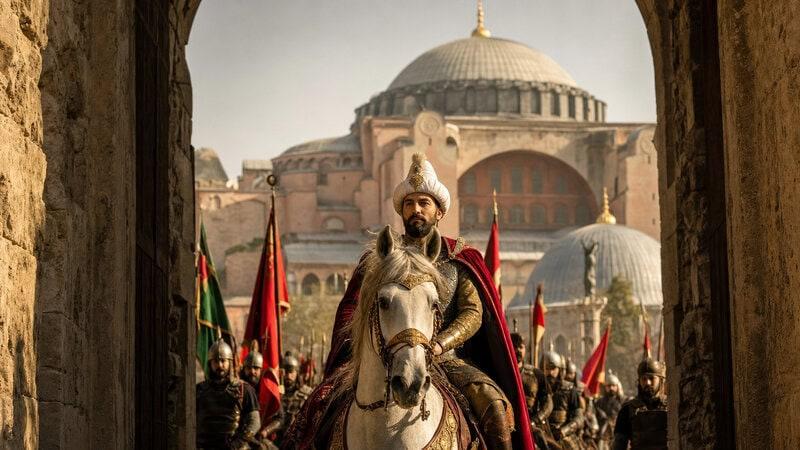

On a May morning in 1453, a twenty-one-year-old sultan rode through the shattered walls of Constantinople and dismounted before the great church of Hagia Sophia. He was, depending on who you asked, a Turkish conqueror, an Islamic ghazi warrior, or the rightful heir to Rome. In his library he kept works in Greek, Latin, Arabic, Persian, and Turkish. He later commissioned his portrait from a Venetian painter and filled his court with Greek scholars, Jewish physicians, and Slavic generals. His name was Mehmed II, and he was simultaneously the product of a Turkic dynasty and something far harder to label.
The question of whether the Ottoman Empire was truly “Turkish” seems simple on its surface. Europeans certainly thought so. For centuries, Venetian merchants, Habsburg generals, and English diplomats referred to the empire collectively as “the Turk” — a shorthand born of fear and geography, not careful study. Even today, reference works list alternative names such as the Turkish Empire. Yet the rulers of that empire, across six centuries, almost never called themselves Turkish. Their official name for their own state was Devlet-i Aliyye — the Sublime State. The gap between those two labels is where one of history’s most fascinating arguments lives.
The Seed: A Small Tribe on the Edge of the World

The Ottoman Empire did not begin as an empire at all. It began as one of dozens of small Turkic principalities scrambling for territory in northwestern Anatolia after the Mongol invasions shattered the Seljuk Sultanate and left a power vacuum across the region. The man who gave the empire its name — known to Italian merchants as Ottomano, which eventually became the English “Ottoman” — was Osman Gazi, who reigned from roughly 1299 to 1324. He was a Turkish tribal leader, and the world he built around him was unmistakably Turkic: the language, the warrior culture, and the founding dynasty all carried that heritage.
This is the kernel of truth inside the “Turkish Empire” label, and it deserves to be taken seriously. According to Britannica, the Ottoman Empire was created by Turkish tribes in Anatolia and grew into one of the most powerful states in the world. The origins are not in dispute. But here is the pivotal distinction that so much modern commentary glosses over: being founded by Turks is not the same as being a Turkish nation-state. The very concept of an ethnically defined nation-state would not exist as a serious political idea for another five centuries. Osman was building a dynasty and a domain, not a nationality.
How Conquest Scrambled the Empire’s Character

What happened next was one of the most dramatic expansions in recorded history. From that provincial principality in Anatolia, the Ottoman Empire eventually stretched across Southeastern Europe, West Asia, and North Africa, absorbing Bulgarians, Greeks, Serbs, Arabs, Armenians, Jews, Kurds, and Albanians into a single administrative structure. The fall of Constantinople in 1453 was not merely a military triumph; it was the moment a small Turkic principality fully matured into a cosmopolitan imperial power, one that now claimed Roman, Islamic, and Turkic legitimacy simultaneously.
The ethnic mixing was not simply a byproduct of conquest — it was turbocharged by deliberate policy. The devshirme system, one of the empire’s most distinctive institutions, involved the conscription of Christian boys from the Balkans, who were brought to Istanbul, educated, converted to Islam, and trained for elite service. These men rose to become grand viziers, admirals, and military commanders. A striking proportion of grand viziers — the empire’s chief ministers, second in authority only to the sultan — were not ethnically Turkish at all, but of Greek, Albanian, or Slavic origin. The ruling class defied any simple ethnic label almost from the beginning.
Consider what that means in practice. The man running the day-to-day affairs of an empire that Europeans called “Turkish” might have been born in a Greek village, raised in an Albanian household, or brought to the capital from the hills of Bosnia. His loyalty was to the sultan and to Islam, not to any ethnic community. That was the Ottoman system, and for long stretches of its history, it worked with formidable effectiveness.
How the State Actually Categorized Its Subjects

If the empire was not organized around Turkish ethnicity, how did it sort its millions of subjects? The answer is the millet system — one of the most consequential administrative frameworks of the pre-modern world. The Ottomans organized their diverse population not by ethnicity but by religious community, granting Greek Orthodox Christians, Armenian Christians, Jews, and others substantial legal and cultural autonomy over their own internal affairs. Your millet determined which courts you appeared before, what personal law governed your marriage and inheritance, and who your community leaders were.
Notice what is absent from that system: any formal category of “Turkish” ethnic citizenship. Identity in the Ottoman world was structured around faith, regional origin, and loyalty to the sultan — not blood lineage. This is a genuinely different framework from anything a modern person schooled in nation-state thinking might instinctively reach for.
The irony runs deeper still. Within the empire itself, the word Türk was sometimes used dismissively — as a label for uneducated Anatolian peasants, rough frontier people far from the sophistication of the imperial capital. The cosmopolitan Ottoman elite, steeped in Persian literary culture and Arabic religious learning, often carefully distinguished themselves from plain “Turks.” Calling the entire empire a “Turkish Empire” would have puzzled, or even offended, many of the people actually running it.
This is the heart of the Ottoman Empire versus Turkish Empire debate. Imposing the label “Turkish Empire” means applying a modern nation-state logic — ethnicity as the fundamental category of political organization — onto a pre-nationalist imperial structure that operated on entirely different principles. It is an anachronism roughly as misleading as calling the Roman Empire an “Italian Empire.”
What Actually Held Six Centuries Together

If not Turkish ethnicity, what bound this enormous, diverse, perpetually threatened empire together for six hundred years? Three things, primarily: Sunni Islam, the Ottoman dynastic brand, and a Persian-inflected court culture that served as the common idiom of educated imperial life.
Consider the language question alone. Ottoman Turkish — the administrative language of the empire — was so heavily saturated with Arabic and Persian vocabulary, grammar, and literary convention that it was barely intelligible to Anatolian villagers who spoke colloquial Turkish in their daily lives. It was a constructed prestige language, a badge of belonging to the imperial world, not a folk tongue. Even the language called “Turkish” in the Ottoman context was itself a multicultural hybrid.
Sultans were acutely aware of the legitimacy game they were playing. They claimed the title of Caliph, positioning themselves as leaders of the global Sunni Muslim community. They styled themselves as heirs to the Roman emperors by virtue of their possession of Constantinople. They recruited talent — poets, architects, scholars, soldiers — from every corner of the empire regardless of ethnic background. This deliberate construction of a multi-source imperial identity was a conscious political strategy, not a happy accident, and it was precisely what gave the empire its extraordinary longevity and its capacity to absorb shocks that destroyed lesser states.
Why the “Turkish” Label Stuck — and Why It Matters

How did the “Turkish” label become so dominant in Western consciousness? The European perspective is understandable, if imprecise. To Venetian traders negotiating in Adriatic ports, Habsburg officers defending Vienna, or English diplomats reading dispatches from the East, the empire’s power radiated outward from Anatolia and its ruling house spoke Turkish. “The Turk” became shorthand for the Ottoman threat — a label rooted in fear, geography, and the limited information available to outsiders.
The label then hardened at a very specific historical moment. When the Republic of Turkey emerged from the ruins of the empire in 1923 under Mustafa Kemal Atatürk, the new nation-state deliberately constructed a national identity that claimed Ottoman history as Turkish history. The retrospective identification of the empire as essentially Turkish served the political needs of a young republic building national consciousness. That framing proved durable, shaping how the empire was taught and remembered across much of the twentieth century.
The historiographical stakes are real. Calling it simply a “Turkish Empire” risks erasing the Arab, Greek, Armenian, Balkan, and Kurdish contributions to one of history’s great civilizations. It can subtly distort understanding of the conflicts that still shape the modern Middle East and the Balkans — conflicts whose roots lie in Ottoman-era arrangements that were never organized along Turkish ethnic lines. When those arrangements collapsed in the nineteenth and early twentieth centuries, the resulting nationalist violence was in part a reaction against an imperial system that had never thought in nationalist terms at all.
None of this is to deny what is legitimately Turkish about the empire. The founding dynasty, the dominant administrative language, and the Anatolian heartland are all real and important. But these are ingredients in a vastly more complex recipe — not the whole dish.
A Multiethnic Legacy That Still Shapes the World

Today, the Ottoman Empire’s footprint touches more than forty modern nations. Every one of them is a living reminder that Ottoman history is not Turkish history alone but shared history across an enormous swath of humanity — from the former Yugoslav states and Greece in the west, to Egypt and the Arabian Peninsula in the south, to Iraq and the Caucasus in the east.
Return, finally, to Mehmed II standing in Hagia Sophia in 1453. His library held works in Greek, Latin, Arabic, Persian, and Turkish. He was the product of a Turkic dynasty and a Persianized court culture, a Muslim ruler who employed Christian artists and Jewish advisors, a conqueror who saw himself as heir to both the Roman emperors and the Islamic caliphs. He was, in a word, Ottoman — a category that was never reducible to any single ethnicity.
The Ottoman Empire was created by Turkish tribes, shaped by Islamic civilization, administered in a Persianized court language, and built by the labor, genius, and suffering of dozens of peoples across three continents. Calling it “Turkish” is not wrong so much as it is dramatically, fascinatingly incomplete. More than anything else, it was one of history’s most ambitious experiments in governing human diversity — an experiment whose architecture, tensions, and unresolved questions still echo, urgently and unmistakably, in the world we inhabit today.

 English
 Arabic
 French
 Spanish
 Portuguese
 Deutsch
 Turkish
 Dutch
Dutch
 Italiano
 Romaian
 Portuguese (Brazil)
 Greek
Greek