


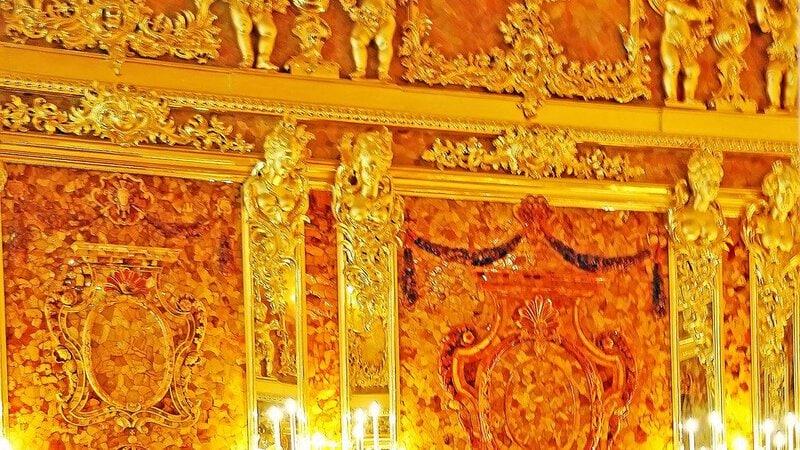

On January 12, 1945, a German museum director moved through the candlelit halls of Königsberg Castle with the careful, mournful attention of a man saying goodbye. Around him glowed honey-gold Baltic amber — carved, fitted, and polished into wall panels, mosaics, and gilded mirrors that made the air itself seem to burn amber. He became, in that moment, the last credible eyewitness in recorded history to set eyes on what contemporaries called the Eighth Wonder of the World. What happened next is one of the most consequential unsolved mysteries of the twentieth century.
Building a Wonder: The Room That Took Twelve Years to Create

The story of the Amber Room begins not in Russia but in the workshops of early eighteenth-century Prussia, where German craftsmen spent more than a decade attempting something that had never been done before and has never been fully replicated since. On the orders of King Frederick I of Prussia, they carved and fitted enormous quantities of Baltic amber — that strange, fossilized tree resin dredged from the shores of the Baltic Sea — into elaborate baroque wall panels intended to clad an entire royal chamber. Amber is not stone. It splinters, it warps with changes in temperature and humidity, and it demands a jeweler’s patience applied at architectural scale. That the craftsmen succeeded at all is a testament to a tradition of specialized skill that has since been largely lost.
In 1716, the panels crossed a border and changed a history. Prussia gifted the Amber Room to Tsar Peter the Great, cementing a political alliance between two powers competing for dominance in northern Europe. The gift was diplomatic genius — you do not forget the country that gave you a wonder. Decades later, Catherine the Great commissioned a major expansion of the installation at the Catherine Palace in Tsarskoye Selo, outside St. Petersburg. Italian and Russian craftsmen enlarged and elaborated what the Prussians had begun, until the room covered roughly 55 square meters. Its walls interlocked amber mosaics in dozens of shades ranging from pale champagne to deep cognac, accented with gold-leaf detail, gemstone inlays, and mirrored pilasters that multiplied the amber’s glow until visitors reportedly fell silent upon crossing the threshold.
To understand why the room’s disappearance matters so deeply, you have to understand what it meant. It was a trophy of diplomacy, a pinnacle of Enlightenment-era craft, and — by the nineteenth century — one of the defining symbols of Imperial Russian cultural identity. Empires are partly built on symbols, and this was one of Russia’s most potent: proof that civilization, artistry, and power had converged on the banks of the Neva. Smithsonian Magazine’s history of the Amber Room traces how the chamber became inseparable from Russian national pride over the centuries — which made what happened in 1941 not merely a theft but a calculated humiliation.
The Nazi Theft: How Soldiers Stripped a Wonder in 36 Hours

When German forces swept into the Soviet Union during Operation Barbarossa in the summer of 1941, Soviet curators at Tsarskoye Selo faced an agonizing problem. They knew the palace would be in the path of the advance. They attempted to dismantle the Amber Room for evacuation and discovered that after more than two centuries fixed in place, the amber had grown too brittle to move safely. Panels that had been stable for generations began to crumble at the touch. Facing an impossible choice between damaging the treasure themselves or leaving it for the Germans, the curators made a fateful decision: they covered the panels with wallpaper and paper backing, hoping to disguise the room as an ordinary chamber.
It fooled no one. When Wehrmacht forces arrived in September 1941, art-looting specialists from Einsatzstab Reichsleiter Rosenberg — the dedicated Nazi unit tasked with stripping occupied Europe of its cultural wealth — identified the concealed panels within hours. What Soviet curators had spent weeks agonizing over, the Germans dismantled in roughly 36 hours. All 27 crates of panels were loaded onto trucks and shipped west to Königsberg. It was one of the most brazen single acts of cultural plunder in the entire history of World War II’s systematic looting campaign.
In a grim coda, the Amber Room was reassembled and put on public display in Königsberg Castle — a stolen wonder repurposed as Nazi trophy art, exhibited to visitors for two years as though its provenance were entirely unremarkable. A treasure that had symbolized peaceful diplomacy between nations had been transformed into a statement of conquest.
The Vanishing: Königsberg, 1945, and a Trail That Goes Cold

By late 1944, the war had turned catastrophically against Germany. Königsberg — the ancient Prussian city on the Baltic — was in the crosshairs of both Allied bombers and the advancing Soviet army. British bombing raids had already badly damaged the castle. The city was collapsing into chaos and fire. It was in this atmosphere of desperate improvisation that German officials made the decision to pack the Amber Room once more and move it to safety — and it was here, in January 1945, that the documented chain of custody simply ends.
The museum director’s inspection on January 12 is the last credible firsthand record of the intact panels. After that date, no verified eyewitness ever reported seeing the Amber Room again. The crates were packed. And then — nothing. The fog of the Reich’s final months swallowed them entirely. Königsberg was engulfed in catastrophic fighting through the spring of 1945. The castle suffered devastating damage, and when Soviet forces finally took the ruined city — renaming it Kaliningrad — they found amber fragments in the rubble but no panels, no intact crates, no treasure.
The question that has driven historians, governments, and treasure hunters for nearly eight decades is deceptively simple: did the Amber Room burn in Königsberg, or did someone move it before the city fell? The historical record on the Amber Room offers tantalizing fragments but no definitive answer — which is precisely what makes this one of history’s most enduring unsolved mysteries.
The Theories: Destroyed, Hidden, or Still Waiting to Be Found?

There are serious researchers who believe the destruction theory is simply correct — that the amber panels burned in the fires that gutted Königsberg Castle in 1945, and that what was lost is gone forever. The evidence they cite is substantial: amber has a relatively low ignition point, the fires that swept the castle were intense and prolonged, and investigators working the ruins afterward found small amber fragments consistent with destroyed panels. On this reading, the search for the Amber Room is a search for something that no longer exists in any recoverable form.
But a discovery in 1997 gave treasure hunters renewed grounds for hope. German investigators recovered a single amber mosaic panel and a Florentine stone inlay that were definitively identified as original components of the Amber Room. The pieces had been in the possession of the heirs of a German soldier who had apparently taken them as personal souvenirs during or after the evacuation from Königsberg. The implication is significant: if individual fragments made it out of the city in soldiers’ personal effects, the argument that the main crates necessarily burned becomes harder to sustain. Heritage Daily’s investigation into the missing Amber Room examines how that recovery reinvigorated the case that more panels survived the war and remain hidden somewhere.
The most persistent alternative to the destruction theory is the underground bunker hypothesis. Over the decades, intelligence reports, deathbed confessions from former German officials, and declassified Soviet and German documents have repeatedly pointed to sealed Nazi storage bunkers — beneath the Baltic coast, somewhere in former East Prussia, or within the network of German salt mines that concealed other looted artworks later recovered by Allied forces. Those salt mine recoveries are not theoretical: enormous caches of Nazi-looted treasure were found in exactly such locations after the war ended, lending credibility to the idea that similar caches may remain sealed and undiscovered.
Fringe theories have accumulated over the decades — a Baltic shipwreck, a secret transfer to South America during the Reich’s dying days, even a Soviet cover-up of a wartime recovery. Serious researchers tend to focus on the bunker and destruction scenarios, but as this examination of the Amber Room mystery notes, no single theory has been conclusively proved or disproved. The case remains officially open.
The Search: Eight Decades of Digging and One Remarkable Replica

The search for the Amber Room has been one of the longest sustained treasure hunts in modern history. Soviet investigators combed the ruins of Königsberg for decades after the war. Post-Cold War German and Russian joint commissions reviewed thousands of documents and interviewed aging witnesses. Amateur treasure hunters have excavated fields, drained ponds, and mapped tunnel networks across the former Eastern Front, following rumor, deathbed testimony, and newly declassified files. The Amber Room has not been found.
What Russia and Germany eventually chose to do, in parallel with the ongoing search, was to rebuild. Over 25 years, craftsmen working from historical photographs, surviving design records, and the small cache of identified original fragments painstakingly recreated the Amber Room at a cost of approximately $11 million, with funding provided jointly by the Russian government and the German company Ruhrgas. The reconstruction was completed in 2003 and unveiled in time for the 300th anniversary of the founding of St. Petersburg. It is, by all accounts, a stunning achievement — a room that reportedly silences visitors, just as the original once did.
But it is a replica. It sits in the Catherine Palace where the original once stood, admired by millions of tourists each year, and it is a meticulous ghost of something irreplaceable. Those who have followed the investigation closely note the bittersweet symbolism: the reconstruction’s very existence underscores how completely the original has vanished, even as it keeps the memory of the thing alive for new generations.
Why the Amber Room Still Matters: Identity, Loss, and the Weaponization of Culture

The Amber Room’s disappearance is not simply an art mystery. It is a case study in the deliberate use of cultural theft as an instrument of conquest. The Nazi regime looted an estimated hundreds of billions of dollars’ worth of art and artifacts across occupied Europe — an industrial-scale erasure of cultural identity designed to impoverish conquered peoples not just materially but spiritually and historically. Stealing the Amber Room from Russia was not incidental to the occupation; it was part of the occupation’s logic. You do not just take a country’s territory. You take its symbols, its stories, its proof that it once made something beautiful and lasting.
If the destruction theory is correct, what was lost is not merely an object but something genuinely irreproducible: a unique fusion of rare natural material and human genius that took more than a decade to build and 36 hours to steal, and that no amount of modern money or technological precision can authentically recreate. The craftsmen who carved those panels worked within a tradition of amber artistry at architectural scale that no longer exists. The amber itself came from specific Baltic deposits worked in specific ways during a specific era. The replica is magnificent. It is not the same thing.
Researchers in Kaliningrad continue to conduct ground-penetrating radar surveys of suspected bunker sites beneath the former East Prussian landscape. Archival discoveries still occasionally surface documents that reframe the existing evidence. And as long as no wreckage has been conclusively identified — no definitive forensic proof that every panel burned beyond any possibility of recovery — the question of where the Amber Room is now remains, technically and tantalizingly, unanswered. Somewhere, perhaps in a sealed vault beneath Baltic soil, perhaps in nothing but ash and the long memory of those who knew what was taken, the Eighth Wonder of the World is still waiting to be accounted for.

 English
 Arabic
 French
 Spanish
 Portuguese
 Deutsch
 Dutch
Dutch
 Italiano
 Russian
 Romaian
 Portuguese (Brazil)
 Greek
Greek