


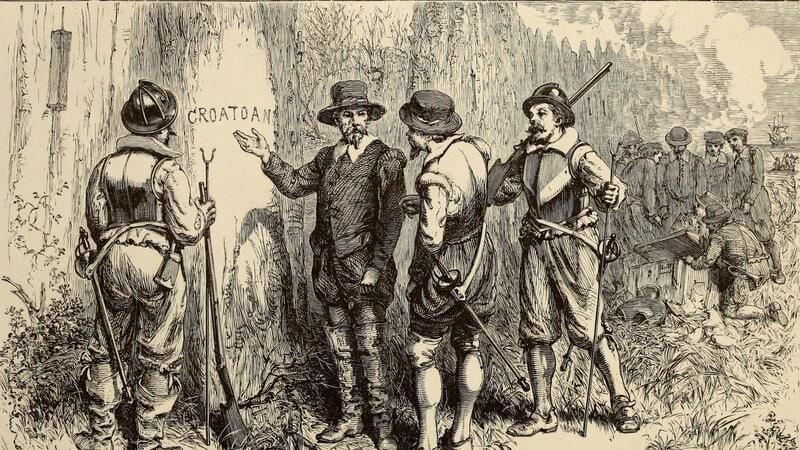

In August 1590, an English governor named John White stepped ashore on Roanoke Island expecting to hear his granddaughter laugh. Instead, he found silence, overgrown paths, rotting chests, and his own armor rusting in the weeds — and then, carved into a post in clean, deliberate capital letters, a single word that would haunt the English-speaking world for the next four centuries: CROATOAN.
The Man Who Came Back to Nothing

White had last seen Roanoke Island in 1587. He had sailed back to England to fetch desperately needed supplies, leaving behind 117 colonists — including his daughter Eleanor, her husband Ananias Dare, and his newborn granddaughter Virginia Dare, the first English child born in the Americas to parents who were themselves English settlers. He had promised to return quickly. He did not. The crisis of the Spanish Armada consumed England’s available ships, and three years of bureaucratic delay, naval emergency, and Atlantic misfortune kept him from the people he loved.
When he finally made it back to the Outer Banks, the settlement was abandoned. The palisade of logs still stood. Some of his own possessions — maps, books, armor — lay scattered and ruined in the undergrowth, as if someone had rifled through them carelessly, or perhaps set them aside deliberately. But the colonists themselves were gone, every single one of them, without any sign of battle or massacre, without blood or broken weapons. What remained was the carving: CROATOAN, cut deep into a post at the fort’s entrance. Nearby, on a tree, the letters CRO — as if someone had started the same message and ran short of time, or timber.
White recognized the word immediately. He had agreed on this signal before he left. The question that has driven historians and archaeologists to distraction ever since is not really what the word meant — White knew. The question is why, for roughly 400 years, almost nobody truly followed where it pointed.
How Colonists Ended Up Alone on the Edge of the World

The Roanoke Colony that White led in 1587 was already a gamble built on a failed foundation. A first English expedition to Roanoke Island in 1585-86 had collapsed under starvation, poor planning, and a serious deterioration of relations with the Algonquian-speaking peoples of the region — a deterioration caused largely by English violence and suspicion. When those first settlers gave up and sailed home with Francis Drake, they left behind a settlement that had achieved almost nothing except poisoning the diplomatic soil for whoever came next.
White’s group was supposed to do things differently. This was not a soldier-heavy expedition. It was a civilian settlement — families, women, children — who had crossed the Atlantic to build an English life in the Americas. They were also supposed to push north to the Chesapeake Bay, which offered better farmland and a more defensible position. Instead, for reasons that remain disputed, their fleet’s captain deposited them at Roanoke Island — the old failed site — and refused to take them further. Their late-season arrival left them scrambling to prepare for winter on an island that earlier English activity had already damaged, among Indigenous peoples who had every reason to distrust English intentions.
Virginia Dare was born there in August 1587, just weeks after the colonists arrived. Her birth was celebrated as a symbol of hope, a sign that this colony would take root where the last one had withered. It makes White’s long absence — and the colony’s eventual fate — feel all the more devastating, and it is part of why the story transformed so quickly from a colonial misadventure into something closer to American mythology.
CROATOAN: The Clue Everyone Dismissed

Croatoan was not a mysterious word. It was a real place — an island roughly 50 miles south of Roanoke, in what is now Hatteras Island, North Carolina — and it was the name of a real people, an Algonquian-speaking group with whom the English had established something genuinely rare in this period: a relatively friendly relationship. That relationship was built largely through a man named Manteo, a Croatoan who had traveled to England and back, who served as interpreter and intermediary, and who represented the most effective bridge between the two communities. The colonists had reason to trust the Croatoan people. They had reason to believe they would be received.
Before White left in 1587, the colonists had agreed on a clear signaling plan for exactly this kind of scenario. If they moved, they would carve their destination. If they left under violent duress, they would add a Maltese cross above the name. White found no cross. The departure, whatever it looked like in practice, had not been panicked. It had been organized enough for someone to take a blade and cut a calm, deliberate forwarding address into a wooden post.
And yet White never reached Croatoan Island to investigate. A storm drove his ship away from the coast before he could land, and the combination of worsening weather, a damaged vessel, and the resistance of his crew ended the search before it began. He returned to England. No serious English search expedition ever went back. The clue was read, logged, and then — astonishingly — largely set aside, while the mystery of the lost colony of Roanoke grew into something far larger and stranger than a single carved word warranted.
400 Years of Wrong Answers

Nature abhors a vacuum, and so does history. With no follow-up investigation, the Roanoke mystery filled rapidly with competing theories, each carrying a grain of plausibility and a fatal absence of proof. Spanish forces moving north from Florida might have wiped the colony out — plausible, but unsupported by surviving Spanish records. The Powhatan Confederacy might have killed the colonists — a claim later attributed to Chief Powhatan in reports from John Smith’s era, though historians debate whether Powhatan was describing a real event or performing political authority. The colonists might have attempted to sail home on a small pinnace and drowned in the Atlantic. They might have starved inland. Each theory offered a tidy catastrophe where the evidence offered only ambiguity.
As the decades stretched into centuries, the story calcified into folklore. Tales circulated of grey-eyed Indigenous children, of unusual cultural practices among coastal peoples, and of a mysterious white doe associated with Virginia Dare that became the centerpiece of 19th-century romantic poetry. The colony’s fate became a ghost story — atmospheric, unresolved, and increasingly untethered from the physical evidence left behind at the site.
The lowest point came in the 1930s, when a series of stones — the so-called Dare Stones — surfaced across the Southeast, purportedly inscribed by Eleanor White Dare and describing the colony’s fate in dramatic detail. Historians and journalists briefly embraced them before investigators concluded they were almost certainly a modern hoax. The episode revealed something telling: people wanted a dramatic answer so badly that they were willing to accept convenient inscribed rocks rather than sit with the uncomfortable simplicity of a word already carved on a post.
Every sensational theory shared the same fundamental flaw. Each one required ignoring the carving, the prior agreement with White, and the living, established community already on Croatoan Island — a community the colonists already knew and had concrete reason to approach.
The Evidence Beneath Hatteras Island

While popular culture was busy manufacturing ghost stories, archaeologists were doing something quieter and more productive: digging. Excavations on Hatteras Island — the site of ancient Croatoan — by researchers including those associated with the Croatoan Archaeological Society have methodically built a circumstantial case for assimilation rather than annihilation. It is not dramatic. It does not offer a single smoking-gun revelation. But the cumulative weight of what has been recovered from Croatoan village sites is difficult to dismiss.
Among the most significant finds are iron fragments — pieces of worked iron recovered at Indigenous Croatoan sites consistent with 16th-century English metalworking. These are not straightforward trade goods passed hand to hand across a boundary. The evidence suggests manufacturing activity: English-style iron-working occurring within the Croatoan community, which implies English people present and actively working, not merely trading at arm’s length. Alongside the iron, excavators have recovered copper-alloy pins of a distinctly English type, a signet ring, and fragments of early English craftsmanship buried in Croatoan village layers — objects that do not appear in purely Indigenous contexts of the same era elsewhere in the region.
None of this proves what happened to any individual colonist. It does not tell us whether Eleanor Dare survived the first winter, or whether Virginia Dare grew up speaking Algonquian, or whether anyone ever looked east toward the Atlantic and thought of the England they had left behind. But collectively, the finds suggest English people were living and working on Croatoan Island — exactly where the carving said they would be, and exactly where John White never went.
What Assimilation Actually Looked Like

It is easy to romanticize assimilation or to frame it as a form of defeat. In practice, for colonists facing a Carolina winter with exhausted supplies and no rescue ship on the horizon, joining the Croatoan community was not surrender — it was survival logic. The Croatoan people had already demonstrated a clear willingness to engage with the English. They had sent Manteo abroad. They had maintained a working relationship through years of difficult contact. They were not an unknown quantity to the colonists, and the colonists were not entirely unknown to them.
The colonists also had something tangible to offer beyond additional mouths to feed. The iron-working evidence hints at a relationship that may have been genuinely reciprocal: English metalworking skills and access to European-style tools represented practical value that a community might actively want to incorporate rather than merely tolerate. Across the Americas, when European settlements failed and survivors sought refuge among Indigenous peoples, integration was not an uncommon outcome. It was survival logic playing out the same way on different shores.
What assimilation ultimately meant, though, was the gradual dissolution of the colonists’ English identity. Within a generation or two, their descendants would have spoken Algonquian, followed Croatoan customs, and understood themselves as members of a different community entirely. Their story would survive not in documents but in the archaeological record — and in the oral traditions of peoples including the Hatteras, who have long maintained claims of ancestry from this encounter, though those claims remain subjects of ongoing scholarly discussion.
Why the Answer Was Always There — and What That Tells Us
Return to the post. CROATOAN, carved in calm capital letters, with no cross above it. This was not a desperate final message scratched by dying hands. This was a pre-arranged notification, cut deliberately by people who knew exactly where they were going and trusted their governor to follow the trail they had left him. The tragedy of the lost colony of Roanoke is not that the colonists vanished without explanation. It is that they explained themselves clearly — and nobody came.
Why did it take so long to take the clue seriously? Part of the answer lies in what the alternative implied. Early English chroniclers wanted conquest narratives, stories of English power projecting itself decisively into new territory. The possibility that a group of English colonists had voluntarily joined an Indigenous community — had found safety, perhaps even welcome, among people the English had already harmed — did not fit the story England wanted to tell about itself in the Americas. Later generations wanted a ghost story, a romantic tragedy, an unsolved mystery that could carry the weight of national mythology. The mundane probability that the colonists walked roughly 50 miles south and made new lives was somehow less satisfying than the idea that they had simply, impossibly, ceased to exist.
The emerging archaeological picture of what happened to the Roanoke colonists is not a dramatic case closed. It is a quiet, accumulating body of evidence — the kind built through iron fragments and copper pins and careful excavation rather than through a single revelation. They went to Croatoan. They were received. They survived by becoming part of someone else’s world. The colony that history remembers as lost may have been findable all along, hidden inside a different community’s continuing story.
On Hatteras Island today, the wind off the Atlantic still moves through the same maritime forest the Croatoan people called home. Somewhere under that soil, mixed into the layers of a thriving Indigenous village, lie the scattered traces of colonists who left one word behind and trusted it to be enough. It was enough. The word always made sense. The mystery was never really in the carving — it was in the four centuries of determined refusal to believe it.

 English
 Arabic
 French
 Spanish
 Portuguese
 Deutsch
 Turkish
 Dutch
Dutch
 Italiano
 Russian
 Romaian
 Greek
Greek