


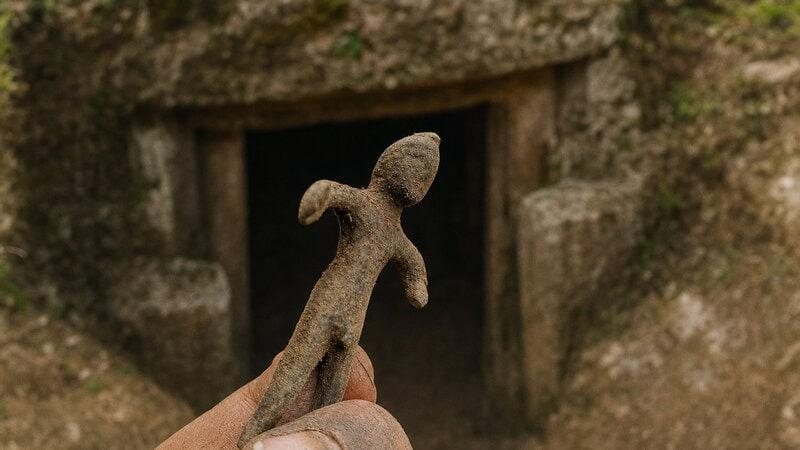

The brush moved slowly across the stone threshold — and then stopped. Beneath a hillside riddled with the ancient dead, at a site called San Giuliano roughly 70 kilometres northwest of Rome, archaeologists were staring at something the modern world had almost no right to expect: an Etruscan chamber tomb sealed so completely, for so long, that the air inside had not mingled with the living world in approximately 2,600 years.
The Door That Stayed Shut for 2,600 Years

Inside that sealed darkness, more than 100 objects waited in precisely the arrangement their placers had intended. A spearhead rested at an angle suggesting it had simply been leaned against a wall and left — except nothing in this room was left carelessly; everything was chosen. A Greek perfume flask, small enough to fit in one palm, sat where it had been placed during the 7th century BCE, having survived a sea crossing from the Greek world, a funeral, and then an unbroken silence that outlasted the Roman Empire, the Renaissance, and every war fought across the Italian peninsula in between. These objects were not buried and forgotten. They were buried and kept.
The tension in that distinction is what makes this discovery so rare it borders on the uncanny. The Etruscan world was not preserved — it was systematically dismantled. Across centuries, tombaroli (tomb robbers) hollowed out the necropolises of central Italy with the thoroughness of a long-running industry, feeding a global appetite for beautiful ancient things. A sealed Etruscan tomb is not merely uncommon. In the landscape of what survives, it is very nearly a ghost.
Who Were the Etruscans, and Why Does Their Silence Haunt Us?

Before Rome dominated the Italian peninsula, the Etruscans were there — a sophisticated, largely urban civilisation that flourished across modern Tuscany, Umbria, and northern Lazio from roughly the 8th century BCE onward. They were master metalworkers, accomplished maritime traders, and ritual specialists whose influence on early Rome was so profound that Roman priests borrowed Etruscan divination practices, Roman kings adopted Etruscan regalia, and Roman engineers drew on Etruscan techniques for constructing arches and drainage systems. They were not a peripheral people. They were, for several centuries, the most culturally complex society on the Italian peninsula.
And yet they remain, in a particular way, unknowable. No great Etruscan library survived. No monumental corpus of inscriptions exists to decode their history the way Egyptian hieroglyphs illuminate the pharaohs. Their language — written in an alphabet adapted from Greek — remains only partially understood, its grammar still resisting full translation. What survives, overwhelmingly, are their tombs. The burial chamber is not merely an important Etruscan source. It is almost the only source. Every looted tomb is not simply a stolen object; it is a destroyed sentence in the only substantial text we have.
The scale of what centuries of looting erased from the Etruscan archaeological record is genuinely staggering. The necropolises of central Italy — at Cerveteri, Tarquinia, Vulci, and dozens of lesser-known sites — were plundered so thoroughly and for so long that finding an unlooted Etruscan chamber tomb is the rough archaeological equivalent of discovering a sealed room in Pompeii: a freeze-frame of a world that otherwise exists only in fragments. When archaeologists encounter one, the response is not routine academic excitement. It is the shock of encountering something that was supposed to be impossible.
San Giuliano: A Necropolis Carved Into Living Rock

The San Giuliano necropolis sits near Viterbo in the Etruscan heartland of central Italy, in a landscape of soft volcanic tufa that the ancient inhabitants carved into with an ease that still astonishes visitors. The cliffs here are riddled with tomb openings — chamber after chamber cut directly into the rock, the interiors shaped and finished to resemble houses, because that is precisely what they were: permanent dwellings for the dead, furnished accordingly. The site is eerie and beautiful in equal measure, a place where the boundary between landscape and archive becomes impossible to locate.
It is also, by its nature, vulnerable. Remote terrain, porous access, and the sheer density of ancient cutting in the rock face made San Giuliano an easy target across the centuries. What was taken can only be estimated; what was lost scientifically can never be recovered. The chamber tomb format found here — carved into rock, deliberately sealed, architecturally distinct from simpler pit or shaft burials of earlier periods — represents a level of elaborate burial practice that speaks directly to social complexity and ritual investment. These were not hasty interments. They were statements.
Which makes what the landscape is now giving back all the more extraordinary — and the timing all the more striking. This sealed chamber tomb is the second intact Etruscan burial found at San Giuliano within approximately twelve months. A site that spent centuries being systematically emptied is suddenly, against every reasonable expectation, yielding the most complete picture of Etruscan burial practice that modern archaeology has encountered here.
Inside the Chamber: Reading 100 Objects Like a Sentence

Entering a sealed Etruscan tomb — even carefully, even with brushes and recording equipment and the full deliberate slowness of modern archaeological practice — is an experience that resists clinical description. The objects do not look stored. They look arranged. The more than 100 grave goods recovered from this chamber at San Giuliano were not simply deposited; they were positioned with an intentionality that archaeologists are still working to fully interpret.
The spearhead speaks first and most loudly. In the social grammar of 7th-century BCE Etruscan burial, weapons were not decorative — they were biographical. A spearhead signals a person of warrior status, or at minimum of elite male standing, within a community that organised its social hierarchies carefully and expressed them through what accompanied the dead. The Etruscan chalices found alongside it point in a complementary direction: toward ritual feasting, toward the idea of the afterlife as a continuation of the elite banquet, toward a world in which the dead were expected to drink well and be seen doing so.
And then there is the Greek perfume flask. Small, almost certainly ceramic, it is the object that most firmly disrupts any lingering assumption that pre-Roman Italy was culturally isolated. Etruscans were active and sophisticated Mediterranean traders, and Greek imports appear across Etruscan archaeological sites precisely because Greek and Etruscan merchants were doing sustained business — in pottery, wine, olive oil, metalwork, and ideas. A Greek perfume flask in a 7th-century BCE tomb at San Giuliano is not a curiosity. It is evidence of a cosmopolitan, interconnected world that most people, raised on a historical narrative that begins with Rome, have rarely been invited to imagine.
The human remains inside the chamber are perhaps the most quietly powerful element of all. A person who lived approximately 2,600 years ago is now present, physically, in a form that modern forensic analysis can begin to interrogate: age at death, biological sex, markers of diet and disease, signs of occupation or injury preserved in the bone. The sealed context makes this possible in ways that a disturbed burial never could. When the spatial arrangement of objects remains intact, archaeologists can read the room as a deliberate ritual grammar — where things were placed matters as much as what they are. The intact context of this find transforms each object from an isolated artefact into a word in a recoverable sentence.
One Year, Two Sealed Tombs: What the Pattern Means

The first sealed Etruscan tomb found at San Giuliano, approximately twelve months before this discovery, was already remarkable enough to command serious attention from the wider archaeological community. The second find, following so quickly at the same site, transforms the remarkable into something that demands a different kind of explanation. Two consecutive sealed tombs do not emerge from a necropolis by accident.
Archaeologists working at San Giuliano may have identified a section of the necropolis that was, for some combination of reasons — topographical obscurity, depth of burial, straightforward good fortune — consistently overlooked by generations of looters. It is also possible that improvements in excavation methodology are now revealing tombs that earlier, less systematic surveys missed. Most likely, it is both: a favourable geography and a more rigorous modern approach working together to produce results that feel, in the context of Etruscan archaeology, nearly miraculous.
The cumulative scientific value of two sealed tombs from the same site and the same broad period is difficult to overstate. One sealed burial provides a snapshot. Two sealed burials from the same community provide the beginning of a comparison — a means of asking questions about variation in burial practice, about differences in social status and ritual expression, about whether the San Giuliano community treated all its elite dead identically or calibrated its funeral grammar to individual circumstance. That is the difference between a single word and the opening of a conversation.
For Italian cultural heritage more broadly, the significance of two intact finds in a single year at a single site carries considerable weight. In a country whose archaeological legacy has been continuously bled by illegal excavation — and whose institutions have spent decades negotiating the return of objects that should never have left — two sealed Etruscan tombs in twelve months feel less like coincidence than like a small but meaningful reversal of a very long tide.
The Race Against Time — and the Looters

The trade in illegally excavated Etruscan material is not ancient history. It supplied major museum collections worldwide throughout much of the 20th century, and the art market’s appetite for unprovenanced antiquities has never entirely disappeared. The damage inflicted on the Etruscan archaeological record is permanent: objects exist in museums and private collections that carry no context, no spatial data, no recoverable relationship to the tombs they came from — beautiful, yes, but scientifically mute in ways that have made the gaps in our knowledge of the Etruscans larger than they needed to be.
This is why the moment of opening matters so profoundly. The instant a sealed tomb is breached by anyone other than a trained archaeological team with the right equipment and methodology, the context — and with it, most of the meaning — is destroyed forever. The objects survive. The story does not.
What modern archaeology brings to a moment like this is a toolkit that would have been unimaginable to earlier generations of excavators: three-dimensional digital mapping of the chamber before a single object is lifted; environmental sampling of the air and soil; stratigraphic recording that tracks every layer of deposition; residue analysis of pottery and organic materials that can reveal, years or decades later, what was stored in a vessel or burned during a ritual. These techniques do not simply document what is found — they extend the life of the evidence across generations of future analysis, allowing questions not yet formulated to be answered by data already collected and preserved.
What This Tomb Still Has to Tell Us
The excavation at San Giuliano is ongoing, and analysis of what has been recovered is in its early stages. The human remains will be examined for isotopic signatures — chemical markers in bone that can reveal where a person grew up, what they ate across a lifetime, and whether they were born into the community where they were buried or arrived from somewhere else. Pottery residues may identify specific substances — wine, oil, grain — and connect this burial to broader patterns of Etruscan ritual practice. As the two sealed tombs are studied in parallel, it may become possible to trace kinship connections within the San Giuliano community and to map how social distinctions were expressed through the grammar of burial.
The larger question the find reopens is harder to answer, and more unsettling. How much of the Etruscan world remains beneath the tufa fields of central Italy — sealed, silent, intact — waiting to be found before someone with a different set of intentions finds it first? The San Giuliano discoveries suggest the answer is: more than pessimists had assumed. The landscape has not given everything up. There are still rooms that have not been opened.
Return, finally, to the Greek perfume flask — that small bottle that survived a Mediterranean crossing, a funeral ceremony, and then 2,600 years of unbroken darkness in a chamber carved from volcanic rock in central Italy. It is now in the light. It is being photographed, catalogued, and analysed. Whatever it once held has long since evaporated, but the vessel itself carries something that looting can never preserve and the art market can never sell: its position in the room, its relationship to the spearhead and the chalices and the person buried alongside all of it, the story of a life and a death and a community’s understanding of what came after. That is what a sealed tomb protects — not objects in isolation, but the sentences objects form when no one has disturbed their arrangement for twenty-six centuries. That is what was almost lost, and what, at San Giuliano, was not.

 English
 French
 Spanish
 Portuguese
 Deutsch
 Turkish
 Dutch
Dutch
 Italiano
 Russian
 Romaian
 Portuguese (Brazil)
 Greek
Greek