



Before a single Viking boot touched the shore at Lindisfarne on that June morning in 793 AD, the monks heard something they had no name for: a low, rhythmic percussion rising from the water, oars biting the North Sea in perfect unison, the sound traveling across the dawn mist like a war drum no one had thought to fear.
The Mast Gets the Glory — The Oars Won the Wars

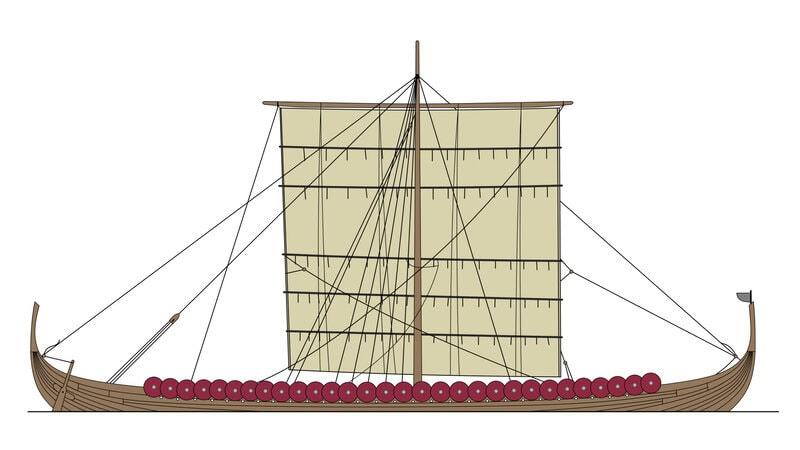
Every illustrated history of the Norse age shows the same image: a dragon-prowed longship under full sail, wind-bellied canvas carrying warriors toward the horizon. It is a beautiful picture. It is also, in the most tactically important sense, incomplete. The sail was the longship’s highway engine. The oars were its weapon.
A well-crewed longship working under oar could sustain five to six knots for hours and sprint to close to ten — fast enough to outpace almost any coastal vessel that a shocked monastery or trading settlement might scramble in response. More critically, the rowing system gave Norse crews something no sail could ever deliver: independence from the wind. In the flat calm of a river, in the pre-dawn fog hugging a coastline, in the narrow throat of an estuary where a sail becomes a liability and a beacon, the oar was everything.
To understand why Viking raiding tactics worked as well as they did for nearly three centuries, you have to climb inside the hull, feel the shaft of an ash oar in your palms, and understand the engineering and human discipline that made this rowing system unlike anything else in the medieval world.
What Made the Longship a Rowing Machine

The first thing that strikes you about a Viking longship when you see a genuine example — say, the Gokstad ship, pulled from a Norwegian burial mound and excavated in 1880 — is how improbably low it sits. The hull drew as little as fifty to sixty centimetres of water. This was not an accident of design or a concession to shallow harbours. It was the entire point.
A shallow draft meant a longship could be rowed directly onto a beach, bow first, at speed. No anchor needed. No longboat ferrying men to shore. The crew stepped off into ankle-deep water, weapons in hand, already moving. When the raid was done, the same ship could be hauled back into the surf and brought to rowing speed in seconds, long before any defender’s heavier vessel could clear its moorings. The beach itself became a launching ramp.
The hull that made this possible was built using clinker construction: overlapping planks, or strakes, fastened with iron rivets and caulked with wool or animal hair soaked in tar. Where a Mediterranean vessel’s hull fought the flex of open water — transmitting every wave-stress directly to the frame — the clinker hull moved with the sea. Sailors who have crewed modern reconstructions describe it as rowing inside a living thing, the hull twisting fractionally with each swell in a way that reduces rather than increases drag.
The oar ports were cut directly into the strakes near the gunwale, not mounted on outriggers or raised platforms as in the Greek and Roman galley tradition. This kept rowers low in the vessel, lowering the centre of gravity, reducing wind profile, and integrating the human engine directly into the ship’s structure. When oar ports were not in use, small round shields were rotated to cover them — a feature confirmed by the rows of shield brackets found on the Gokstad ship.
There is one more contrast with Mediterranean rowing culture worth stating plainly. Greek and Roman war galleys were powered, at least in part, by enslaved rowers — men who had no stake in the outcome and no choice about their role. A Viking longship carried no such division. Every oarsman was also a fighter. The rowing system therefore had to be sustainable: it could not destroy the men who would be forming a shield wall within the hour.
The Mechanics — How Viking Rowing Actually Worked

The oars themselves were typically made of ash or pine, running five to six metres in length. The stroke that drove a longship was not the long, sweeping pull of a racing shell. It was shorter, more vertical, and higher in cadence — a technique that prioritised clean water entry and exit over raw leverage, keeping the hull’s flexing rhythm undisturbed and reducing the risk of a missed stroke throwing the whole crew off.
Synchronisation was achieved through chant. Norse crews used rhythmic calls and syllabic patterns to lock dozens of men into a single tempo. The word ro — the Old Norse imperative of róa, meaning simply “row” — was a functional command called across the water by steersmen and watch leaders. It was operational language, as practical as any order given on a modern vessel.
On longer voyages — the kind that took Norse crews across the North Atlantic to Iceland and, by around 1000 AD, to the shores of North America — rowing was managed in watches. A large crew could be divided so that one group rowed while another rested, ate, or slept on the open deck. This is how the Norse reached Greenland without arriving broken. The longship was, in the most literal sense, a machine for keeping human beings operational across enormous distances.
The steering oar was mounted on the right side of the stern, giving us the word starboard from the Old Norse stjórnborði. How the crew distributed their weight while pulling at the oars directly affected the ship’s tracking through the water. Every rower was, in a small but real sense, part of the navigation system.
Rowing as Raiding Tactic — The Upstream Advantage

The tactical choreography of a Viking raid followed a consistent pattern that historians have pieced together from monastic chronicles, saga accounts, and archaeological evidence. Miles offshore, while the target coast was still below the horizon, the sail came down and was stowed. Oars were run out. From that point forward, the approaching ship presented a fraction of its under-sail profile, and it made a very different kind of sound — or, if the crew chose silence, almost none at all.
Pre-dawn approaches, coastal fog banks, and the blind corners of river bends all became tactical assets available only to a ship under oar. Viking raiding success was not, in the end, about ferocity alone. It was about arrival: getting there before the alarm could sound, hitting before resistance could organise, and leaving faster than pursuit could mount.
The river capability is where the rowing system achieved something genuinely unprecedented. The Seine, the Thames, the Loire, the Rhine, the Dnieper — Norse crews rowed deep into the continental interior along waterways that no seagoing enemy had ever penetrated in the same way. When a Viking fleet sacked Paris in 845 AD, those ships had travelled roughly 480 kilometres upstream from the sea, rowing against the current of the Seine the entire way. Walls facing land were one thing. An enemy arriving by river was supposed to be impossible.
When rivers ran too shallow even for the longship’s modest draft, Norse crews used portage: the ship was unloaded, hauled out, and physically carried overland to the next navigable waterway. A longship could weigh as little as twenty tonnes — remarkable for a vessel of its capability — and a crew of conditioned rowers was more than equal to the task. The Varangian trade routes connecting Scandinavia to Byzantium via the rivers of what is now Russia were built on exactly this practice, with ships carried across the watersheds between the Volga and Dnieper systems.
The Human Engine — Who the Rowers Were

Hollywood has populated Viking longships with a very specific human type: enormous, horn-helmeted, operating mostly on rage. The actual crew was considerably more interesting. Most were farmers, fishermen, and craftsmen who had grown up rowing in a landscape where the fjord or the sound was the road — where you rowed to market, rowed to the neighbouring farm, rowed to fish, rowed home. The oar was not a specialised military skill. It was closer to literacy.
This produced something remarkable in physical terms. A man who had rowed since childhood possessed a specific structural strength — the shoulder-to-hip power chain, the cardiovascular base, the instinctive sense of boat balance — that translated directly into effectiveness in a shield wall. The famous Norse warrior fitness was not primarily the product of weapons training. A great deal of it was the product of a lifetime at the oar.
The social dimension of the oar bench was equally distinctive. In an age of rigid hierarchy, the longship was strikingly flat. A jarl — a Norse chieftain — pulled an oar beside a free farmer. Rank had its place in command decisions, but in the work of crossing water, everyone rowed. The sagas describe the bond between crewmates with a warmth usually reserved for family, and that cohesion was not incidental to Viking military effectiveness. It was the mechanism of it.
From Norse Fjord to Football Stadium — The Chant That Crossed a Thousand Years

There is a moment in certain football stadiums — most famously associated with Scandinavian supporters — when large sections of the crowd sit or crouch in lines and begin to move their arms in slow, synchronised pulls, as though rowing a Viking longship, while chanting in unison: Ro! Ro! Ro! The effect, seen from above, is of an entire stand rowing a longship the size of a city block.
This is the Viking Row, one of the most visually arresting fan rituals in modern sport. What makes it more than a curiosity is the word at its centre. Ro is the imperative form of the Old Norse verb róa — the same command that Norse steersmen called across the water more than a thousand years ago. The word has not changed. The gesture has not changed. Only the context has.
When a football stand performs the Viking Row, it achieves something no purely visual symbol can: it puts the motion in the body. The crouching posture, the pull-through, the collective rhythm — these are not approximations of rowing. They are rowing, stripped of water and wood. Thousands of people simultaneously enacting the physical logic of a civilisation built on oar-power, collapsing a millennium of distance into a single shared gesture.
The chant is a reminder that the longship’s power was never primarily mechanical. Wood, iron, and clinker-built hull design all mattered. But the thing that actually moved the ship — that outran coastal patrols, that carried raiders up the Seine to Paris, that crossed the North Atlantic to a continent no European had named — was people, in rhythm, together.
Why the Rowing System Still Matters
The integrated rowing-and-sailing design of the Viking longship cast a long shadow across northern European shipbuilding. Elements of clinker construction and shallow-draft hull logic influenced the design of the cog — the broad-beamed merchant vessel that dominated Baltic and North Sea trade through the high medieval period. The idea of a ship that could be beached, portaged, and launched under oar shaped how northern Europeans thought about vessel design for generations after the Viking age faded.
Modern experimental archaeology has done more to validate ancient claims about longship performance than any amount of textual analysis. The Sea Stallion from Glendalough, a full-scale reconstruction of a large Viking warship built at the Roskilde Viking Ship Museum in Denmark and launched in 2004, completed a voyage from Roskilde to Dublin in 2007 — rowing and sailing the open North Sea and around the Scottish coast. The voyage confirmed speed and endurance figures from the sagas that many historians had long treated with scepticism. The ships were, it turned out, exactly as capable as the people who built them claimed.
Every time you see a longship image in a museum, a documentary, or a football stadium filled with people pulling invisible oars, you are looking at a piece of military and maritime engineering so refined that it required almost no fundamental improvement across three centuries of active use. That is not a record many technologies can claim.
The monks at Lindisfarne heard the oars before they saw the ships. The sound arrived first — rhythmic, purposeful, and entirely unlike anything the sea had delivered to their shore before. Twelve centuries later, the word those oarsmen were chanting still echoes in stadiums across Scandinavia and beyond. Ro. Ro. Ro. The sound was always the point. And it turns out we have not forgotten it.

 English
 Arabic
 Spanish
 Portuguese
 Deutsch
 Turkish
 Dutch
Dutch
 Italiano
 Russian
 Romaian
 Portuguese (Brazil)
 Greek
Greek