


"Cosmic Immigrants": Daytime Star Seen In 1604 May Be An "Alien Type Ia Supernova"
"Cosmic Immigrants": Daytime Star Seen In 1604 May Be An "Alien Type Ia Supernova"
An explosion seen in the cosmos in the early 1600s may actually be an "Alien Type Ia supernova", according to a new paper.
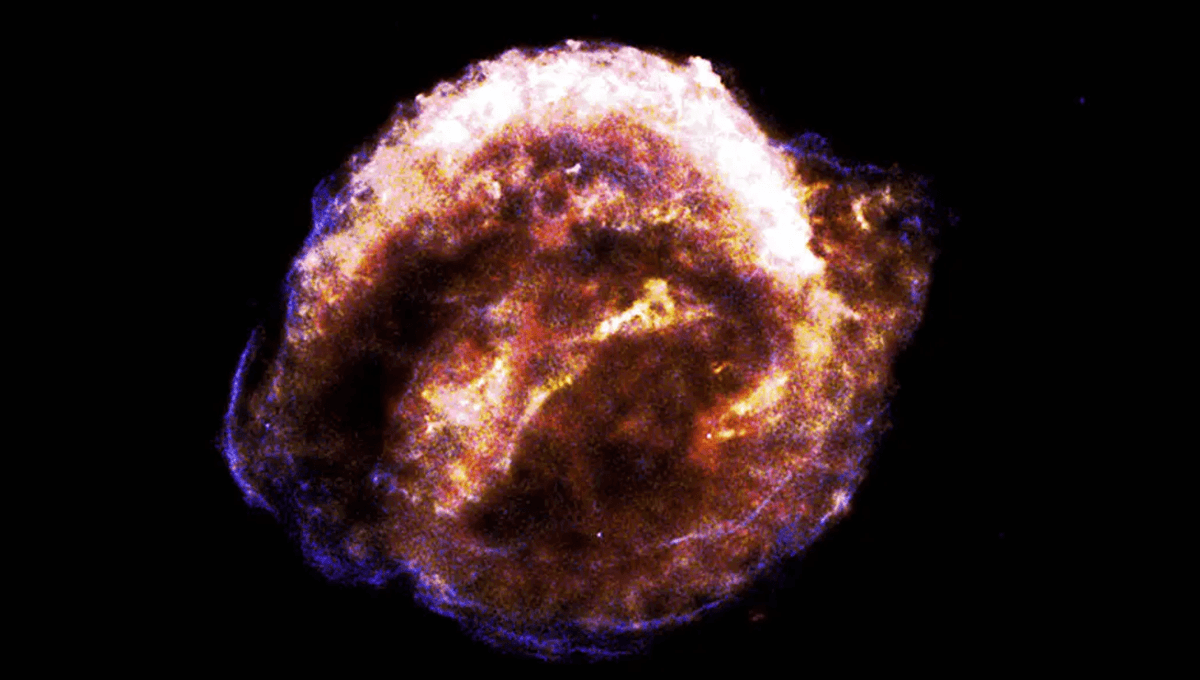
In October 1604, astronomer and mathematician Johannes Kepler spotted a new star in the sky and began tracking it. Over the course of several weeks, the star remained visible in the daytime and outshone Jupiter at night, before disappearing once more. Kepler and other astronomers believed the event to be the birth of a star, but we now know that he was witnessing a Type Ia Supernova; the violent end of a white dwarf with a companion star. "Astronomers today classify supernovas according to their characteristics, and SN 1604 belongs to the group known as Type Ia supernovas, typically found in binary star systems composed of a white dwarf and a red giant," NASA explains. "The gravitation force of the white dwarf draws in material from its larger less dense companion until it reaches a critical mass, around 1.4 times the mass of our Sun. At that point, a runaway thermonuclear chain reaction begins, causing a release of tremendous amounts of energy, including light, that we see as a sudden brightening of an otherwise dim star." Regular supernova explosions – as the core of a massive star collapses – occur in the Milky Way once every 50 years or so, while Type Ia supernova happen around once every 500 years. But a new team thinks they have identified a candidate for something rarer still: an "Alien Type Ia supernova". The Milky Way is expected to have merged with other galaxies throughout its history, increasing in size as it does so. "These mergers bring stars with kinematic and dynamic properties differing from the main stellar population," the team explains in their paper. "However, it remains uncertain whether any of the Galactic supernova remnants can be attributed to such a merger origin." In other words, as other stars are brought into our galaxy in a merger, it's possible that some of that population of stars could meet a white dwarf and cause a Type 1a supernova. Kepler's supernova is the most recent confirmed supernova we have seen within the galaxy, and it was this event that the team decided to analyze. Modeling the kinematic history of the supernova remnant and trying to figure out the properties of its progenitor, the team found that the star differed significantly from its environment. "The kinematic and dynamic properties of Kepler’s progenitor differ significantly from the in situ Milky Way stellar populations, with higher total energy (E ) compared to the Galactic bulge, and lower angular momentum (Lz) compared to the Galactic disk," the team explains in their paper. "The progenitor exhibits greater radial and vertical motion, consistent with accreted stars from disrupted satellite galaxies. While these anomalies suggest that Kepler’s progenitor is unlikely to belong to the in situ Milky Way population, its association with specific accreted substructures remains inconclusive." "We call the Type Ia supernovae (SNe Ia) produced by stars accreted into the Milky Way through merger events 'alien SNe Ia' since they are cosmic immigrants," they add. Attempting to model how many of these "cosmic immigrants" we should expect to see in the galaxy, the team suggest we should see 0.9 to 3.0 events every 60,000 years, making them a small but significant fraction of Type Ia supernovas in the Milky Way. "In the scenario where Kepler is an alien SN Ia, the anomalous high-velocity escape of its progenitor from the Galactic plane and the asymmetric morphology of the [supernova remnant] can be naturally explained," the team adds. While interesting, more work is needed to see if galactic mergers can lead to Type Ia supernova explosions. But the team suggests that if they do occur, they would likely be present and perhaps even detectable in extragalactic systems. The paper is published in The Astrophysical Journal.

 Arabic
 French
 Spanish
 Portuguese
 Deutsch
 Turkish
 Dutch
Dutch
 Italiano
 Russian
 Romaian
 Portuguese (Brazil)
 Greek
Greek