


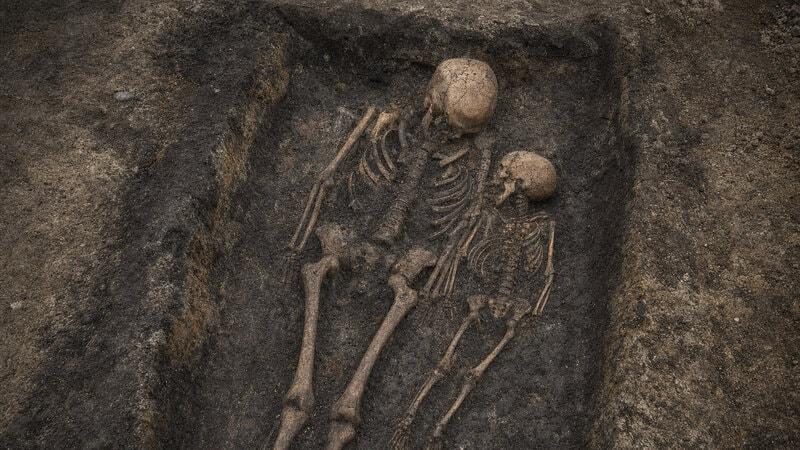

The ground was hard, the churchyard quiet, and someone — a priest, a neighbor, a grieving parent — made a decision that would puzzle archaeologists for centuries: they lowered a child’s body into a grave already occupied by an adult, tucked the small form beside the larger one, and filled the earth back in. What looked like an act of intimate family grief, it turns out, was something far stranger and far more revealing about the world these people inhabited.
A Small Hand in a Stranger’s Grave

For decades, when archaeologists in Sweden unearthed shared graves — an adult skeleton lying alongside a child’s — the interpretive reflex was almost automatic. A mother and infant. A father and young son. Grief and love made visible in bone. It was a story that felt true because it felt human, because it was the story modern observers instinctively projected backward onto medieval communities. The problem, as a landmark new study has now demonstrated, is that it was almost certainly wrong.
Ancient DNA extracted from 142 individuals across three medieval Swedish cemeteries has delivered a verdict that upends those assumptions entirely. The adults and children sharing graves in Viking Age and early medieval Sweden were, in the overwhelming majority of cases, not close biological relatives. They were, by blood, strangers. And understanding why communities made that choice — deliberate, repeated, consistent across multiple sites — opens a window onto a society in the middle of a profound religious transformation, improvising new rules for death as it converted to Christianity.
These were real decisions made by real grieving communities. The choices they made, now finally legible through genomic science, tell us something startling about how medieval Scandinavian society valued, categorized, and remembered its youngest and most vulnerable members.
Digging Into the DNA: What the Study Actually Did

The research, published in the peer-reviewed journal Science Advances, applied ancient DNA genomics to skeletal remains recovered from three medieval cemeteries in Sweden, covering the critical transition period from the Viking Age into the early Christian era, when Scandinavia was being reshaped by new theology, new burial rules, and new ideas about what happened to the soul after death.
Ancient DNA analysis is painstaking, technically demanding work. Genetic material degrades rapidly after death, attacked by bacteria, moisture, and time. Researchers must drill into dense bone or teeth — the places where DNA survives longest — extract vanishingly small quantities of genetic material, and then use sophisticated sequencing technology to reconstruct biological relationships. Done carefully, it can determine with high confidence whether two individuals were parent and child, siblings, grandparent and grandchild, or unrelated entirely. No grave good, no burial position, no artifact could ever provide that precision.
What the researchers were specifically looking for was evidence of close biological kinship between the adults and children who shared the same grave. Were the people buried together actually family? For generations, the field had assumed they were. The DNA was about to say otherwise.
The Verdict the Bones Delivered

The core finding, as reported by Live Science, is as clear as it is disorienting: in the vast majority of shared graves, the adults and children interred together were not close biological relatives. The cemetery arrangements that had been narrated for so long as expressions of family love and parental grief were organized around something else entirely — something the bones alone could never reveal, but whose outlines the DNA has now thrown into sharp relief.
A striking pattern emerged around sex. Children in medieval Sweden were far more likely to share a grave with an adult of the same sex than with a close family member. Boys alongside men. Girls alongside women. This is not random. It suggests that some social or religious logic — a set of rules about categories and community — was governing burial decisions rather than the simple, raw fact of biological kinship.
But the pattern is not perfectly tidy, and the outliers are among the most provocative details in the entire study. In some cases, infant girls were buried among men — an arrangement that defies even the same-sex affinity pattern and deepens the interpretive puzzle considerably. Whatever logic governed these burials, it was not simple and not uniform. It was a living social practice, varied and contextual, being worked out by communities on the ground as they navigated new religious territory.
The conclusion is difficult to escape: biological kinship was rarely, if ever, the organizing principle of these shared graves. Something else — rooted in early Christian ideology, community social structure, or ritual bonds that leave no skeletal trace — was driving these decisions.
Early Christianity’s Complicated Relationship With Children
To understand why, you have to understand what Christianity brought to Scandinavia when it arrived. It did not arrive with a complete, settled theology of burial. It arrived with ideas — powerful, transformative ideas about the soul, about baptism, about resurrection — that communities then had to translate into physical practice, often without clear guidance from Church authorities who were themselves still working things out.
Children, and especially infants, occupied a particularly thorny position in early Christian thought. Unbaptized babies who died before they could receive the sacrament existed in a genuine theological limbo. Were they saved? Were they excluded? Where should their bodies rest? The Church’s guidance on these questions was inconsistent, ambiguous, and contested across different regions and periods. That ambiguity created space — and perhaps necessity — for local communities to improvise their own answers.
As archaeologists have noted, if families were not the organizing principle behind shared burials, then early Christian communities may have been grouping the dead according to spiritual category, social role, or some form of religious affiliation that mapped onto the community of the living in ways we no longer fully understand. Patron-saint associations, parish identity, the status of baptism itself — any of these could have shaped decisions about who lay beside whom for eternity.
This makes the study a methodological landmark as much as a historical one. It is among the first times that genomic evidence has been used to interrogate how a converting society physically organized death — to ask, with scientific precision, whether the religious revolution happening above ground was reshaping the social logic of what happened below it.
Three Cemeteries, One Revealing Pattern

The strength of the findings rests partly on their consistency. The three Swedish cemetery sites examined span different community types and different moments within the Viking Age-to-medieval transition, giving the research genuine geographic and chronological breadth. These were not all the same kind of place, the same kind of congregation, or the same decade.
And yet the burial configurations they contained were strikingly similar: single grave cuts holding multiple individuals, larger adult skeletons positioned alongside smaller ones, side-by-side interments that looked, to every earlier generation of archaeologists, like nothing so much as a parent holding a child. The arrangements were tender. They were intentional. And they were, the DNA now confirms, almost never between close relatives.
The fact that the pattern of non-relatedness held consistently across all three sites is significant. It rules out the possibility that one unusual community’s idiosyncratic customs was distorting the picture. This was not a local aberration. It was a regional, possibly widespread practice — a way of organizing death that made sense to people across a broad sweep of early Christian Sweden, even if its precise logic remains to be recovered.
The physical evidence alone could never answer the interpretive question that the DNA now so forcefully raises: if not family, what social bond connected these adults and children in death? Godparenthood — the ritual kinship created by baptism — is one compelling candidate. Fosterage, a common practice in medieval Scandinavian society, is another. Guild membership, parish community, shared religious status — each is possible, and none can yet be confirmed.
What This Means for How We Read the Medieval Past

The implications reach well beyond Sweden and well beyond the Viking Age. This study is a vivid demonstration of how ancient DNA is challenging assumptions that archaeologists built up over generations — assumptions constructed by analogy with modern Western family structures that may never have applied to medieval communities in the first place.
Consider how museums have labeled these graves. Consider how textbooks have narrated them. Consider how many popular histories and documentaries have shown the reconstruction drawing: a mother, a child, an expression of universal parental love. That narrative is emotionally powerful. It is also, the genomic evidence now suggests, frequently inaccurate. It needs revision — not because the emotional reality of these burials was absent, but because the social categories organizing them were different from the ones we assumed.
Across Europe, similar ancient DNA studies of medieval cemetery populations are beginning to reveal a comparable pattern: biological kinship was often less important than social, religious, or political bonds in determining burial placement. The Swedish study adds a crucial dataset to that emerging picture, and its focus on the moment of Christian conversion makes it particularly valuable for understanding how new religious ideologies reshaped the most intimate practices of everyday life.
What the DNA cannot tell us — and this is worth sitting with — is the emotional texture of these burials. Whether communities mourned these unrelated children as their own. Whether the invisible thread connecting adult and child was the water of baptism rather than the blood of kinship. Whether the grief in the churchyard was any less real for the fact that the relationship defied our categories. Those questions belong to historians, anthropologists, and the sustained work of interpretation that follows every scientific discovery.
The Children History Overlooked — And What We Owe Them Now
The 142 individuals at the center of this study were not data points. They were people — adults who had lived long enough to leave extractable DNA in their teeth, and children who had not lived long at all. Their deaths mattered enough to their communities that careful, intentional choices were made about who would lie beside them for eternity. Someone decided. Someone placed that small body in the ground next to a person who was not their parent, not their sibling, not their grandparent — and did so with what we can only assume was purpose and meaning.
The study’s greatest contribution is not simply a corrected burial record, though that correction matters enormously. It is a prompt to ask better questions. Who were these children to their communities, if not the biological children of the adults beside them? What did it mean, in a newly Christian Sweden still learning the grammar of its new faith, to be buried beside someone who was not your kin? What did that proximity promise — in this life, in the next?
As ancient DNA genomics becomes cheaper, faster, and more widely applied to medieval cemetery sites across Scandinavia and the broader medieval world, the answers — and the surprises — are only going to multiply. Every churchyard is an archive. Every grave is a sentence in a language we are only beginning to learn to read.
Return, then, to that frozen Swedish churchyard. The gravedigger, the small body, the adult already at rest below. For generations, we told ourselves we understood that scene. Now, the genomic evidence asks us to look again. The small hand in the stranger’s grave is no longer simply a mystery to be solved. It is an invitation — to recover a world where community, faith, and identity in death meant something different from anything we assumed, and where the most vulnerable members of society were placed, with intention and care, beside people whose connection to them we are only now beginning to understand.

 English
 Arabic
 French
 Spanish
 Portuguese
 Deutsch
 Turkish
 Dutch
Dutch
 Italiano
 Romaian
 Portuguese (Brazil)
 Greek
Greek