


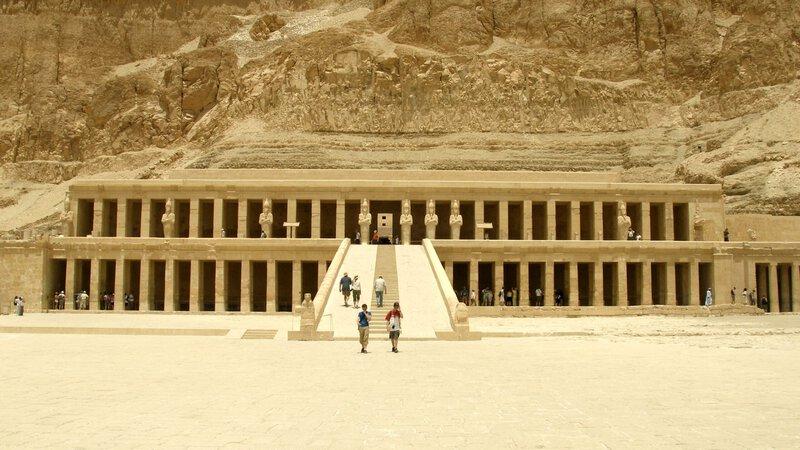

Somewhere in Egypt, around 1458 BCE, a stonemason received an order that had nothing to do with building. His task was to destroy — specifically, to climb the painted walls of the most breathtaking temple on the Nile and chisel a woman’s face out of existence. The command came from the new pharaoh himself. And yet, three and a half thousand years later, the temple still stands, the cliff still cradles it, and the woman it was built to immortalize remains very much alive in history’s memory.
A Queen Who Claimed the Throne

Hatshepsut was born into Egypt’s Eighteenth Dynasty, a royal bloodline that had already seen more than its share of ambition. She began her political life as queen consort — the expected role, the acceptable one. But around 1479 BCE, following the death of her husband Pharaoh Thutmose II and with his young son Thutmose III still a child, she made a move that must have stunned the Egyptian court: she claimed the full title of pharaoh for herself.
This was not a quiet regency. Hatshepsut didn’t merely administer power — she seized its symbols entirely. She had herself depicted in statues and reliefs wearing the double crown of Upper and Lower Egypt, the crook and flail of kingship, and the ceremonial false beard that had for centuries marked the face of a ruler as exclusively male. She forced the entire visual grammar of Egyptian power to bend around her. In doing so, she was not being reckless. She was being strategic in the way that only someone who truly understood her world could be.
Her reign lasted approximately 21 years, from around 1479 to 1458 BCE. During that time, Egypt flourished. Trade expeditions — most famously to the land of Punt, generally believed to have been located somewhere along the Horn of Africa or the southern Red Sea coast — returned with exotic goods, live trees, and precious resins. Building projects multiplied across the kingdom. The country, by every measure of the ancient world, thrived. Hatshepsut understood something that her eventual erasers perhaps feared most: in ancient Egypt, to be forgotten was to die a second death, permanently. She built accordingly.
The Temple That Was Meant to Tell Her Story

On the west bank of the Nile, directly opposite the city the ancient Egyptians called Waset and the modern world knows as Luxor, a natural bay is carved into the limestone cliffs as if the earth itself made room for something important. The pale golden rock rises in dramatic vertical columns. The light at dawn floods the hollow with a color somewhere between amber and white. It is the kind of place that stops people in their tracks — and it stopped Hatshepsut too.
She gave the order to begin construction at Deir el-Bahari early in her reign as pharaoh. The timing was deliberate. She was not building a temple as an afterthought or a late-career monument — she was building it as a declaration of intent, a statement carved in limestone and painted in vivid color that would outlast every critic and every rival. The temple was designed not merely as a place of ritual but as a visual autobiography: the story of her life, her divine right to rule, and her relationship with the gods, rendered permanent in stone.
Construction spanned roughly 15 years. What emerged was unlike anything Egypt had seen. Three broad colonnaded terraces rise in clean horizontal lines against the dramatic vertical face of the cliff behind them — a design so crisp, so apparently rational in its geometry, that 19th-century archaeologists arriving at the site reportedly struggled to reconcile it with their assumptions about ancient aesthetics. The cliff does not merely sit behind the temple; it is the temple’s partner, its natural backdrop amplifying the structure’s lines the way a stage amplifies a performance.
Inside, the walls told her story in extraordinary detail. Reliefs depicted the expedition to Punt in scenes of remarkable precision — images of foreign landscapes, exotic animals, and trade goods being loaded onto ships. Most audaciously of all, Hatshepsut had the walls painted with scenes of her own divine birth: the god Amun, the reliefs suggested, had willed her into existence as Egypt’s rightful ruler. It was propaganda, yes — but it was also a woman making the only argument that carried weight in her world.
Architecture as Audacity: What Makes Deir el-Bahari Extraordinary

To arrive at Hatshepsut’s temple at Deir el-Bahari is to experience something that photographs genuinely cannot prepare you for. A processional causeway once led from the valley floor to the temple entrance, flanked on both sides by sandstone sphinxes bearing Hatshepsut’s likeness — hundreds of them, a corridor of stone guardians announcing that what lay ahead belonged to someone of consequence. The sphinxes are largely gone now, victims of later destruction and centuries of exposure, but the approach still commands attention.
Ascending through the terraces, visitors pass papyrus-topped columns whose proportions feel almost classical in their restraint. Sanctuaries dedicated to Amun, Anubis, and Hathor branch off from the main axis, each preserving traces of the pigment that once made these interiors blaze with color. Scholars recognize the whole complex as one of the world’s most striking architectural achievements — and standing beneath those limestone cliffs with the morning light moving across the colonnades, it is not difficult to understand why.
What separates Hatshepsut’s temple from virtually every other New Kingdom monument is its relationship with the landscape. Egyptian temples of this era typically announced themselves through sheer overwhelming mass — pylons, colossal statuary, walls that dwarfed the human figure. Hatshepsut’s architects took the opposite approach. They read the land and worked with it, creating a structure that feels less like it was built against the cliff than grown from it. The result is unique in Egypt, and that uniqueness was a deliberate choice — a reflection of a ruler willing to be different in every dimension.
The temple’s principal architect was Senenmut, Hatshepsut’s most trusted official and the overseer of her building program. His hand is evident in the design’s remarkable coherence: the way each terrace steps back toward the cliff at a consistent ratio, the way the colonnades frame the sky rather than compete with it. Whatever their precise personal relationship — a subject scholars continue to debate — Hatshepsut and Senenmut together produced a monument that no subsequent pharaoh fully replicated.
The Erasure: When a Successor Tried to Rewrite the Past

Hatshepsut died around 1458 BCE. Thutmose III, her stepson and co-regent, finally assumed sole power over Egypt. He would go on to become one of Egypt’s greatest military pharaohs, a conqueror whose campaigns stretched the empire to its widest boundaries. But sometime after Hatshepsut’s death — scholars debate exactly when, with evidence pointing to relatively late in Thutmose III’s long reign rather than immediately after her death — he ordered something that had less to do with conquest than with erasure.
Across Egypt, workers set to the methodical task of removing Hatshepsut from the record. Her cartouche — the oval frame enclosing a pharaoh’s name, their identity in hieroglyphic form — was chiseled out of walls and replaced with the names of Thutmose III or his predecessors. Statues were smashed and buried in pits, their fragments hidden from view. At Deir el-Bahari, her face was removed from reliefs, her figure gouged from scenes she had commissioned to tell her own story. The campaign was so systematic that it suggests something more than personal grievance. Someone wanted her not merely dead but unmemorable.
Modern Egyptologists continue to debate the motive. Was it personal — the resentment of a man who had spent years subordinate to a woman who was not his biological mother? Was it dynastic necessity, tied to anxieties about succession and the integrity of the royal line? Or was it more coldly calculated: a determination to prevent any future claimant from pointing to Hatshepsut as a usable precedent? The evidence does not settle the question cleanly. What it does settle is the scale and deliberateness of the effort.
And here the erasure undoes itself in a magnificent irony. The statues smashed and buried in pits were, by virtue of that burial, preserved. Sealed away from the destructive effects of sun, wind, and further interference, they survived in extraordinary condition. When archaeologists excavated the area around Deir el-Bahari in the early 20th century, they found thousands of fragments and were able to reconstruct Hatshepsut’s face with a clarity that centuries of open exposure might have prevented. The attempt to hide her had, in effect, protected her.
Rediscovery: How the World Got Hatshepsut Back

For 19th-century Egyptologists working to decode the hieroglyphic record, Hatshepsut appeared as a troubling puzzle. Here was a figure referred to in texts with feminine verb forms and feminine pronouns — but also described in the language of kingship, wearing the full titles of a pharaoh. The prevailing assumption was that this must be a scribal anomaly, something that didn’t mean what it appeared to mean. The idea of a female pharaoh who had ruled Egypt for over two decades simply did not fit the framework scholars had brought to the evidence.
The mortuary temple at Deir el-Bahari was the key witness that eventually broke the case open. Its walls, even damaged and defaced, preserved enough of the story — the divine birth scenes, the Punt expedition reliefs, the records of her building projects — that the erasure could not hold. Piece by piece, as excavations continued through the 20th century and the buried statues came out of the ground, scholars rebuilt the picture. By the mid-20th century, the consensus was firm: this was not a scribal error. This was a woman who had ruled Egypt, built its most architecturally singular mortuary temple, and been deliberately written out of the record by someone who found her existence inconvenient.
The American Egyptologist Herbert Winlock, excavating on behalf of the Metropolitan Museum of Art in the 1920s, was among those who made sense of the fragments recovered from the burial pits near Deir el-Bahari. His work, and the decades of scholarship that followed, transformed Hatshepsut from a footnote into a central figure of Egyptian history. Today her reconstructed statues stand in major museums around the world, including a dedicated gallery at the Metropolitan Museum of Art in New York.
Hatshepsut is now widely regarded as one of the most consequential rulers of the ancient world. Her temple draws visitors from every continent. She has become, in the 21st century, a symbol not of victimhood but of the stubborn persistence of evidence in the face of power’s attempts to shape memory.
Visiting the Temple Today

The temple at Deir el-Bahari sits within the Theban Necropolis on the west bank of the Nile near modern Luxor, a UNESCO World Heritage Site. It is accessible year-round, with early morning visits strongly recommended both for the quality of the light — which floods the colonnades in a warm amber glow shortly after sunrise — and to avoid the intense midday heat that characterizes the valley for much of the year.
The site is managed by Egypt’s Ministry of Tourism and Antiquities, and ongoing conservation work means that some areas may be periodically restricted. Visitors who combine Deir el-Bahari with the nearby Valley of the Kings and the Ramesseum can trace the full arc of New Kingdom royal building in a single day — though the temple of Hatshepsut, with its terraces and painted sanctuaries, typically earns the longest stays. A recent discussion among archaeology enthusiasts captures the near-universal reaction of first-time visitors: the photographs, however good, do not prepare you for the scale or the silence of the place.
Why Hatshepsut — and Her Temple — Still Matter
There is a larger lesson embedded in the limestone at Deir el-Bahari, one that reaches well beyond the history of ancient Egypt. Hatshepsut’s story is a case study in how political power tries to control not just the present but the past — and how that control is always, eventually, incomplete. The temple she built was meant to make her permanent. The erasure ordered after her death was meant to make her temporary. The cliff, indifferent to both projects, held everything in place until someone came along with enough curiosity to look.
The temple was, at its core, an argument: a ruler’s defiant claim that she had been here, that she had mattered, that the gods themselves had sanctioned her rule, and that the stone record of that rule would endure longer than anyone who disagreed with it. She was right. The stonemason’s chisel did its work. Faces were removed, names were erased, statues were buried. And yet the cliff at Deir el-Bahari held, the terraces held, and the woman they were built for held with them.
But the temple also forces an uncomfortable question on every visitor who stands beneath those golden cliffs and looks up at the colonnades still rising against the sky: how many others were there? How many rulers whose existence threatened someone else’s grip on power were erased so completely that no temple survived to betray the lie? Hatshepsut got her monument. She got her burial pits full of carefully smashed fragments. She got lucky, in the way that history sometimes permits. The ones we don’t know about were not so fortunate — and their silence is part of her story too.

 English
 Arabic
 French
 Spanish
 Portuguese
 Deutsch
 Turkish
 Dutch
Dutch
 Italiano
 Romaian
 Portuguese (Brazil)
 Greek
Greek