


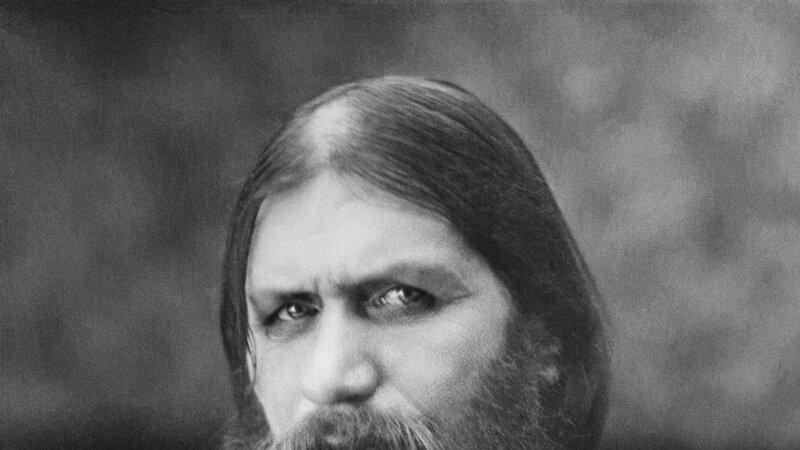

The cakes were arranged on a silver tray, the wine poured into crystal glasses, and somewhere above the cellar a gramophone scratched out a cheerful melody into the St. Petersburg night. What happened next — or rather, what stubbornly refused to happen — would become one of history’s most disputed death scenes, and would cement the name Rasputin in the nightmares of an empire already coming apart at the seams.
The Night They Couldn’t Kill Him

It was late December 1916, and Prince Felix Yusupov had gone to considerable trouble. The basement of his Moika Palace had been decorated to look inviting — a fire crackling, food laid out, the gramophone playing upstairs to suggest a party in progress and muffle whatever sounds might drift up from below. The food, however, was not ordinary food. According to the conspirators’ own later accounts, the cakes and wine had been laced with potassium cyanide. The dose, those present would insist, was enough to kill several men.
Grigori Rasputin ate the cakes. He drank the wine. He sat in his chair, very much alive, and asked to hear the gramophone again.
Behind a locked door, Yusupov and his co-conspirators — including Grand Duke Dmitri Pavlovich, a cousin of Tsar Nicholas II, and right-wing politician Vladimir Purishkevich — exchanged looks of undisguised horror. They had planned a quiet, efficient poisoning. Instead they had a problem that would require, before the night was over, a pistol, more bullets, a frozen river, and would still leave history arguing about exactly how Rasputin finally died.
To understand why Russian nobles felt compelled to kill a Siberian peasant — and why that killing proved so chaotic and so contested — you have to go back to the beginning. To a frozen village nobody had ever heard of, and a rough-handed young man with unsettling eyes who was about to walk out of the steppe and into the heart of an empire.
A Peasant from the Siberian Frost

Grigori Yefimovich Rasputin was born in 1869 in Pokrovskoye, a remote village in western Siberia. The landscape there is vast and unforgiving — flat marshland, brutal winters, a horizon that seems to go on forever in every direction. It produced people who were tough, practical, and accustomed to a spiritual life lived far outside the comfort of city churches. Rasputin was illiterate for much of his early life, rough in his manners, and by most accounts physically striking in a way that was difficult to ignore rather than easy to admire.
As a young man he underwent a religious transformation, attaching himself to wandering holy men known as stranniki — pilgrims who moved across Russia’s vast interior, living by charity and prayer. When Rasputin emerged from this period, he carried a reputation for healing, for prophecy, and for an intense personal magnetism. He was never formally ordained as a priest and held no official standing in the Russian Orthodox Church. The label “renegade monk” that newspapers would later paste on him was technically inaccurate — he preferred to see himself as a starets, a holy elder answerable to God rather than to any church hierarchy.
By the early 1900s he had made his way to St. Petersburg, where his wild eyes, peasant directness, and confident prophecies began drawing the attention of aristocratic society. Russia’s upper classes, anxious and spiritually restless in the years before revolution, found something in him they couldn’t name — and couldn’t look away from.
The Healer Who Reached the Tsar

What brought Rasputin inside the walls of the imperial court was not politics or ambition, at least not at first. It was a sick child. Tsarevich Aleksey, the only son of Tsar Nicholas II and Tsarina Alexandra, suffered from severe hemophilia — a condition in which the blood fails to clot properly, meaning even a minor bruise or knock could become life-threatening. The boy’s parents had kept his illness as quiet as they could manage, but they lived in constant fear for his life. Conventional medicine offered no reliable answers.
Rasputin, brought into the family’s circle around 1905, appeared to help. Whether through hypnosis, calming suggestion, prayer, or some combination that physicians still debate, his presence seemed to ease Aleksey’s bleeding episodes. One plausible explanation that has gained traction among historians is that Rasputin discouraged the doctors from administering aspirin — then commonly prescribed — which worsens bleeding in hemophiliacs. Whatever the mechanism, his influence over the imperial family grew directly from this apparent ability to do what the court physicians could not.
For Alexandra, this was not coincidence or trickery. It was the hand of God. She became Rasputin’s most powerful and unwavering protector, convinced that this strange, semi-literate man from the Siberian steppe had been sent by heaven to save her son and, through her son, the Romanov dynasty. She corresponded with him regularly, defended him against his growing army of critics, and treated his counsel with a reverence that alarmed nearly everyone around her. Rasputin called her “Mama” in his letters, sat at the family’s table, and in the later war years — with Nicholas away commanding troops at the front — his whispered opinions sometimes rippled outward into actual policy decisions, influencing ministerial appointments and court affairs in ways that contemporaries found scandalous and historians still debate in their precise extent. A peasant mystic had found his way to the center of the largest empire on earth, and neither the court nor the country could tolerate what that meant.
Saint or Sinner? The Legend Grows

To the pilgrims who sought him out for healing and intercession, Rasputin was a genuine holy man. To St. Petersburg society, he was something considerably darker. He was simultaneously reviled and revered in a way few figures in history have managed — described in the same breath as a sexual predator who exploited aristocratic women, a faith healer who performed genuine miracles, a German spy sabotaging Russia’s war effort from inside the palace, and a drunken fraud who traded on royal access for personal pleasure.
The truth, as historians have worked to disentangle the myths from the documented record, is considerably more complicated. Some charges against him were exaggerated; others were fabricated by political enemies with clear agendas. The stories of superhuman sexual prowess and hypnotic control over women owe far more to lurid newspaper campaigns and the self-serving memoirs of his killers than to reliable evidence. But Rasputin did not always help his own cause. He drank heavily and made little secret of it. He boasted openly of his closeness to the imperial family. He seemed constitutionally incapable of the discretion that might have saved him, courting scandal with an almost deliberate enthusiasm that suggested he either didn’t understand the danger or didn’t much care about it.
By 1916, the calculus had shifted from gossip to genuine crisis. World War One was grinding Russia into dust. Food shortages were sparking unrest in the cities. The army was suffering catastrophic losses. And with the Tsar at the front, it was widely believed — rightly or wrongly — that Rasputin’s influence over Alexandra was shaping ministerial appointments and the management of the war. For men who considered themselves patriots, this was intolerable.
The Conspiracy at the Moika Palace

The plot to kill Rasputin came together among people who believed, with apparent sincerity, that they were saving Russia. Prince Felix Yusupov was one of the wealthiest men in the country — by some accounts his family’s fortune rivaled or exceeded that of the Romanovs themselves. Grand Duke Dmitri Pavlovich was the Tsar’s own cousin. Vladimir Purishkevich was a prominent right-wing politician with a national profile. These were not fringe fanatics. They were men at the very apex of Russian society, and they had convinced themselves that removing one man could somehow reverse the catastrophic momentum of a nation careening toward collapse.
Their plan had the tidy logic of something designed on paper rather than tested in reality. Lure Rasputin to the Moika Palace on the pretext of a late-night social visit, poison him, and dispose of the body beneath the ice of a frozen waterway. They settled on the night of December 29th moving into the early hours of December 30th, 1916 — barely a year before the revolution that would render their entire social world extinct.
Three Attempts, One Corpse

The poison, by every witness account, failed. Rasputin consumed the cyanide-laced food and wine and remained functional — apparently relaxed, enjoying himself, while his would-be killers ran out of explanations behind their locked door. Yusupov eventually returned downstairs and shot Rasputin once in the chest at close range. Rasputin collapsed.
Then, according to Yusupov’s own memoir — the primary source for the most dramatic elements of that night — he got up. He seized Yusupov by the throat. He staggered out of the cellar and into the freezing courtyard, calling out for help. Purishkevich gave chase and fired. Multiple shots were needed to bring him down.
The conspirators wrapped the body, drove through the dark city, and pushed it through a hole in the ice of the Little Nevka River. When Rasputin’s body was recovered several days later, the autopsy reportedly found water in his lungs — feeding the enduring legend that he had still been breathing when he entered the river. Modern forensic reassessments have since cast serious doubt on several of the most dramatic elements of the night: the effectiveness of the poison, the precise sequence of events, and the drowning interpretation. A 2004 investigation by Dr. Lamar Cohn suggested that a bullet wound to the forehead was the likely fatal shot, and that the lung water evidence was ambiguous at best. It is also worth noting that Yusupov’s memoir, the cornerstone of the story, was written and published years later by a man with strong personal and reputational reasons to dramatize his own role. What the documented record confirms is stark enough: it took an organized group of armed, determined aristocrats an entire night of escalating violence to kill one man, and they disagreed among themselves almost immediately about exactly what had happened.
Why the Murder Changed Nothing
Rasputin’s death resolved nothing. Nicholas II abdicated in March 1917, weeks after Rasputin’s body was pulled from the ice. The entire Romanov family was executed by Bolshevik forces in July 1918. The nobles had killed Rasputin, but they could not stop the revolution already rolling toward them — and in attempting to preserve their world through a cellar murder, they had demonstrated only how completely they had lost touch with the forces reshaping it.
Rasputin had reportedly warned Alexandra that if he were killed by members of the Russian nobility, the royal family would not long survive him. History delivered on that statement with grim precision, the Romanovs outlasting him by less than two years. Whether the warning was genuine foresight, a calculated manipulation, or simply the kind of dark utterance that sounds prophetic only in retrospect is impossible to know. It became one more layer in a legend that was already impossible to separate cleanly from myth.
Why Rasputin Still Haunts History
His story endures because it sits at the collision point of forces that remain recognizable: the desperation of a ruling family clinging to power through faith rather than strategy; the paranoia of a class that could not see the ground shifting beneath it; the capacity of a single charismatic outsider to destabilize an entire system of authority simply by existing inside it. As a Russian mystic and self-proclaimed holy man, Rasputin attracted legends that his actual biography could never quite contain. But what made him genuinely dangerous to his enemies was something simpler and more human — he had found the one crack in the Romanov armor, a mother’s terror for her sick child, and he had walked through it.
The harder question his story forces is not whether Rasputin was saint or fraud, healer or manipulator. It is why a sophisticated, educated ruling class chose to believe that killing one peasant would save an empire. The conspiracy at the Moika Palace was not a sign of power. It was a sign of how little power those men actually had left — and how poorly they understood the world that was about to replace them.
And so we return, inevitably, to that cellar. The silver tray. The cakes. The crystal glasses filled with poisoned wine. A gramophone playing somewhere above, filling the palace with incongruous sound. And a Siberian peasant sitting in the firelight, apparently unhurried and unharmed, asking for more — while the men who had come to kill him stood in the dark and tried to understand how this was possible. They never entirely figured it out. The historical record, even now, does not entirely resolve it. What it does confirm is that the story they told afterward, dramatic and self-serving as it was, has outlasted everything else about them — the titles, the palaces, the world they were trying to save.

 English
 Arabic
 French
 Spanish
 Portuguese
 Deutsch
 Turkish
 Dutch
Dutch
 Italiano
 Russian
 Romaian
 Portuguese (Brazil)