


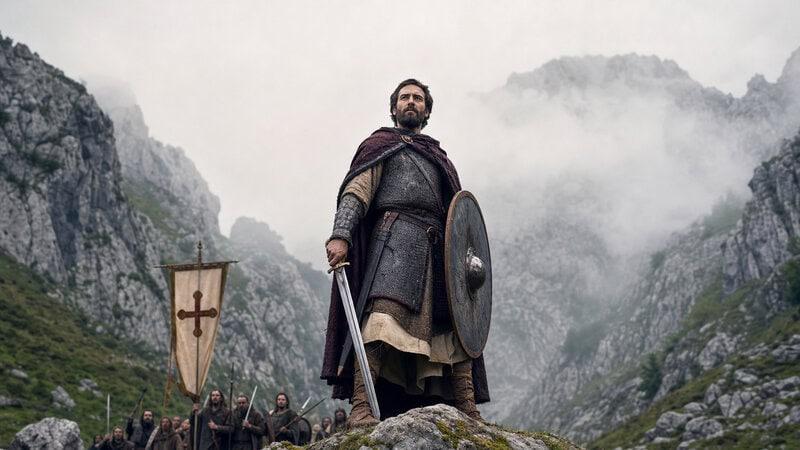

In 722 AD, a small band of Christian fighters took refuge in the mist-soaked Cantabrian mountains of northern Iberia, outnumbered, outmatched by the standards of their age, and cornered against the rock face of a gorge called Covadonga. What happened next would not end for another 770 years — an unbroken thread of conflict, coexistence, and reconquest stretching longer than the entire lifespan of Rome’s Western Empire.
A Mountain Refuge and the Spark of Nearly Eight Centuries of War

The man at the center of that mountain moment was Pelayo, a Visigothic nobleman who refused to accept the new order that had swept across Iberia in the decade before. By 711 AD, Umayyad Muslim forces had crossed the Strait of Gibraltar from North Africa and dismantled the Visigothic Kingdom with breathtaking speed — a civilization toppled in a matter of years rather than decades. Survivors fled north into rugged mountain country where Moorish cavalry could not easily follow. Pelayo was one of them. His victory at Covadonga was not a grand set-piece battle; it was a scrappy, symbolic act of refusal. But that refusal planted a seed that would grow, slowly and painfully, into what history would eventually call the Reconquista.
Consider the scale of what that name contains. The Western Roman Empire, that colossus of ancient history, lasted roughly 500 years from its traditionally recognized origins to the fall of Romulus Augustulus in 476 AD. The Reconquista outlasted it by nearly three centuries. Most wars that reshape civilizations last years, sometimes decades. The Hundred Years’ War between England and France — already remarkable for its duration — ran 116 years. The main campaigns of the Crusades spanned roughly 200 years. The Christian reconquest of Iberia dwarfed them all, grinding forward across generations so numerous that a fighter at Covadonga would have needed more than twenty-five generations of descendants before anyone lived to see it end.
The World the Moors Built — and Why It Was So Hard to Undo

To understand why the Reconquista took so long, you have to understand what the Christian kingdoms were actually fighting. Al-Andalus — the Muslim-ruled territory of medieval Iberia — was not a backwater to be easily swept aside. At its height under the Umayyad Caliphate of Córdoba, that city rivaled Constantinople and Baghdad as one of the great urban centers of the world, home to libraries, philosophers, physicians, and poets at a time when much of Christian Europe was still largely agrarian and had limited access to learning. The Moors built the Alhambra in Granada, the Great Mosque of Córdoba, and elaborate irrigation systems that transformed dry Iberian soil into productive farmland. The Christian kingdoms to the north were fighting not just soldiers but an entire civilization — one that was, by many contemporary measures, more administratively and intellectually sophisticated than their own.
This is the central paradox of Reconquista history: the Christian kingdoms wanted the land back, but they also wanted — and absorbed — what the Moors had done with it. Arabic words entered their languages by the hundreds. Architectural techniques crossed the frontier in both directions. Muslim administrators served in Christian courts; Jewish scholars translated Arabic philosophical texts into Latin that would eventually reach European universities. The medieval Iberian Peninsula produced a phenomenon scholars call convivencia — coexistence — in which Christian, Muslim, and Jewish communities lived in uneasy but genuine proximity, trading knowledge across the very fault lines that the wars were supposedly being fought along. This was not a clean clash of civilizations. It was messier, stranger, and more human than that framing allows.
The Long Middle: Lurching Forward, Falling Back

Anyone who imagines the Reconquista as a steady, southward march is imagining a different war entirely. The real story lurched forward and stumbled backward across centuries. Toledo, one of the great prizes of central Iberia, finally fell to Alfonso VI of Castile in 1085 — a landmark moment that seemed to signal real momentum. Then came the Almoravids: Berber warriors from North Africa summoned by the fractured Muslim rulers of Al-Andalus, who crossed the strait and delivered crushing defeats that rolled the Christian advance back like a tide. The frontier shifted. Maps changed. Generations who had known nothing but slow, grinding gain suddenly found their fathers’ conquests erased.
The turning point that historians most consistently identify as decisive came in 1212, at the Battle of Las Navas de Tolosa, where a coalition of Christian kingdoms — Castile, Aragon, and Navarre, joined by forces from Portugal and beyond — delivered a shattering blow to the Almohad Caliphate. The momentum that followed proved harder to reverse. Over the subsequent decades, major cities fell in rapid succession: Córdoba in 1236, Valencia in 1238, Seville in 1248. By the late thirteenth century, only the Emirate of Granada in the far south remained under Muslim rule — a remnant state that would survive, improbably, for another two centuries, paying tribute, playing rival kingdoms against one another, and enduring.
Throughout these centuries, military religious orders — the Knights of Santiago, the Order of Calatrava, the Order of Alcántara — reframed what had begun as a local struggle for land and survival into something that resonated with the broader crusading ideology sweeping medieval Europe. Foreign fighters arrived from France and elsewhere, eager to earn spiritual credit on what they understood as a holy frontier. The Christian reconquest of Iberia became entangled with the larger drama of Christendom’s relationship with the Islamic world, even as the people actually living on that frontier went on trading grain, translating manuscripts, and doing the unglamorous daily work of survival.
What 770 Years Actually Feels Like From the Inside

It is worth pausing to consider what this duration meant for the people who lived through it. The men and women in the middle centuries of the Reconquista had no idea they were in “the Reconquista” — that term was largely a construction of later historians, a label applied backward onto centuries of fragmented, local experience. What they knew was this: the frontier was dangerous, the next raid might come before harvest, the treaty signed last year might be broken next spring, and their children would inherit whatever they managed to hold. They were not characters in a recognized epic. They were farmers, soldiers, priests, merchants, and parents doing what people always do — trying to live, and occasionally dying for something larger than themselves.
The sheer scale of generational turnover across 770 years resists easy comprehension. The faith traditions of some readers’ great-grandparents are younger than this conflict. Nations that exist today had not yet been imagined when Pelayo stood in that mountain gorge. Languages transformed, dynasties rose and collapsed, plagues swept through entire populations — and still the war continued, muted sometimes to an uneasy cold peace, flaring at others into open devastation, but never truly ending until a single January morning in 1492.
The Final Act: Ferdinand, Isabella, and the Fall of Granada

By the late fifteenth century, the endgame had acquired a shape. The 1469 marriage of Ferdinand of Aragon and Isabella of Castile united the two most powerful Christian kingdoms on the peninsula under a single political project. They were methodical, ambitious, and theologically motivated. The Granada War, launched in 1482, was the instrument they chose for the final reckoning.
It lasted ten years. This was not a war of single pitched battles but of sustained, grinding pressure — sieges that starved cities into submission, the deliberate destruction of crops to break civilian endurance, campaigns designed to exhaust a state rather than simply defeat it in the field. The Emirate of Granada was neither small nor weak; it had survived two centuries as a tributary state through shrewd diplomacy and difficult terrain. Internal dynastic conflict — a civil war between Emir Muhammad XII, known to history by the Spanish nickname Boabdil, and his father and uncle — ultimately undermined its capacity to resist. Ferdinand and Isabella exploited that division with precision, and when it mattered most, they had the resources, the unity, and a patience proportionate to the long scale of the conflict they were closing.
On January 2, 1492, Boabdil surrendered the keys of the Alhambra and rode south out of the city he could no longer hold. Contemporary accounts describe him pausing at a mountain pass to look back at the red palace towers his dynasty had built. Whether the tears attributed to him in later tradition are history or legend, the image captured something true: a world was ending. The fall of Granada completed the Christian reconquest of Iberia. After 770 years, no Muslim-ruled territory remained on the Iberian Peninsula.
The same year — the same staggering calendar year — Christopher Columbus sailed west under the patronage of those same monarchs. The fall of Granada and the first crossing to the Americas share a single date: 1492. One long story closes; another, with consequences the world is still reckoning with, opens on the same page.
Why the Reconquista Still Matters — and Why Its Legacy Is Unresolved

The legacy of the Reconquista does not resolve neatly into triumph. The final months of 1492 also brought the expulsion of the Jewish population from Spain — perhaps 150,000 people forced from their homes under the Alhambra Decree, signed in March of the same year Granada fell. The Spanish Inquisition, already active since 1478, gained new institutional reach from the consolidation of royal and religious authority that the Reconquista’s conclusion made possible. The Moriscos — Muslims who had converted to Christianity but remained subjects of deep institutional suspicion — were expelled in waves across the sixteenth and early seventeenth centuries, culminating in the decrees of 1609 to 1614. The end of a long war rarely produces a clean peace.
In modern political discourse, the Reconquista’s symbolism has been weaponized in troubling ways. Far-right movements in Europe and elsewhere have seized on a simplified version of this history to assert an eternal, inevitable conflict between Christianity and Islam — a reading that serious historians reject as a fundamental distortion of a medieval reality that was plural, negotiated, and irreducible to a single civilizational narrative. Christian rulers preserved mosques in conquered cities. Muslim engineers built for Christian patrons. Jewish scholars translated Arabic philosophy into Latin for European universities. The Reconquista was a war, yes, but it was also a 770-year conversation, and the conversation shaped the combatants as surely as the combat did.
What the Longest War Left Behind
Modern Spain and Portugal carry the Reconquista in their bones without always recognizing it. The Spanish language contains thousands of words of Arabic origin — aceite (oil), algodón (cotton), azúcar (sugar), almohada (pillow) — everyday vocabulary absorbed from the civilization that was slowly, incompletely displaced over eight centuries. The architecture of Andalusia is a palimpsest: Christian churches constructed within mosque walls, Moorish arches framing Catholic altars, gardens designed according to Islamic principles of water and shade tended by people who may no longer remember why the channels run the way they do.
The Alhambra in Granada stands as the perfect emblem of this layered inheritance. Built by the rulers the Reconquista displaced, preserved rather than demolished by the Catholic Monarchs who defeated them, declared a UNESCO World Heritage Site in 1984, and visited today by millions of people who feel its beauty without quite knowing how to hold the contradiction it represents — a monument to both conquest and survival, to the fact that history rarely produces clean winners, only inheritors of extraordinary complexity.
Most conflicts that reshape civilizations last years or decades. This one lasted longer than most nations have existed. It moved, as the most consequential things tend to, at the pace of stone — slow, heavy, and impossible to ignore once you see its full shape stretching from a misty mountain gorge in 722 to a weeping emir riding away from his palace on a winter morning in 1492.

 English
 Arabic
 French
 Spanish
 Portuguese
 Deutsch
 Turkish
 Dutch
Dutch
 Italiano
 Russian
 Portuguese (Brazil)
 Greek
Greek