


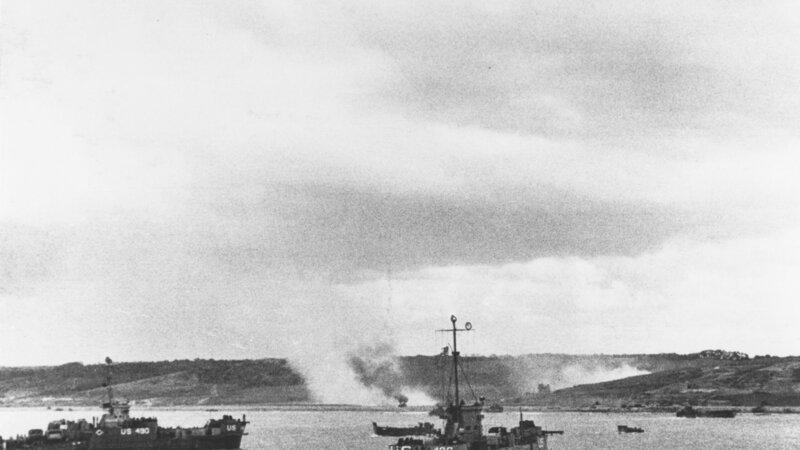

At 6:30 in the morning on June 6, 1944, the ramps of the Higgins boats dropped on Omaha Beach, and men stepped — or were pushed by the surge behind them — into water that came up to their chests, their necks, sometimes over their heads entirely. The ones who made it to the sand often wished, in those first minutes, that they hadn’t. Before most Americans on the home front had sat down to breakfast, thousands of Allied soldiers had already fallen on that stretch of Norman coastline — and the world would spend the next several decades still trying to figure out exactly how many of them had died.
The ‘4,414’ Figure: Authoritative, and Incomplete

For generations, the number most people encountered when they asked how many died on D-Day was 4,414. It appeared in textbooks, documentaries, and government memorials. It carried the weight of authority. And it was, in important ways, incomplete.
The breakdown behind that figure gives it a human geography: 2,501 Americans, 1,449 British, 391 Canadians, and 73 men drawn from the other Allied nations — Free French, Norwegians, Australians, and others — who crossed the Channel alongside them. Each number represents a national wound, a generation of families who received telegrams rather than sons. The scale of D-Day casualties across all Allied nations made June 6, 1944, one of the most costly single days in the history of modern warfare.
Where did 4,414 come from? It was compiled from military records assembled under wartime pressure, by clerks working in conditions that made precision nearly impossible. Units were still in contact with the enemy. Radios were down. Men listed as “whereabouts unknown” were often carried on the books that way for weeks before anyone dared write the word “dead” beside their name. The system was built for speed, not for archival accuracy — and the dead paid the price of that priority in the form of administrative limbo.
What the 4,414 figure also fails to capture is the full scale of what a single day cost. Total Allied casualties on D-Day — wounded, captured, and missing alongside the confirmed dead — reached at least 10,000 men. Measured against that broader toll, even 4,414 feels like a narrow window onto an immense catastrophe.
Omaha Beach: Where the Math Became Unbearable

If you want to understand why the D-Day death toll took decades to count accurately, Omaha Beach is where that story begins. Approximately 2,400 Allied casualties fell on that single sector — meaning roughly half of all D-Day losses were concentrated in a killing ground barely a mile wide.
The reasons for that concentration were tactical and brutal. The bluffs above Omaha gave German defenders an almost perfect field of fire. The draws — the narrow ravines through which men had to funnel to escape the beach — were zeroed in by machine guns before the first American boot touched the sand. The amphibious Sherman tanks meant to provide armored cover sank in the Channel chop, taking their crews with them. The bombers tasked with cratering German fortifications released their loads too late, burying their ordnance in Norman farmland miles inland. Every safety net had been cut before the ramps dropped.
And then the chaos created a secondary catastrophe in the record books. Bodies were carried out to sea by the tide and never recovered. Dog tags were lost, blown free, or simply never found. Men from units shattered in the first minutes were folded into improvised squads under officers they had never met, fighting under no paper trail at all. A soldier who died at Omaha at 7 a.m. might not appear in any official accounting for months — if he appeared at all.
That is the arithmetic of Omaha: not just the human cost, but the documentary wreckage left behind — a filing disaster that would take historians and memorial organizations the better part of a century to begin untangling. The Normandy landings as a whole were the largest seaborne invasion in history, but it was at Omaha where that ambition met its most catastrophic friction.
The Necrology Project: Correcting History Name by Name
Decades after the guns went quiet, a small team of researchers began doing something that no wartime clerk had ever had the luxury of attempting: they tried to identify every single person who died on June 6, 1944, by name. The National D-Day Memorial’s Necrology Project cross-referenced sources that had never before been examined simultaneously — pension files, repatriation records, grave registries, unit diaries held in archives across four countries, and oral histories collected from veterans before they, too, were lost to time.
The result surprised even experienced military historians. The project identified not 4,414 Allied dead, but 4,436 — a discrepancy of 22 men. Twenty-two people who had been miscounted, omitted, or swallowed by the administrative chaos of the day, and who had spent decades as a rounding error in someone else’s accounting. The revised figures placed 2,519 Americans among the dead, alongside 1,917 soldiers from other Allied nations.
Twenty-two sounds like a small number against the backdrop of a battle this vast. It is not. Each of those 22 men had a family, a hometown, a face. Each had been carried on the wrong side of a ledger — present in the world one morning, absent from the record the next, and absent from the corrected record for decades after that. The Necrology Project stands as one of the most painstaking acts of historical reckoning in modern military history: the slow, methodical rescue of real people from administrative limbo.
The Invisible Dead: German and French Casualties

Any honest accounting of the D-Day death toll has to grapple with the numbers that history least often discusses. German casualties on June 6, 1944, are estimated at somewhere between 4,000 and 9,000 men — a range so wide it says everything about the state of Wehrmacht record-keeping by the summer of 1944. Records were destroyed in the retreat, captured by advancing Allied forces, or simply never completed in the first place. The army that had engineered some of the most meticulous military bureaucracy in history left its D-Day dead among the least documented of any major combatant force.
Then there are the people who almost never appear in headline D-Day statistics at all: the French civilians. Approximately 3,000 French men, women, and children were killed on June 6, 1944, caught between Allied bombardment of coastal fortifications and German defensive fire in the towns and villages behind the beaches. They were not combatants. They were simply present in a landscape that had been designated a battlefield, and they died for it. Their deaths rarely make it into the standard recitation of D-Day casualties, and their absence from that recitation is its own kind of erasure.
Add the figures together — a minimum of 4,436 confirmed Allied dead, up to 9,000 German soldiers killed, roughly 3,000 French civilians — and a complete D-Day death toll likely exceeded 17,000 human lives on a single calendar day. A full accounting of D-Day’s dead across all parties transforms how we understand the true cost of June 6, 1944. It is not a war-movie number. It is barely comprehensible as a real one.
Why Counting the Dead Is Never Just Arithmetic

The gap between 4,414 and 4,436 is not pedantry. It is proof of something important about how historical knowledge actually works. Wartime records are built for operational speed, not archival precision. The agencies tasked with reconciling casualties in peacetime are chronically underfunded. And the incentives sometimes run in the wrong direction — precise totals invite precise questions about the command decisions that produced them, which gives institutions quiet reasons to let vague numbers stand.
But each generation of historians inherits tools the last generation did not have. Digitized archives allow cross-referencing that would have taken a human clerk a lifetime. DNA identification technology continues recovering and naming remains from battlefields decades old. Declassified foreign records open doors that were sealed for the entire Cold War. The “final” count, in this sense, is always provisional — not because historians are careless, but because the sources keep improving.
That is the real lesson embedded in the Necrology Project’s work. History is not fixed when the guns go quiet. It is fixed, slowly and imperfectly, by the people willing to keep counting long after the world has decided the count is done. Questions about what D-Day soldiers actually experienced continue to surface in public conversation for exactly this reason — the event still feels unresolved, because in important ways it is.
What the Numbers Mean Now

At low tide, Omaha Beach is flat and quiet. The water pulls back to reveal the same dark sand it revealed on the morning of June 6, 1944, and the bluffs above still look down on everything below them with perfect clarity. At Colleville-sur-Mer, just above the beach, the crosses and Stars of David climb the hillside in rows so precise they seem architectural — 9,388 markers in the American cemetery alone, each one a data point that was once just a missing form in a clerk’s filing tray.
The full human ledger of D-Day, assembled as carefully as current knowledge allows, looks like this: at minimum 4,436 confirmed Allied dead, with 2,519 of them American; between 4,000 and 9,000 German soldiers killed; approximately 3,000 French civilians dead in the towns and farms behind the beaches. A single day’s cost, across all parties, that likely exceeded 17,000 lives — and that no single textbook figure has ever fully captured.
The Necrology Project’s implicit message is simple and demanding in equal measure. The work of honoring the dead is not finished when a monument is built or a number is carved into a wall. It is finished — if it is ever finished — when every name has been found and correctly recorded. As of today, that work continues.
Twenty-two men moved from a footnote to a name because someone, decades after the fact, refused to let the arithmetic stand unchallenged. That is not a small thing. That is what accounting for the dead actually looks like.

 English
 Arabic
 French
 Spanish
 Portuguese
 Deutsch
 Turkish
 Dutch
Dutch
 Russian
 Romaian
 Portuguese (Brazil)
 Greek
Greek