



The ship pulled into Buenos Aires harbor and a man walked down the gangplank carrying a suitcase, a set of engineering credentials, and a name that was not quite his own. Nobody on the docks was asking too many questions in 1948, and that, for him, was the entire point.
Two Systems, One Premise

By the time the war ended in Europe in May 1945, two very different systems were already competing to absorb what Nazi Germany had built. One was official, American, and operating under presidential authorization. The other was improvised, shadowy, and running through the back corridors of Italian monasteries and Spanish consulates. Both systems shared a common premise: that certain expertise was too valuable to simply bury in the rubble.
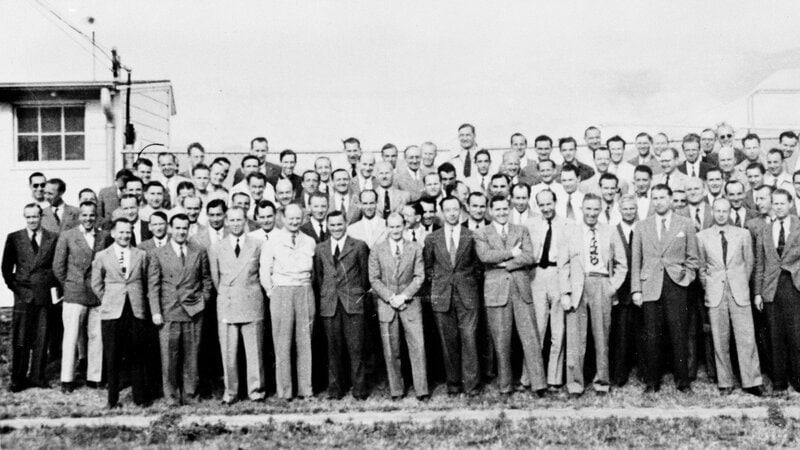
Operation Paperclip was the American answer to the question of what to do with Germany’s scientists. More than 1,600 German scientists, engineers, and technicians were recruited under the program and brought to the United States to work on the country’s most advanced weapons and space programs. Rocket engineers, aeronautics specialists, chemists — the intellectual infrastructure of the Third Reich’s war machine was systematically transferred into American laboratories and proving grounds. It was a breathtaking act of institutional pragmatism, and it worked, in the narrow sense that American aerospace and weapons development accelerated dramatically as a result.
But Paperclip was also, from the beginning, a program defined as much by what it concealed as by what it accomplished. Some of those recruited had been directly implicated in Nazi activities — including the use of forced labor at underground facilities like the Mittelwerk rocket factory, where concentration camp prisoners died building the very weapons these scientists had designed. To smooth the path through American immigration, personnel files were quietly sanitized. Criminal histories were softened or omitted entirely. The program’s architects understood that the full truth about who they were recruiting would destroy it politically, so they managed the truth accordingly.
The CIA’s own reviewers later noted that Annie Jacobsen’s book on the subject represented perhaps the most comprehensive, up-to-date narrative available to the general public on Paperclip — which itself suggests how thoroughly the program’s real scope remained obscured for decades. When the most complete public account of a classified program is a book by a journalist, the gaps in the official record are telling.
And those gaps mattered, because Paperclip’s recruiters were racing Soviet talent-hunters across a shattered continent, working fast, working selectively, and inevitably leaving people behind. Some of those left behind were caught by war-crimes investigators. Others simply vanished — southward, along routes that the American program’s secrecy had done nothing to illuminate.
The Ratlines: Europe’s Hidden Exit Routes

The word “ratline” has a nautical origin — it refers to the small rope rungs of a ship’s rigging — but in the postwar context it came to describe something altogether more sinister: the networks of false documents, sympathetic intermediaries, and strategic border crossings that funneled Nazi fugitives out of a defeated Europe and toward more welcoming shores.
The main southern route ran through Italy, where a combination of sympathetic clergy, overwhelmed Allied administrators, and the sheer chaos of postwar displacement created ideal conditions for people to reinvent themselves. From Italian ports, the route branched toward Spain and, most significantly, toward South America. Argentina was not the only destination — Brazil, Paraguay, and Chile absorbed their share — but Argentina was the most consequential. Under President Juan Perón, the country had developed an active interest in importing European technical expertise to modernize its military and industrial base, and a corresponding willingness to ask very few questions about the politics of those who arrived carrying engineering degrees and new surnames.
This was not passive negligence. Perón’s government dispatched agents to postwar Europe specifically to recruit German and other Axis-aligned technical specialists, and Argentine diplomatic missions issued the necessary paperwork with a discretion that bordered on institutional complicity. What the ratlines provided was the mechanism for transit; what Argentina provided was the destination — a country that mirrored Paperclip’s appetite for Nazi-era expertise without any of Paperclip’s bureaucratic inconvenience or its thin moral accounting.
Decades later, Argentina announced plans to declassify documents about Nazi ratline escape routes — immigration records, intelligence correspondence, and internal government communications that could finally map the Argentine end of the network with archival precision. It represents one of the most significant potential documentary releases on the subject in decades, and what it reveals about which officials facilitated which arrivals may revise important parts of the standard history.
The Knowledge That Was Worth Protecting

To understand why both systems — Paperclip and the ratlines — functioned as effectively as they did for as long as they did, it helps to think carefully about what was actually being moved. This was not simply a matter of individuals escaping punishment. It was a transfer of specific, hard-won technical knowledge: rocket engineering, jet propulsion, advanced chemistry, aeronautical design. The kind of knowledge that takes decades and enormous resources to develop from scratch, and that any power with strategic ambitions — a superpower racing a rival, or a developing nation trying to build an air force — would find difficult to refuse.
The United States understood this calculus clearly, which is why Project Paperclip sponsored the immigration of German and Austrian scientists and technicians on terms that would have been politically indefensible if fully disclosed. Argentina understood it too. German aeronautical engineers contributed to early Argentine jet development programs. Chemical and medical researchers embedded themselves in universities and state industries, often operating under assumed names that created just enough distance from their wartime biographies.
The gap Paperclip left — between the scientists it absorbed and those it missed — was never cleanly documented, because the program’s secrecy meant that records of who had been considered, recruited, or rejected remained incomplete. A shadow population of credentialed specialists simply ceased to appear in the ledgers of any official program. Some ended up in Soviet facilities. Others ended up in Argentine ones. The institutional amnesia that allowed Paperclip to sanitize the files it did keep also ensured that Western intelligence had only a fragmentary picture of where the remainder had gone.
The Hunters and the Hunted

The depth of that uncertainty becomes vertiginous when you examine what CIA files reveal about the agency’s own tracking of Nazi fugitives in South America. Declassified records show that U.S. intelligence was still actively investigating reported sightings of Adolf Hitler in South America as late as a decade after his reported suicide — searches that, whatever their ultimate evidentiary value, illustrate with remarkable clarity how thoroughly South America had become a blind spot for Allied investigators. If the agencies pursuing the most famous fugitive of the twentieth century were still, ten years on, turning over rocks in Argentina and Brazil, the picture they held of second-tier scientists and engineers was inevitably far more fragmented.
The postwar intelligence landscape was fractured in ways that made coordination nearly impossible. Denazification tribunals, the Nuremberg process, early CIA operations, and the nascent Israeli intelligence services were often working from different lists, with different priorities, across jurisdictions that rarely communicated cleanly. Individuals who understood the system — or who had handlers who did — could exploit the seams between these competing bureaucracies for years.
Private Nazi hunters frequently knew more than the agencies. Simon Wiesenthal, working from a cramped office with limited institutional resources, built his intelligence from community testimony — from survivors who recognized faces in Buenos Aires markets, who heard accents in neighborhoods where German was spoken too fluently for comfort. His network operated on human recognition rather than signal intercepts, and it was often more reliable than official channels. The capture of Adolf Eichmann in Buenos Aires in 1960 by Israeli Mossad — years after he had been living under a thin alias, commuting to work by bus, recognized eventually by someone who simply knew what he looked like — demonstrated simultaneously how successful the ratlines had been and how belated the reckoning was. Eichmann had not been brilliantly hidden. He had been hiding in plain sight in a country that lacked the motivation to look.
Argentina’s Reckoning: Files That Were Never Meant to Surface

The announced declassification of Argentine documents about Nazi ratline escape routes arrives at a moment when the documentary baseline is already shifting. CIA files now entering the public domain — including records related to the agency’s postwar investigations in South America — provide a framework against which Argentine releases can be cross-referenced, raising the prospect of a combined picture significantly clearer than either archive could produce alone.
What those Argentine files are expected to contain matters enormously. Immigration records naming the ships, the dates, and the aliases used. Intelligence correspondence tracing communications between Argentine diplomatic missions in Europe and officials in Buenos Aires who knew precisely who was coming. Internal government documents recording the decisions — not oversights, but deliberate decisions — that shaped who was welcomed and on what terms. For the first time, it may become possible to map the Argentine end of the ratline network with archival evidence rather than inference.
And yet decades of selective preservation, deliberate destruction, and periodic reclassification mean that even a full release will contain absences. Some files will simply not be there. Those absences will themselves be informative — a missing sequence of immigration records from a particular year, a correspondence thread that ends abruptly, a registry with pages that do not appear. What someone once chose to destroy tells its own story about what was worth destroying.
Mirror Images of the Same Bargain

Seen together, Operation Paperclip and the Nazi ratlines to Argentina look less like opposites than like mirror images. One was an official state mechanism — documented, authorized, and predicated on the idea that technical utility could outweigh criminal past. The other was an unofficial network — improvised, deniable, and predicated on exactly the same idea operating in different institutional clothing. Both succeeded on their own terms. Both created consequences that outlasted the Cold War that justified them. The history of Operation Paperclip that most Americans absorbed was the triumphant version — Werner von Braun at NASA, rockets reaching the moon — not the version that asked where the ones who didn’t go to Houston ended up.
The moral architecture Paperclip constructed — that certain knowledge is worth more than accountability for how it was obtained — echoed through Cold War intelligence recruitment globally and left lasting precedents about when states choose not to know what they know. Those precedents did not remain in the 1940s. They shaped the institutional cultures of agencies and governments that continued operating for generations.
Back on that Buenos Aires dock in 1948, the man with the engineering credentials and the new name walked into a city of wide boulevards and deliberate forgetting. He was a product of two systems failing simultaneously — one that grabbed selectively and moved fast, one that looked away deliberately and called it policy. The documents now being unsealed in Buenos Aires and the CIA files now entering the public domain represent the first real, systematic attempt to count who was actually there — to reconstruct the full roster of a migration that both governments had strong reasons never to complete.
The history of Nazi fugitives after World War II has always been told as though it ended with Nuremberg, or with the founding of Israel, or with the last war-crimes trial of an elderly man in a German courtroom. But the archives keep opening. They keep revealing rooms that nobody mapped, corridors connecting institutions that were never supposed to have known each other, names written in careful bureaucratic handwriting that no one was supposed to read again. The excavation is not finished. It may not be finished for a very long time.

 English
 Arabic
 French
 Spanish
 Portuguese
 Deutsch
 Turkish
 Dutch
Dutch
 Italiano
 Romaian
 Portuguese (Brazil)
 Greek
Greek