


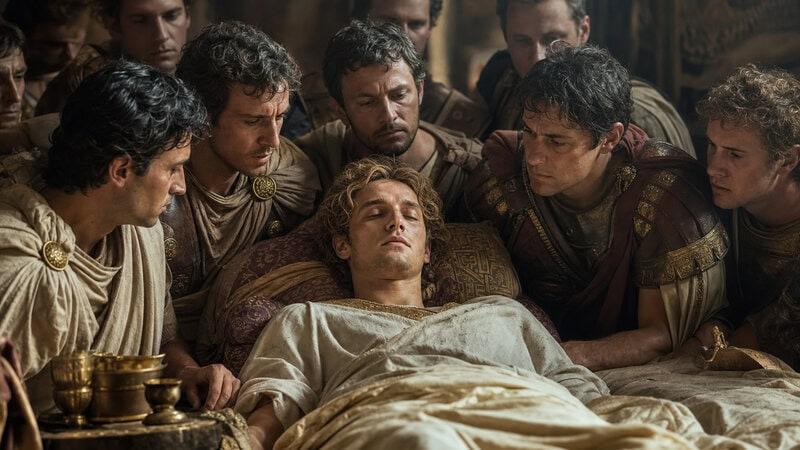

In the suffocating heat of Babylon in June 323 BCE, the greatest conqueror the ancient world had ever seen lay dying at thirty-two years old. His generals pressed close, desperate, asking who should inherit an empire that stretched from the rain-soaked hills of Greece to the scorching plains of what is now Pakistan. Alexander the Great, if the ancient sources are to be believed, gave the most Alexander answer imaginable: to the strongest.
That deathbed scene captures everything essential about the Macedonian Empire — its staggering ambition, its dependence on a single extraordinary personality, and the violence that would inevitably follow once that personality was gone. What Alexander built in roughly a decade of relentless campaigning was the largest empire in the world, surpassing the Achaemenid Persian Empire at its height and dwarfing anything Rome would claim for centuries more. And it evaporated almost as quickly as it rose.
This is the central paradox of the Macedonian Empire: no conqueror in history seized so much, so fast, and left so little of the original structure standing. The unified empire at full extent lasted roughly ten years. What came after was something categorically different — a fractured, squabbling collection of successor kingdoms that spent the next half-century tearing each other apart. To understand why, you have to start not with Alexander, but with his father.
Macedonia Before Alexander: A Kingdom No One Expected to Matter

In 359 BCE, Macedonia was not a place anyone would have bet on to conquer the world. It occupied the northern fringe of the Greek world — a rough, timber-rich kingdom of highlands and horse pastures that the more polished city-states of Athens and Corinth regarded with barely concealed contempt. Macedonians spoke a dialect of Greek that southern Greeks found difficult to follow, and their kings ruled through personal charisma and military loyalty rather than anything resembling the democratic or oligarchic institutions of the south. They were, in the eyes of the cosmopolitan Greek city-states, semi-barbarians.
What transformed this peripheral kingdom was Philip II, Alexander’s father and the true architect of Macedonian power. Philip had spent time as a political hostage in Thebes as a young man, and he returned to Macedonia having absorbed everything there was to learn from the most sophisticated military culture in Greece at that moment. He reformed the Macedonian army from the ground up, developing an infantry phalanx equipped with the sarissa — a pike roughly eighteen feet long that could shatter a conventional Greek battle line before opposing soldiers ever made contact. He paired that infantry with a devastating heavy cavalry arm, the Companion Cavalry, which would become Alexander’s signature weapon. He also proved himself a sophisticated diplomat, using marriage alliances, bribery, and carefully timed military pressure to expand Macedonian influence without always needing to fight.
By 338 BCE, after his decisive victory at the Battle of Chaeronea against a combined Athenian and Theban force, Philip stood as the dominant power in the Greek world. He organized the Greek city-states into the League of Corinth — a coalition nominally led by Macedonia — and began planning an invasion of the Persian Empire. Macedonian history in the fullest sense begins with Philip’s systematic expansion from 359 BCE onward. Alexander inherited a loaded weapon and a strategic plan already in motion, not a blank slate.
When Philip was assassinated in 336 BCE — almost certainly the result of a court conspiracy, though the full truth remains debated by historians — his twenty-year-old son moved with terrifying speed. Alexander crushed internal rivals before opposition could organize, secured the loyalty of the army, and within two years had consolidated Macedonia and turned his gaze east. The world had no idea what was coming.
The Conquests: Eleven Years, Twenty Thousand Miles

The campaign that followed belongs to a category of human achievement that is genuinely difficult to process at ordinary scale. In 334 BCE, Alexander crossed the Hellespont into Persian-controlled Anatolia with an army of perhaps forty thousand men — a combined force of Macedonians, Greeks from the League of Corinth, and allied contingents. He began by visiting Troy, making conspicuous offerings at the tomb of Achilles in a gesture that tells you a great deal about how Alexander understood himself and his mission.
The first major engagement came at the Granicus River, where Alexander led the Companion Cavalry across a contested river crossing in a move that most sober commanders would have rejected as reckless. He won decisively, and the pattern was established: Alexander fought from the front, accepted physical risk that no rational general should accept, and repeatedly converted what looked like tactical vulnerability into psychological dominance over opponents who could not anticipate someone genuinely indifferent to his own survival.
The confrontation with Darius III at Issus in 333 BCE ended with the Persian king fleeing the battlefield and his family — including his mother, wife, and daughters — falling into Alexander’s hands. Alexander treated them with conspicuous respect and courtesy, a calculated act of political theater that helped establish his claim to be not merely a conqueror but a legitimate successor to Persian royal authority. He then swept south through the Levant, conducting a brutal seven-month siege of the island city of Tyre that required building a causeway to the island, before entering Egypt in 332 BCE. There the priests at the oracle of Siwa declared him the son of the god Amun — a claim Alexander encouraged with considerable enthusiasm, because divine sanction was useful whether or not you believed in it.
The killing blow to the Persian Empire came at Gaugamela in 331 BCE, on a plain in what is now northern Iraq. Darius had chosen the ground carefully, leveling it to give his scythed chariots room to operate. Alexander’s response was to open a gap in his own line deliberately and drive the Companion Cavalry through it directly at Darius. The Persian king fled again and was later murdered by his own subordinate Bessus, handing Alexander not just a military victory but a dynastic claim to the Persian throne itself. He entered Persepolis, the ceremonial heart of the Achaemenid world, and burned the great palace — an act that ancient sources variously attribute to calculated political symbolism, personal revenge for the Persian burning of Athens in 480 BCE, or a night of excessive drinking. The truth is probably some combination of all three.
Then he kept going. East through Bactria and Sogdiana — modern Afghanistan and Uzbekistan — where a guerrilla insurgency led by the warlord Spitamenes proved far more resistant than any set-piece battle had been. North into the Central Asian steppes, founding cities as he went. And finally, by 326 BCE, into the Punjab region of what is now Pakistan, where he fought King Porus at the Battle of the Hydaspes River — an engagement that required crossing a monsoon-swollen river in darkness to achieve surprise, and which featured war elephants arrayed against Macedonian cavalry in a tactical problem that had no precedent in any Greek military manual.
At its greatest extent, the Macedonian Empire stretched from Greece and Egypt in the west to the borders of India in the east. The army that achieved this marched over twenty thousand miles in roughly eleven years. They crossed the Hindu Kush in winter. They fought in deserts, river deltas, high mountain passes, and monsoon-flooded plains.
The army mutinied only once — at the Hyphasis River in the Punjab in 326 BCE, where soldiers who had been away from home for nearly a decade refused to march further east. It was the only time Alexander’s will was ever successfully defied, and by all accounts it broke something in him. He turned back toward Babylon, choosing a punishing desert route through the Gedrosian wasteland that killed thousands, in what some historians interpret as unconscious punishment directed at men who had finally told him no.
Alexander was not merely a destroyer, though destruction followed him. He founded more than twenty cities across the territories he conquered — outposts of Greek urban culture planted from Egypt to Central Asia, many of which became significant commercial and intellectual centers. He adopted Persian court customs, titles, and dress, which enraged his Macedonian officers and contributed to a series of violent confrontations, including the killing of his close friend Cleitus in a drunken argument and the execution of his official historian Callisthenes on charges of conspiracy. Whether Alexander’s adoption of Persian customs reflected genuine political vision — a desire to build a blended Greco-Persian civilization — or was primarily a tool of legitimacy that he rationalized philosophically is a question historians have been arguing about for two thousand years.
How Long Did the Empire Actually Last?

The honest answer requires a distinction. The unified Macedonian Empire, as Alexander conceived and administered it, lasted roughly a decade at full strength — from the fall of Persepolis around 330 BCE to Alexander’s death in Babylon in June 323 BCE. Even that framing is generous. The empire’s administrative coherence was largely aspirational; what actually held it together was Alexander himself — his presence, his capacity for violence when necessary, and the intensely personal loyalty his soldiers felt toward him rather than toward any institution, law, or idea of Macedonian statehood.
The moment he died, the Wars of the Diadochi — meaning the Successors — began. What followed was roughly forty years of warfare among his senior generals that dismembered everything he had assembled. Ptolemy, one of Alexander’s childhood friends and senior officers, seized Egypt and founded a dynasty that would last nearly three centuries, ending only with the death of Cleopatra VII in 30 BCE. Seleucus seized Persia and Mesopotamia, founding the Seleucid Empire. Antigonus, Cassander, and Lysimachus fought savagely over Macedonia, Greece, and Anatolia in shifting coalitions. None of them, despite occasional attempts and essentially unlimited ambition, ever came close to reuniting what Alexander had assembled.
By 275 BCE — less than fifty years after Alexander’s death — the single empire had fragmented into at least three major successor states and a constellation of smaller kingdoms. The unified Macedonian Empire was, functionally, a historical event rather than a durable political structure.
Why Did It Collapse So Completely?

The structural weakness was almost architectural in its simplicity: Alexander was the empire’s only load-bearing wall, and he had made no serious provision for what would hold the structure up when he was gone.
The succession situation at his death was genuinely catastrophic. His only legitimate heir was an infant — his son Alexander IV, born posthumously to his Bactrian wife Roxana. His half-brother Philip Arrhidaeus, who had some claim to the throne, suffered from a cognitive disability that made effective rule impossible. Into that vacuum stepped men with armies, and men with armies in the ancient world do not defer to infants or compromised regents for long. The first regent, Perdiccas, was murdered by his own officers within two years. Roxana and young Alexander IV were eventually murdered on the orders of Cassander in 310 BCE, eliminating the last direct heirs of the Argead dynasty.
Beyond the succession crisis, the loyalty that had held the army together was irreducibly personal. Macedonian soldiers followed Alexander — his physical courage, his recklessness, his habit of leading cavalry charges from the front and somehow surviving, his ability to endure the same hardships he asked of his men. That quality of loyalty does not transfer by inheritance or institutional assignment. Each senior general commanded his own faction’s devotion, and those factions immediately began competing once the unifying figure was absent.
Geography made everything worse. Governing a contiguous territory stretching from Greece to the borders of India, without reliable roads connecting the extremities, without a unified bureaucratic system capable of functioning independently, without any communications technology faster than a horse — this was functionally impossible to sustain through an extended period of contested succession. The empire was too large for its own administrative infrastructure, and Alexander had spent his energy conquering new territory rather than building the systems, institutions, and local power-sharing arrangements that might have held existing territory together across a generational transition.
Compare this to the Achaemenid Persian Empire that Alexander replaced: the Persians had governed their vast territories for two centuries through a sophisticated system of provincial governors called satraps, a royal road network that enabled rapid communication, and a deliberate policy of leaving local religious and cultural institutions intact. Alexander adopted some of these tools but never had time — or perhaps inclination — to fully embed them in a self-sustaining system before his death.
What the Empire Left Behind: A Legacy Larger Than Its Lifespan

The Macedonian Empire’s brevity as a political structure is almost misleading as a measure of its historical importance, because what it seeded outlasted everything.
The Hellenistic Age — roughly 323 to 31 BCE — saw Greek language, philosophy, science, and artistic styles spread across the Middle East and Central Asia along the paths Alexander’s armies had opened. The Library of Alexandria, one of antiquity’s great intellectual monuments, grew from the city Alexander founded at the mouth of the Nile in 331 BCE. Greek became the administrative and cultural lingua franca of the eastern Mediterranean and much of the Near East for centuries after the empire that spread it had ceased to exist.
When Jewish scholars in Alexandria translated the Hebrew scriptures into Greek during the third century BCE, producing the text known as the Septuagint, they were working in the linguistic world Alexander’s conquests had created. When the authors of the New Testament wrote their texts four centuries later, they wrote in Greek — not because they were Greek, but because Greek was the shared educated language of the entire eastern Mediterranean world. Euclid developed his foundational work in geometry at Alexandria. Archimedes worked within the intellectual tradition that Hellenistic culture sustained. The philosophical schools of Athens continued to attract students from across the Greek-speaking world that the Macedonian conquests had defined.
The trade networks that military conquest opened became precursors to the Silk Road connections between the Mediterranean and Central Asia. Greek-influenced art styles appear in Buddhist sculpture from Gandhara — modern Pakistan and Afghanistan — centuries after any Macedonian soldier had set foot there. The cultural transmission set in motion by ten years of conquest continued operating for five hundred years afterward.
The successor kingdoms themselves were not negligible. The Ptolemaic dynasty governed Egypt with considerable sophistication for nearly three centuries. The Seleucid Empire, at its height, controlled territory from Anatolia to Bactria and served as a crucial intermediary between Mediterranean and Asian trade networks. These were not ruins of Alexander’s achievement — they were its mature flowering, the form the Macedonian encounter with the wider world took once the chaos of conquest had settled.
Alexander’s Empire in Context: What Made It Different

Placing the Macedonian Empire in comparative perspective clarifies both its achievement and its limits. The Achaemenid Persian Empire, which Alexander destroyed, had governed comparable territory for roughly two centuries before its fall — sustained by deep administrative roots, a coherent royal ideology, and a system of provincial governance that survived multiple dynastic crises. The Roman Empire, which would eventually absorb much of the same territory that Alexander had conquered, lasted in its western form for roughly five centuries, and its eastern successor — the Byzantine Empire — endured for nearly fifteen hundred years. Rome built roads, codified law, extended citizenship, and constructed bureaucratic institutions that could function without any particular emperor. Rome was a system. The Macedonian Empire under Alexander was, at its core, an extension of one man’s will — and extraordinary as that will was, it could not outlast him.
This is not to diminish what Alexander achieved. The speed and scale of his conquests remain, by any military-historical standard, astonishing. He never lost a battle. He adapted his tactics to radically different terrain, opponents, and logistical conditions across eleven years of continuous campaigning. He held together a multinational army far from home through a combination of charisma, shared danger, and the forward momentum that made stopping feel more dangerous than continuing. These are genuine achievements that military historians have studied carefully for generations.
But achievement in conquest and achievement in governance are different skills, and Alexander’s genius was overwhelmingly concentrated in the former. The empire he built was, structurally, a performance — magnificent, unprecedented, and inseparable from its performer.
The Macedonian Empire’s Enduring Significance
Return, finally, to that deathbed in Babylon. When Alexander reportedly said to the strongest, he may have been describing not merely a succession arrangement but the fundamental logic of everything he had constructed — a structure built entirely on personal force, on the will of one individual whose particular combination of military genius, physical courage, and annihilating ambition was genuinely without precedent.
Alexander the Great and the Macedonian Empire matter to us now not primarily because of what the empire was as a political structure — it was too short-lived and too dependent on a single personality for that — but because of what it put into motion. The Hellenistic world it created became the cultural substrate within which early Christianity spread, within which Greco-Roman science and philosophy developed, and within which the eastern and western ends of the ancient world began to exchange goods, ideas, and artistic forms with an intensity that would not be matched again for centuries.
Julius Caesar, visiting Alexandria as a young man, reportedly stood before Alexander’s tomb and wept — overcome by the feeling that he had accomplished nothing of significance at the same age. The ghost of that ten-year empire haunted ambitious men for generations. It represented something seductive and ultimately impossible: the idea that one person’s will could be large enough to hold the world together by force of personality alone. Alexander proved that it could, briefly. History proved that briefly is not the same as lastingly. He won the world. He simply could not give it anywhere to go after him.

 English
 Arabic
 French
 Spanish
 Portuguese
 Deutsch
 Turkish
 Dutch
Dutch
 Italiano
 Romaian
 Portuguese (Brazil)
 Greek
Greek