




Sergey Ryzhov/Shutterstock
Starting a new hobby or interest can be intimidating. This is particularly true for something like drinking whiskey, where there are not only countless options at most liquor stores but also a centuries-old culture and set of expectations that can make newbies nervous about selecting a few bottles for their home bar. For help, we turned to master mixologist Justin Lavenue, co-owner of The Roosevelt Room and owner-operator of both The Eleanor and RoadHaus Mobile Cocktails. He provided three styles and characteristics novice whiskey fans should avoid: "barrel-strength" spirits, heavily peated Scotches, and bottles selected just for hype or rarity.
Before breaking down the specifics, Lavenue offered an important caveat to his recommendations. "I'm always hesitant to tell someone to avoid a whiskey, because taste is subjective and [if] a beginner's first sip of a 130-proof bourbon or heavily peated Scotch causes the clouds to part and angels to sing," he noted, "who am I to interfere with divine intervention?"
His guidance on what to avoid is generally precautionary, designed to help new imbibers enjoy the spirit in an approachable way. In his words, novices should avoid these spirits "before the drinker has learned to separate alcohol heat, oak, sweetness, spice and smoke."
Avoid barrel-strength and high-proof whiskey
Liudmila Chernetska/Getty Images
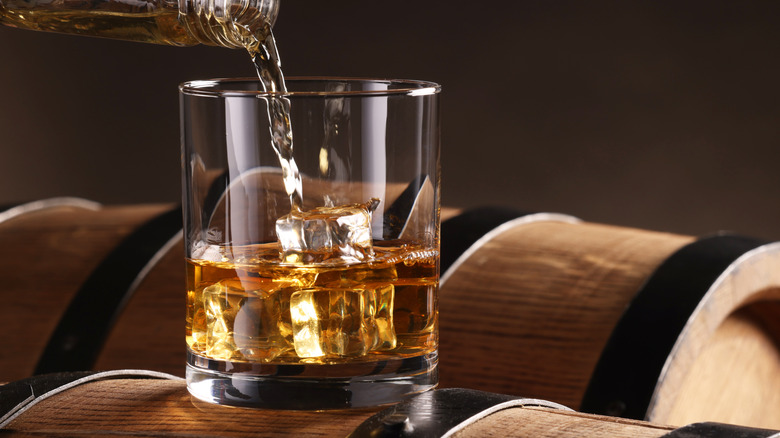
Barrel-strength or high-proof whiskies are an easy first category newbies should avoid. Also known as cask-strength, these spirits are sold at a higher proof (or alcohol content) than most regular whiskies. Typically, this is above 50% alcohol by volume — closer to the undiluted strength at which the whiskey ages in the barrel — rather than the roughly 40% of most normal varieties.
Naturally, this extra booze packs a punch. Justin Lavenue described starting out with one as "a little like teaching someone to swim by dropping them into the North Atlantic." By keeping your first few whiskey choices under 100 proof (50% ABV), he said drinkers will enjoy "enough flavor and structure to understand the whiskey without making the first tasting note simply, 'My tongue is on fire.'"
Skip the ultra-peaty Scotch

Adilson Sochodolak/Shutterstock
The second type of whiskey worth skipping is heavily peated Scotch. For those unfamiliar with the terminology, peat is a dense mix of decomposed vegetation and other substances that's burned to smoke the barley used in Scotch whiskey before distilling. This can create a powerfully smoky taste and aroma that practically transports you to Scotland, similar to the way various woods are used to imbue barbecue with particular flavor.
To be sure, many drinkers love the experience. Unfortunately, others can't stand peat's unmistakable taste and aroma, which is why Justin Lavenue strongly recommends at least sampling a prospective peaty Scotch at a bar or other establishment before purchasing. "There's no need to spend good money discovering that your preferred flavor profile does not include licking a fireplace while standing on a rocky beach," he observed.
Save the rare, hyped, or collectible bottles for later

Drazen Zigic/Shutterstock
Beginner whiskey drinkers also should avoid bottles that are heavily hyped, rare, or collectible. The reasons for this are numerous, according to Justin Lavenue. "Scarcity is not a flavor note," he pointed out. "An allocated bottle may be fantastic, but being hard to find does not make it automatically better for your palate than something sitting on every liquor store shelf in America."
In addition, these types of whiskey rarely come cheap. For example, the world's most expensive bourbons can easily reach into the thousands or even 10s of thousands. And forking over an entire month's mortgage or rent for a bottle you don't enjoy is undoubtedly enough to deter most newbies from continuing in the whiskey hobby.
Instead, Lavenue suggested using familiar and affordable benchmark brands to "learn whether you gravitate toward corn sweetness, rye spice, malt, fruit, oak, smoke, or sherry influence." Once you've established your favorites, you can spend on well-known (and high-priced) bottles, confident that they won't go to waste.
What beginners should buy instead

L.O.N Dslr Camera/Shutterstock
Fortunately, Justin Lavenue also has some helpful hints and advice about what whiskey beginners should buy instead. First, he suggests experimenting with a wide selection of different types. "Whiskey covers an enormous spectrum of flavor," he noted, "so I think the smartest introduction is to taste a handful of approachable benchmarks from different categories and pay attention to what changes from glass to glass."
That doesn't mean he doesn't have a few specific choices worth considering. Among bourbons, that's Maker's Mark, which he praised for showing "the softer, rounder side of the category," along with "balanced and easy to read" Four Roses Small Batch. His rye recommendations include Willet, which he called a "useful teaching bottle" due to its high proof and sufficient spice and structure, noticeable in cocktail recipes like Manhattans. Meanwhile, the Scotch-curious should grab a bottle of Balvenie or Monkey Shoulder, drinkable malt entry points into the diverse variety Lavenue called "a universe, not a flavor."
Although there are certainly broad do's and don'ts when it comes to beginners and whiskey, it's vital to remember it's a lifelong learning process. As Lavenue puts it, "The goal is not to find your forever whiskey on Day One. Where would the fun be in that?"

 English
 French
 Spanish
 Portuguese
 Deutsch
 Turkish
 Dutch
Dutch
 Italiano
 Russian
 Romaian
 Portuguese (Brazil)
 Greek
Greek