



Just before sunrise on the Theban plain, a Roman general — or a poet, or an emperor — would stand in the desert dust, heart quickening, waiting for a stone colossus to speak. And then it did: a low, resonant tone, somewhere between a harp string snapping and a human sigh, rising from the cracked quartzite figure as the first rays of Egyptian dawn touched its ancient face.
A Sound That Stopped an Empire in Its Tracks

For centuries, one of the two immense statues standing sentinel on the west bank of the Nile was said to emit a musical sound at the moment of sunrise — reliably enough, and strangely enough, to draw pilgrims, scholars, and rulers from the farthest edges of the ancient world. The geographer Strabo made the journey and recorded it with careful skepticism. The historian Pausanias came and left convinced. Most famously, the Roman Emperor Hadrian traveled to the site in 130 CE with his court, waited in the predawn chill, and reportedly was not disappointed. His visit inspired commemorative verses carved by members of his retinue directly into the statue’s legs, joining hundreds of other inscriptions left by awed travelers across the decades.
Three questions shadow these stones, and none of them is simple: What was that sound? Who built these giants, and why? And why does the singing statue sing no more?
Stone Giants on the West Bank
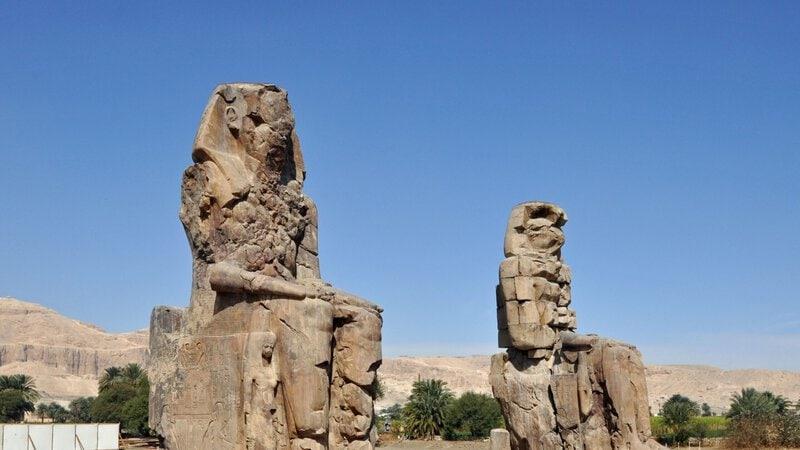
To visit the Colossi of Memnon today is to experience a particular kind of vertigo — the sensation of something impossibly large appearing somewhere impossibly ordinary. They rise from flat agricultural land on the west bank of the Nile near modern Luxor, the city built over the bones of ancient Thebes, like two petrified gods who simply decided to stop walking. Each stands more than 18 meters tall, and that is before accounting for the pedestals beneath their feet.
Up close, the statues are battered by time in ways that make them more affecting, not less. Their quartzite faces are eroded to a kind of serene blankness, features softened by roughly 3,400 years of wind and flood. The side panels of their thrones carry carved reliefs of Hapy — the god of the Nile inundation — binding the lotus and papyrus plants of Upper and Lower Egypt together: a visual declaration of unified royal power that visitors have been reading, misreading, and marveling at since before the Roman Republic was founded.
Behind them, where one of the largest mortuary temple complexes ever built in ancient Egypt once stretched toward the limestone cliffs, there is now largely open field. The temple has almost entirely vanished, quarried for building stone across millennia, leaving its two great guardians standing alone like sentinels outside a house that no longer exists. Local Arabic tradition has given the statues names that carry their own quiet poetry: el-Colossat and es-Salamat — names that stitch the ancient world to the living one and remind you that these stones have never been truly abandoned.
Amenhotep III: The Pharaoh Who Built on a Superhuman Scale

The man who ordered these giants into existence was Amenhotep III, an 18th Dynasty pharaoh who ruled Egypt in the 14th century BCE during what many historians regard as one of the civilization’s supreme golden ages — a reign of prosperity, diplomatic sophistication, and architectural ambition that has rarely been matched. He built temples at Luxor and Karnak, filled his court with art of extraordinary refinement, and corresponded as near-equals with the rulers of Babylon and Mitanni. He was, in short, a pharaoh who understood exactly what colossal monuments were for.
The colossi were not decorative whims. They were guardians — supernaturally scaled images of the pharaoh himself, positioned to protect his mortuary temple, which was at the time of its construction the largest such structure ever raised in Egypt. The temple served as the ritual home of Amenhotep III’s divine afterlife, where priests maintained his cult and ensured his eternal union with the gods. The statues, facing east toward the rising sun, embodied that eternal vigilance: the pharaoh keeping watch in stone long after his body had returned to dust, his gaze locked permanently on the horizon where Ra was reborn every morning.
The logistics of making them remain breathtaking. The statues are believed to have been carved from single blocks of quartzite sandstone quarried near modern Cairo and transported hundreds of miles to the Theban plain — a feat requiring not just technical skill but an entire civilization’s coordinated human effort. The scale of Amenhotep III’s building program was, by any measure, among the most audacious undertaken in the ancient world.
The Song of Memnon: How a Greek Myth Hijacked an Egyptian Monument

When Greek and Roman travelers began arriving at Thebes in significant numbers — after Alexander the Great’s conquest of Egypt in 332 BCE opened the country to the Mediterranean world — they brought their own stories with them and laid them, with characteristic confidence, over the ones already there. The northern statue, the one that made the sound, became identified not with Amenhotep III but with Memnon: the Ethiopian king and Trojan War hero, son of Eos, the goddess of the dawn. The mythological fit was irresistible. A statue that sang at sunrise, facing the rising light — what could that be but a son greeting his mother as she drove her chariot across the sky each morning?
Ancient sources described the sound with remarkable consistency: a ringing, musical tone, sometimes compared to a plucked harp string, sometimes to a trumpet’s note, sometimes simply to a human voice. It occurred at the moment of sunrise, most reliably during the cooler months, and was understood by virtually everyone who witnessed or reported it as something extraordinary — a form of divine communication, the boundary between the natural and the supernatural dissolving in the desert air.
The inscription record is one of the most extraordinary aspects of the site’s ancient history. More than 100 Greek and Latin inscriptions carved by visitors into the lower portions of the statues survive — an ancient guestbook written by Roman soldiers, provincial governors, tourists, and at least one empress. They record the date of the visit, whether the sound was heard, how many times it rang out, and the emotional reaction it provoked. They are at once deeply human documents — people writing their names on something magnificent because they wanted it known they were there — and rare, direct evidence that the phenomenon was genuinely witnessed by a wide range of people across at least two centuries.
The Science Behind the Mystery

Modern researchers have proposed an explanation that is elegant without being deflating. The northern statue was severely damaged — most likely by a major earthquake that struck the region around 27 BCE — and that damage left its quartzite body riddled with fractures and micro-cracks. Quartzite is a porous stone, and cracked quartzite behaves in interesting ways when temperature shifts rapidly. In the Egyptian desert, the gap between predawn cold and the warmth of first direct sunlight is dramatic and swift. As the stone expanded unevenly — different sections warming at different rates, moisture evaporating from the cracks, stress propagating through fractured rock — it would have vibrated. Those vibrations, resonating through the enormous mass of the statue, could produce audible sound. Thermal expansion in cracked stone creating acoustic phenomena has been documented at other ancient sites, and the physics, while not trivial, requires no appeal to the supernatural.
The crucial and genuinely tragic plot twist comes around 199 CE. The Roman Emperor Septimius Severus visited the site and ordered the damaged upper portion of the northern statue restored with new stone blocks — an act of imperial piety, or perhaps imperial tidiness. The renovation was well-intentioned. It was also fatal to the legend. After the repairs were completed, the singing stopped. The new stone, uniform and uncracked, no longer possessed the internal architecture necessary to vibrate and resonate at sunrise. The silent colossus that stands today is partly a monument to a well-meaning emperor who accidentally silenced one of antiquity’s great wonders.
Honest uncertainty deserves its place here. Some ancient accounts were almost certainly embellished, and the inconsistency in descriptions — a harp string, a trumpet, a voice — suggests that different people heard different things, or that some heard nothing and reported it anyway, as travelers occasionally do. But the physical mechanism is plausible, the inscription record is real, and the phenomenon drew one of history’s most powerful rulers across hundreds of miles of desert to stand in the cold and listen. Something was happening at that broken statue in the Egyptian dawn.
Layers of Time: From Pharaoh to the Present

The centuries after Septimius Severus were not kind to the Colossi’s celebrity. As Christianity spread through Egypt and the old religious meanings of the site faded, and later as Islamic Egypt reshaped its relationship with pre-Islamic antiquity, the statues settled into long, quiet semi-obscurity — enormous and unmissable, but no longer the object of pilgrimage from across the known world. They became landscape, as monuments eventually do when the civilization that made them legendary retreats far enough into the past.
The 19th century changed that. European travelers flooding into Egypt in the wake of Napoleon’s expedition — and feeding the Romantic era’s appetite for ruins and lost grandeur — rediscovered the Colossi with fresh eyes. The cultural moment that produced Shelley’s Ozymandias was exactly the right one for two colossal, eroded pharaonic faces staring out of the desert, their temple gone, their purpose half-forgotten. The statues became famous again, this time as emblems of time’s indifference to human ambition — which is, of course, not what Amenhotep III had in mind at all.
Archaeological work since the 1990s has dramatically expanded understanding of the site. Excavations beneath the surrounding fields have begun to reveal the staggering footprint of Amenhotep III’s mortuary temple — statues, columns, sphinxes, and artifacts continuing to emerge from the soil with each new season. Ongoing restoration work has brought other statues from the complex back to public view, and the picture of what once stood here grows richer and more astonishing as digging continues.
Today, the Colossi of Memnon stand in the open air without a ticket gate or perimeter fence — accessible to anyone who walks across the plain toward them at any hour. Tour buses stop. Photographs are taken. The statues receive all of this with the same expression they have worn for thirty-four centuries: serene, slightly eroded, entirely unimpressed.
What These Stones Still Have to Say
The Colossi of Memnon are that rare thing: a monument that belongs to multiple civilizations without quite belonging to any of them. The Egyptians made them as an act of divine architecture. The Greeks and Romans renamed them, mythologized them, and made them a destination. Arabic culture integrated them into the living landscape. Each layer of story remains legible in the stone — in the intent of the original builders, in the Latin verses scratched by Roman visitors, in the names the statues carry today.
What the singing phenomenon reveals, most of all, is something important about how the ancient mind worked — or rather, how the ancient heart worked, which is not so different from our own. The boundary between a natural event and a divine message was porous, available to wonder. A sound from a cracked stone at dawn was not a curiosity to be explained away but a communication to be received. That emperors, poets, and ordinary travelers made long, difficult journeys to stand before a statue and listen tells us less about credulity than about the enduring human need to be in the presence of something larger than ourselves — something that seems, however briefly, to speak.
Stand at the Colossi of Memnon before the tour groups arrive, in the particular stillness of an Egyptian morning when the sky above the necropolis cliffs is going gold and the surrounding fields are still silver with night, and you will understand the impulse entirely. The sound is gone. The temple is gone. The pharaoh who built them, the empire that renamed them, and the emperor who silenced them are all gone. But the stones remain exactly where Amenhotep III placed them — outlasting every civilization that came to marvel, still meeting every sunrise, still watching.

 English
 Arabic
 French
 Spanish
 Portuguese
 Deutsch
 Turkish
 Dutch
Dutch
 Italiano
 Russian
 Romaian
 Greek
Greek