


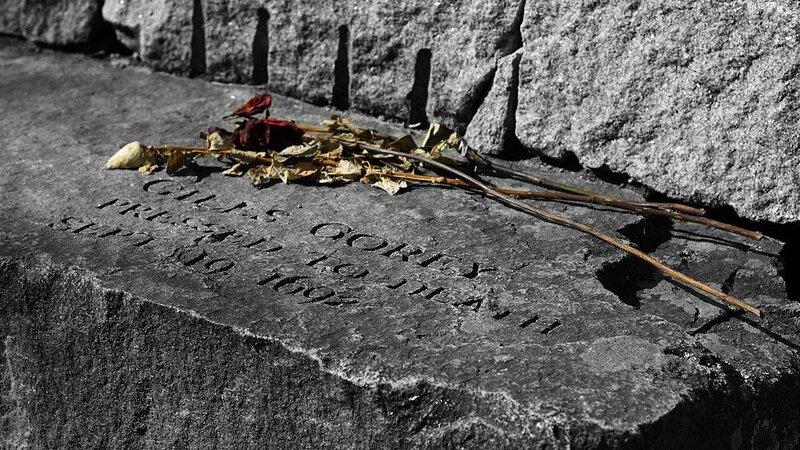

On a cool September morning in 1692, an eighty-one-year-old man lay in an open field near the Salem Town jail while his captors stacked heavy stones onto his chest, one by one, demanding a single word from him. He gave them two: more weight.
The Man Who Refused to Speak — and Why It Mattered

The procedure was called peine forte et dure — strong and hard punishment — and it was, by design, an instrument of compulsion. Say something. Enter a plea. Acknowledge the court’s authority over you. For three days, Giles Corey refused. He was pressed to death in Salem in September 1692, becoming the only person in American colonial history to die by this method. In doing so, he may have accomplished something no one else caught inside the machinery of the Salem witch trials managed: he turned the court’s own tool of coercion against it.
This is not simply a story about a victim. The Salem witch trials claimed the lives of nineteen people hanged on Gallows Hill and one man crushed beneath stones. But Corey’s death stands apart — not only because of its particular brutality, but because it was a deliberate choice made by a man who understood exactly what silence could accomplish that words could not.
A Hard Man on 150 Acres

To understand what Giles Corey was protecting — and why he was willing to die slowly to protect it — you have to understand who he was before the accusations came. Giles Corey was born in England around 1611, which made him eighty-one years old at the time of his death, a remarkable age for any colonial American and a testament to the particular durability of the man. He immigrated to Massachusetts Bay and spent decades building himself into a figure of real local consequence in Salem Village, the area now known as Danvers, Massachusetts.
By 1692, Corey owned approximately 150 acres in Salem Farms — a substantial landholding that placed him firmly among the prosperous farmer class of the region. He was not a fringe figure or a social outcast whose persecution could be easily dismissed. He was a man with deep roots in the soil he farmed, known to his neighbors across decades.
He was also, by any honest reckoning, not a gentle soul. In 1676, Corey beat a farmhand named Jacob Goodale so severely that the man died. He was fined for the act but never tried for murder — a fact that speaks less to his innocence than to the protections that property and social standing could buy in colonial Massachusetts. The portrait that emerges is of someone stubborn, acquisitive, occasionally brutal, and entirely accustomed to surviving the consequences of his own actions.
His third wife, Martha, complicates and deepens that portrait. She was a woman of deep religious conviction and unusual intellectual courage — sharp enough to look at the spreading accusations of 1692 and say, publicly, that she did not believe them. In a community vibrating with fear and theological anxiety, that kind of skepticism was not safe. It made her a target. And because she was his wife, it made him one too. The site of the Giles and Martha Corey home preserves something of what their lives in that community represented.
How the Accusations Swept Them Both Up

Martha Corey was accused first. Her vocal doubts about the trials — her refusal to treat the afflicted girls’ testimony as unquestionable — made her precisely the kind of woman the accusers found threatening. If people like Martha were right to be skeptical, the entire edifice of the proceedings began to wobble. So she was charged, and the accusations against her were rendered in the lurid terms the court had come to expect.
Giles was formally charged with witchcraft on April 18, 1692. But before suspicion reached him directly, he made what would later look like a serious error in judgment: in the early days of Martha’s examination, he had given testimony that could be read as working against her — apparently calculating that distance from her case might protect him. It did not. The hysteria consuming Salem Village in the spring of 1692 was not a force that respected careful positioning. It consumed neighbors, church members, and apparently husbands who had tried to hedge their bets.
The cruel irony settled heavily. Here was a man who had escaped legal accountability for actual violence against an actual human being, now facing execution for an imaginary crime conjured by neighbors in a community he had farmed for decades. The law that had once shielded him would not shield him now.
The Legal Trap — and the Loophole Corey Found

The legal mechanics of Corey’s situation are worth understanding plainly, because they are the key to everything that followed. Under English common law, a court could not try a defendant who refused to enter a plea. The procedural response to that silence was peine forte et dure: the defendant would be pressed with heavy weights until they agreed to plead — or died.
What made Corey’s silence strategic rather than merely obstinate was what Massachusetts Bay law meant for a convicted person’s estate. Someone formally convicted of a capital crime faced not only execution but the forfeiture of their property to the colonial government, leaving their heirs with nothing. A person who died without ever entering a plea, however, could not be formally convicted. The estate could pass intact to the children. The court would get a body, but it would not get the land.
Corey had watched enough of the trials to understand the arithmetic. Pleading meant a trial. A trial in Salem in 1692 meant a guilty verdict — the conviction rate before the Court of Oyer and Terminer was, in practice, absolute. Guilty meant hanging, and it meant his 150 acres, his farm, everything he had built across eight decades, stripped away from his family. Silence meant dying slowly under stones, but it meant his heirs kept what was theirs.
The bitter ingenuity of it deserves a moment’s consideration: the court’s instrument of compulsion — the crushing weight designed to force compliance — became, in Corey’s hands, the mechanism of his final act of resistance. He turned their tool against them. The Massachusetts Historical Society’s account of his pressing captures the grim deliberateness of what he chose.
Three Days Under the Stones

The pressing began on September 19, 1692. The field outside the Salem Town jail was not a private space — witnesses gathered around the spectacle of an old man and a growing pile of stones. Sheriff George Corwin oversaw the procedure, returning repeatedly to ask whether Corey would enter a plea and spare himself further weight.
Each time, according to the accounts that have survived, Corey’s answer was the same: more weight. The phrase has carried through more than three centuries precisely because of what it refuses. It refuses fear. It refuses the legitimacy of the proceeding. It refuses to give the court the one thing it actually needs — his participation in his own destruction. It is the response of a man who has worked out exactly what his silence is worth and decided the price is one he will pay.
Over roughly three days, the stones did their work. Giles Corey died without ever entering a plea. He was, as recorded in the historical documentation of Salem’s witchcraft crisis, the only person in American colonial history to die by pressing.
What His Death Actually Accomplished

Three days after Giles Corey died in that field, on September 22, 1692, Martha Corey was hanged on Gallows Hill alongside seven others. His refusal did not save her. That truth should not be softened or argued around — the tragedy of their parallel ends is real, and the cost of his defiance was paid in full by both of them.
But Corey’s death accomplished something beyond the property question. The spectacle of an eighty-one-year-old man crushed to death over the course of three days, demanding more stones, was witnessed, reported, and discussed throughout the colony. It was impossible to frame as justice. It was difficult to observe without asking what exactly the Court of Oyer and Terminer believed it was doing.
By October 1692, Governor William Phips had suspended the court. The following year, the remaining accused were released. Colonial opinion had shifted, and it had shifted in part because of moments like the one in that field — moments where the machinery of the trials exposed itself as something that decent people could no longer keep defending. Corey’s death was not the only cause of that collapse, but it was among the most visible and the hardest to explain away. The ongoing public discussion of Corey’s case reflects how persistently it captures the imagination, precisely because its meaning remains so layered.
As for the property itself — historians debate the degree to which Corey’s legal strategy fully succeeded in protecting his estate from seizure. The intent, however, was clear. A man of eighty-one, facing certain death by one means or another, chose the form of death that denied the court a conviction. That is a remarkable calculation, and it deserves to be called what it is: strategy, not merely stubbornness.
Why Giles Corey Still Matters
The phrase more weight has lived for more than 330 years. It appears in Arthur Miller’s The Crucible, in poetry, in discussions of civil resistance wherever someone is trying to describe what it looks like to refuse to legitimize a process that has already decided you are guilty. It endures because it names something true: that there are moments when the most powerful thing a person can do is refuse to speak on the court’s terms, refuse to play the role the system insists you play.
Corey was not a saint. He was a hard, property-minded, occasionally violent man whose final act of resistance was at least partly about acreage and inheritance. He had beaten a man to death and paid a fine and returned to his farm. He had, in the early stages of the crisis, given testimony that worked against his own wife. He was fully human — which is to say fully complicated — which is to say that his story is more honest and more instructive than a simple martyr’s tale would be.
What his story reveals about the Salem witch trials, beyond what a list of executions can convey, is this: even inside a machinery of mass delusion and legal terror, individuals made choices. Some confessed falsely in order to survive. Some pleaded innocent and hanged. One old farmer, who had spent eighty years being exactly as difficult as the world required him to be, found a third way — one written in silence and stones and a phrase that has outlasted everyone who was there to hear it.
He asked for more weight. History gave him more time. In the way that matters most, he got exactly what he wanted.

 English
 Arabic
 French
 Spanish
 Portuguese
 Turkish
 Dutch
Dutch
 Italiano
 Russian
 Romaian
 Portuguese (Brazil)
 Greek
Greek