


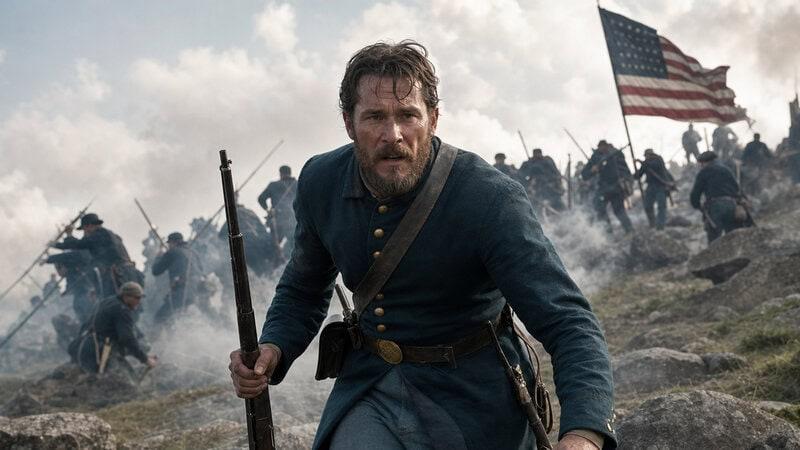

The man crests the boulder-strewn slope of Little Round Top in July 1863, lungs burning, rifle hot, the Alabama line surging upward through smoke so thick it tastes like sulfur. For a few seconds, the chaos is total — and then a director yells cut, a costume assistant hands someone a water bottle, and the whole terrible beauty of the American Civil War collapses back into craft services and call sheets. Hollywood has staged that hill, and a thousand hills like it, for more than a century. Sometimes the result is shattering and true. Sometimes it is pure invention dressed in period wool. The difference matters more than most audiences realize — and knowing how to tell the two apart changes how you watch every film in the genre.
Why the Civil War Became Hollywood’s Favorite War

No other conflict in American history has supplied filmmakers with raw material quite like the Civil War of 1861-1865. Estimates place the death toll somewhere between 620,000 and 750,000 soldiers — more American lives than any other war the country has ever fought — and behind those numbers lies an almost inexhaustible reservoir of tragedy, moral complexity, and unresolved argument. The war did not end so much as it transformed, its wounds going underground and resurfacing in legislation, in monuments, in memory, and inevitably in movies.
From the silent era onward, directors understood that the Civil War was not simply history — it was a mirror. D.W. Griffith’s The Birth of a Nation (1915) arrived at a moment when Jim Crow laws were being hammered into place across the South, and the film weaponized the so-called Lost Cause myth with ruthless efficiency, recasting Confederate defeat as noble tragedy and Black Americans as the story’s villains. That it was also a technical landmark — advancing the grammar of film editing, including innovations in cross-cutting and close-up work that influenced decades of filmmakers — makes it one of the most dangerous artifacts in American cinema. Its lies were told beautifully, and they stuck.
The genre never stopped evolving. Hollywood Reporter critics identify Glory, Gettysburg, and Cold Mountain among the landmark Civil War films — titles that span several decades and reveal how radically the genre’s moral compass has shifted, even if it has never fully corrected course. And the pipeline keeps moving: a film titled Gettysburg 1863 was rounding out its cast as of January 2026, proof that Hollywood’s appetite for the war remains nowhere near exhausted.
What the Best Civil War Films Actually Get Right

The films that historians consistently praise share a single quality: they trust the real story to be dramatic enough. They do not reach for invented set pieces when the documented record is already almost unbearable.
Glory (1989) is the clearest example. Edward Zwick’s film follows the 54th Massachusetts Infantry, one of the Union Army’s first Black regiments, through its formation, its internal battles against systemic racism within the army itself, and finally its assault on Fort Wagner on July 18, 1863 — a charge that was tactically a disaster and symbolically a turning point. The film does not romanticize. It shows men fighting for a country that had not yet decided whether to count them as human, and it earns every moment of its emotional power through fidelity to what actually happened. For anyone beginning to explore Civil War cinema, Glory is the necessary first stop.
Gettysburg (1993), adapted by Ronald F. Maxwell from Michael Shaara’s Pulitzer Prize-winning novel The Killer Angels, reconstructs the three-day battle of July 1-3, 1863 with painstaking attention to troop positions, commanders’ dialogue drawn from letters and memoirs, and the tactical logic — or tragic illogic — of Pickett’s Charge, in which roughly 12,500 Confederate soldiers walked across three-quarters of a mile of open ground toward entrenched Union artillery. The film is long, deliberately paced, and occasionally stiff in its dialogue. It is also among the most historically rigorous Civil War films ever produced, developed in consultation with historians and shot on the actual Gettysburg battlefield, giving its landscapes an authenticity no studio backlot could replicate.
Less celebrated but equally honest in its way is Ang Lee’s Ride With the Devil (1999), which takes the camera to the guerrilla war burning through Missouri and Kansas — a theater of the conflict where no front lines existed, where neighbor turned on neighbor, and where the violence was intimate and personal in a way that pitched-battle films rarely capture. Most Civil War movies ignore this dimension of the war almost entirely. Lee does not, and the result is an underseen film that complicates every clean narrative the genre loves to tell. Its portrait of young men radicalized by cycles of retaliation carries a contemporary resonance that helps explain why it deserves far more attention than it has received.
What Hollywood Consistently Gets Wrong

The most visible failure is battle choreography. Films routinely show soldiers charging in neat, shoulder-to-shoulder lines long after the actual fighting has dissolved into chaos — a visual choice that obscures the central military reality of the war. By 1862, the rifled musket had made those parade-ground formations catastrophically dangerous. A trained soldier could hit a target accurately at 300 yards or more. The casualty rates at Antietam, at Cold Harbor, at Spotsylvania were staggeringly high precisely because tactics developed for smoothbore muskets — weapons accurate only to roughly 50 yards — were being executed against far more lethal technology. Hollywood tends to make the charges look heroic and symmetrical. The historical record suggests they looked like organized slaughter.
Then there is the Lost Cause, the mythology that The Birth of a Nation mass-marketed and that countless films through the mid-20th century quietly reinforced: the idea that Confederate soldiers were noble defenders of a regional way of life, that the war was about states’ rights and honor, that slavery was incidental rather than central. Historians have spent decades dismantling this distortion, and the primary sources — Confederate leaders’ own secession declarations, Alexander Stephens’s Cornerstone Speech of March 1861, in which the Confederate vice president explicitly named slavery as the “cornerstone” of the new government — make the war’s cause unambiguous. Yet the mythology proved extraordinarily resilient onscreen, partly because it generates the kind of symmetrical tragedy that filmmakers find irresistible. Two sides, both honorable, both suffering. It is a more comfortable story than the truth, and comfort sells tickets.
Cold Mountain (2003) is visually gorgeous and emotionally resonant, but its portrait of the Confederate home front softens the coercive, often violent reality of a society holding four million people in bondage while simultaneously demanding that poor white men die to preserve it. The film finds poetry in its protagonists’ longing without fully reckoning with what surrounds them. That selective focus is not unique to Cold Mountain — it runs through the genre like a fault line.
Perhaps the deepest blind spot is demographic. Films almost universally under-represent the approximately 180,000 Black soldiers who served in the Union Army, the guerrilla wars tearing through Appalachia and the border states, and the experience of enslaved people who liberated themselves — often at tremendous personal risk — by fleeing to Union lines. These are the stories that most complicate a clean hero-versus-villain narrative, and their absence from most Civil War cinema is itself a historical argument, made in silence.
A Viewer’s Guide: Civil War Films Ranked by Historical Honesty

For viewers building a watchlist, a rough hierarchy of trustworthiness is useful — not to dismiss the less accurate films, but to watch them with appropriately calibrated eyes. Think of it less as a ranking of quality and more as a guide to how much independent reading each film demands alongside it.
- Tier 1 — Trustworthy: Glory and Gettysburg earn the top positions. Both were developed with historian input and hew close to documented events, characters, and timelines. They are the genuine entry points for anyone serious about understanding what the war actually looked like on the ground.
- Tier 2 — Flawed but Valuable: Cold Mountain, The Red Badge of Courage (1951), and Ride With the Devil take liberties — composite characters, compressed timelines, softened social contexts — but illuminate authentic emotional and material textures of the era. Watch them, then read around them.
- Tier 3 — Entertaining Fiction: The Outlaw Josey Wales (1976) uses the war’s aftermath as Western mythology rather than history. Clint Eastwood’s Confederate guerrilla is a revenge fantasy, not a document. Yet the film honestly conveys something real: the post-war trauma and displaced violence that haunted both sides of the conflict for generations, and the impossibility of simply returning to ordinary life after years of killing.
- A Category of Its Own: The Birth of a Nation is technically groundbreaking and historically catastrophic. It is essential viewing precisely because understanding its lies explains how America misremembered its own bloodiest chapter for half a century. Watch it last, watch it critically, and do not watch it without reading about its production history and its real-world consequences — including its role in inspiring a resurgence of Ku Klux Klan activity in the 1910s and 1920s.
Alex Garland’s Civil War and the Genre’s Modern Evolution

The most provocative entry in recent American war cinema is not set in the 1860s at all. Alex Garland’s Civil War (2024), produced by A24, is a dystopian war-thriller set in a near-future United States fractured by armed conflict. The film follows a team of war journalists — played by Kirsten Dunst, Wagner Moura, Cailee Spaeny, and Stephen McKinley Henderson — traveling from New York City to Washington, D.C. as the country disintegrates around them. It is deliberately vague about the political causes of the conflict, a choice that divided critics but served a clear artistic purpose: Garland is interested in what civil war feels like from the inside, not in adjudicating its politics.
By stripping away period costumes and familiar battles, Garland forces audiences to confront what internal armed conflict actually does to human perception: the moral vertigo, the collapse of shared reality, the journalist’s impossible attempt at neutrality while the world burns. There is no comfortable distance of history. The suffering is contemporary, the politics deliberately unresolved, the discomfort fully intentional. Viewers who found the film’s political ambiguity frustrating may have been expecting it to function as historical allegory. Garland seems to have had something harder in mind — a phenomenology of war itself, stripped of the narrative scaffolding that usually makes it bearable to watch.
The film’s release reignited a debate that has always lurked beneath the surface of American war cinema: what are Civil War movies actually for? Do they teach us what happened? Do they use the past as a lens for the present? Do they allow audiences to process anxieties too raw to address directly? Garland’s implicit answer is that the experience of war — what it does to human perception, to moral clarity, to the stories people tell themselves — may be more honestly rendered by abandoning historical specificity altogether. It is a paradox worth sitting with, and one that the next generation of Civil War filmmakers will have to contend with whether they intend to or not.
Why the Blind Spot Still Matters

With Gettysburg 1863 in development as of early 2026, the next wave of Civil War cinema is already forming. Whether it deepens historical honesty or retreats to familiar myths will depend partly on audience demand and partly on whose stories the filmmakers choose to center. The choices directors make — which regiment to follow, which death to linger on, which cause to render sympathetically — are not neutral aesthetic decisions. They are arguments about history dressed in cinematography, and they shape how millions of people understand a war that still has direct consequences for American law, politics, and identity.
The battle scenes Hollywood gets right are the ones where directors accepted an uncomfortable truth: the Civil War was not a clash of equally noble causes, and the camera’s choice of whose suffering to show is itself a historical statement. The scenes Hollywood gets wrong are the ones where the pull toward symmetrical tragedy — toward the romance of lost causes and gallant charges — proved stronger than the pull toward accuracy.
A nation that cannot agree on what its most consequential war was about will keep making movies about it. The gap between what those movies show and what the historical record actually says remains one of the most revealing blind spots in American popular culture. Closing it, even partially, requires viewers willing to ask not just whether a battle scene looks spectacular, but whether it is true — and to understand that the answer to that question is never merely aesthetic.

 Arabic
 French
 Spanish
 Portuguese
 Deutsch
 Turkish
 Dutch
Dutch
 Italiano
 Russian
 Romaian
 Portuguese (Brazil)
 Greek
Greek