


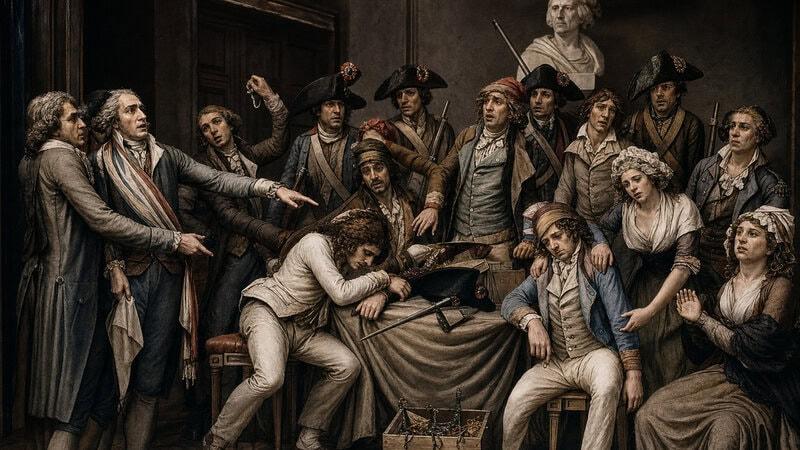

The steel tracks shriek. Riders plunge through a darkened cavern, inverting, spiraling, the Seoul skyline invisible somewhere above the ceiling of Lotte World’s vast indoor adventure zone. The ride is called French Revolution — and for about ninety seconds, that name is pure, gleeful, theme-park hyperbole. Then you learn what the real French Revolution actually did to the people who started it, and the name suddenly carries a great deal more weight.
What Most People Get Wrong About the French Revolution

Most people carry the same postcard image in their heads: powdered wigs tumbling into straw-lined baskets, aristocrats finally receiving the wrath of starving peasants, a righteous mob dismantling a rotten monarchy. It is a satisfying story — the oppressed rise, the oppressors fall, justice arrives in the most dramatic fashion imaginable. It is also, in crucial ways, incomplete.
Historians estimate that approximately 17,000 people were officially executed during the Reign of Terror, the brutal period between September 1793 and July 1794 when the revolutionary government turned its machinery of death on the French population. The breakdown of who actually died is the real shock. Nobles — the powdered-wig crowd of popular imagination — made up roughly 8 percent of those guillotined in Paris. The remaining 92 percent were clergy, peasants, middle-class citizens, and, in a twist that permanently reframes the story, the revolutionaries themselves.
That single statistic flips the French Revolution from a triumphant uprising into something far more unsettling: a cautionary tale about how radical movements consume themselves. It is a pattern that has echoed through every century since. And the revolution itself lasted far longer than the single dramatic year most readers picture — a full decade, from 1789 to 1799, ending only when a young general named Napoleon Bonaparte staged a coup and declared the chaos finished.
The Reign of Terror and How It Turned on Its Own

By September 1793, France was genuinely besieged. Austrian and Prussian armies pressed at the borders. The royalist Vendée region had erupted into a civil war so savage it would eventually claim hundreds of thousands of lives. Grain was scarce, inflation was savage, and the fragile republic felt as though it might shatter at any moment. Into this atmosphere of crisis stepped the Committee of Public Safety, with Maximilien Robespierre as its ideological engine, and it made a fateful decision: suspicion would become official government policy.
The Law of Suspects, passed in September 1793, is one of the most chilling documents in the revolution’s history. Under its terms, anyone who “behaved suspiciously,” failed to demonstrate sufficient patriotism, or was denounced by a neighbor could be arrested without detailed charges. The definition of “enemy” expanded so rapidly and so elastically that it soon swallowed the revolution’s own architects.
Georges Danton had been one of the revolution’s great thunderous voices — a man whose physical presence and oratorical power had helped propel the republic into existence. By April 1794, he was arguing that the Terror had gone too far, that France needed to find a path back toward mercy. He went to the guillotine for it, condemned by the very tribunal he had helped create. Weeks before Danton’s execution, the radical journalist Jacques Hébert — the darling of Paris’s most militant poor — was executed for being deemed too extreme. Too much revolution. Too little revolution. The charges almost did not matter. What mattered was that Robespierre’s committee had decided, and the blade fell.
Of the roughly 2,700 people guillotined in Paris alone, the aristocracy was almost incidental. Peasants, artisans, priests, merchants, and committed republicans who had simply landed on the wrong side of a shifting political line — these were the people filling the tumbrils.
Portraits of the Condemned

Marie Antoinette did go to the guillotine in October 1793, and her death is the one the postcards remember. But walk a few names further down the ledger and you find Olympe de Gouges — playwright, abolitionist, and early feminist who had written the Declaration of the Rights of Woman and of the Female Citizen, demanding that the revolution’s promise of liberty actually extend to half the human race. Robespierre’s government had her executed for publishing a pamphlet it disliked. She had not defended the monarchy. She had pushed the revolution to be more revolutionary. It killed her for the presumption.
In the provinces, the methods became even more industrial. In Nantes, the representative on mission Jean-Baptiste Carrier organized what became known as the noyades — the drownings. Priests, Vendée rebels, and suspected counter-revolutionaries were loaded onto barges on the Loire River, the barges were scuttled, and the prisoners drowned en masse. Estimates of those killed in the Vendée region through executions, summary killings, and military campaigns run into the tens of thousands. When historians widen their accounting to include all Terror-related deaths — official executions, summary killings, and prison deaths from disease and violence — the total reaches somewhere between 40,000 and 50,000 people.
The cycle completed itself with a kind of dark, inevitable logic on July 27, 1794 — 9 Thermidor on the revolutionary calendar. Robespierre, the architect of the Terror, the man who had sent Danton, Hébert, and Olympe de Gouges to their deaths in the name of virtue and the republic, was arrested by members of the very National Convention he had terrorized into submission. He was guillotined the following day. The machine had finally consumed the man who fed it.
Why Did the Revolution Eat Itself?

There is a structural logic to the Terror, even if there is no moral defense of it. France in 1793 was a state fighting for its life on multiple fronts simultaneously. The Committee of Public Safety genuinely believed that unity was survival, and that unity meant the elimination of anyone who questioned the pace, direction, or methods of change. Dissent was reframed as treachery. Moderation became evidence of corruption.
Robespierre articulated this through the concept of “virtue” — his vision of the ideal republic required citizens of perfect civic morality and undivided loyalty to the revolutionary project. Any private interest, any expressed doubt, any negotiation with moderates was, by definition, proof that you harbored the seeds of counter-revolution. It was a closed logical system that could only ever produce more victims, because the definition of purity could always be tightened one more turn.
Historians of the period see the Terror not as an aberration but as a prototype. The same grammar — the same language of betrayal, purity, and the enemy within — reappears in the Soviet purges of the 1930s, in Maoist China’s Cultural Revolution, in Cambodia under the Khmer Rouge. Each time, the revolution’s most committed believers discover that the revolution has decided they are insufficiently committed. The question the history poses is deeply uncomfortable: at what point does a movement to liberate people become the thing it was fighting against, and how quickly can that transformation happen?
The Lotte World Coaster: A Name That Carries More Than Its Riders Know

On July 12, 1989, the French Revolution roller coaster at Lotte World in Seoul opened to the public. The timing is pleasingly layered: 1989 was the year the Berlin Wall fell, and it fell exactly two centuries after the revolution the ride commemorates. Lotte World debuted that year as one of the largest indoor theme parks on earth, and the French Revolution coaster — a Vekoma-manufactured steel coaster — was one of the park’s two opening coasters and its signature attraction, announcing the adventure zone’s ambitions to visitors walking through the door.
The ride accommodates 28 passengers per cycle, welcomes anyone 120 centimeters or taller, and runs daily from 10:00 to 20:55. Coasterpedia classifies it as a steel, sit-down, extreme coaster — theme park language for the kind of experience that inverts your body, scrambles your sense of direction, and deposits you back at the platform slightly unsure which way is up. Riders have been putting it through its paces for more than three decades, and reviews on Captain Coaster confirm it still delivers the disorientation its name implies.
Theme park designers reach for “revolution” because it promises exactly what a roller coaster promises: the world turned upside down, chaos contained within a steel structure, danger that resolves safely in about ninety seconds. It is thrilling shorthand. But the naming carries an unintentional depth. The real French Revolution also turned the world upside down — it simply had no mechanism to guarantee a safe landing, and it made no promises about who would still be standing when the ride stopped.
What the Guillotine’s Ledger Actually Tells Us

The Reign of Terror was not primarily an aristocratic bloodbath. Strip away the mythology and what remains is a political civil war waged by revolutionaries against each other, against the church, and against ordinary citizens ground up in the machinery of ideological paranoia. The nobles were present — Marie Antoinette was real, and her execution was real — but they were a single thread in a much larger, much darker tapestry.
The numbers deserve to be stated plainly, because they are the kind of facts that permanently alter the picture: approximately 17,000 official executions during the Terror; between 40,000 and 50,000 total Terror-related deaths when the full accounting is done; roughly 8 percent of those guillotined in Paris were of noble birth. The rest were the people the revolution claimed to represent.
None of this erases what the revolution achieved. The Declaration of the Rights of Man and of the Citizen, the abolition of feudalism, the permanent end of divine-right monarchy in France — these were extraordinary ruptures with a brutal past, and they rippled forward through two centuries of democratic development. They were real. They mattered. They were paid for, in part, with the blood of the very people who made them possible.
Every revolution — the real kind and the steel-track kind — promises the same thing: the thrill of the drop, the rush of turning the world upside down, the exhilaration of a world remade. The question that the history of 1793 and 1794 burns into anyone who looks closely is always the same one: who gets to walk away from the ride?

 English
 Arabic
 French
 Spanish
 Portuguese
 Turkish
 Dutch
Dutch
 Italiano
 Russian
 Romaian
 Portuguese (Brazil)
 Greek
Greek