


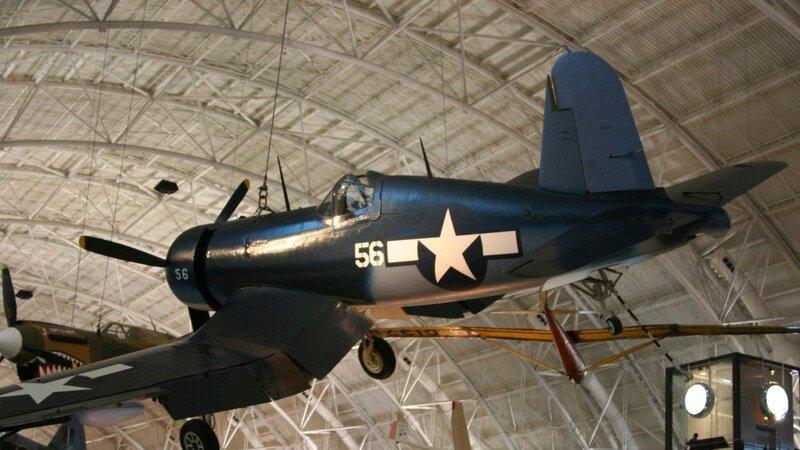

The Zero pilot saw it before he heard it — a bent-winged silhouette dropping out of the Pacific glare at a speed nothing in Japanese inventory could match, its distinctive gull-wing shape cutting the sky like a bird of prey caught mid-stoop. By the time the sound reached him, a rising mechanical shriek from the air intakes that Japanese aviators would come to dread, it was already too late to do much about it.
Born From an Impossible Brief

To understand why the Vought F4U Corsair looked the way it did — that unmistakable inverted gull wing, that predatory, elongated nose — you have to go back to 1938 and a design competition that amounted to an engineering dare. The United States Navy wanted a carrier-based fighter that could outrun, outclimb, and outgun anything flying over any ocean. The specification was so demanding that Chance Vought’s engineers essentially had to start with the most powerful engine available and then build an airframe around it.
The engine they chose was a Pratt & Whitney R-2800 Double Wasp radial, an air-cooled eighteen-cylinder powerplant producing around 2,000 horsepower in later variants and already delivering 1,850 horsepower in early production form. Its frontal diameter created an immediate, almost comic cascading problem: a propeller large enough to actually harness all that power required blades running to nearly thirteen feet in length. Mount those blades on a conventional undercarriage, and they would strike the flight deck on landing. The wheels would need to be implausibly tall to provide clearance, and tall, spindly landing gear was a recipe for catastrophe on the pitching, rolling deck of a carrier at sea.
The solution was elegant and audacious in equal measure: bend the wing. By cranking the wing roots sharply downward in an inverted gull configuration, Vought’s designers could shorten the main landing gear legs dramatically — keeping them stout and sturdy — while still giving the enormous propeller the ground clearance it demanded. The result was a silhouette unlike anything else in the Pacific sky, one that would become among the most recognized shapes in aviation history.
The obsession with performance did not stop at the wing geometry. Chance Vought’s team flush-mounted every stud on the entire airframe, sinking each fastener so that the skin was almost uncannily smooth to the touch. This was an extraordinary level of aerodynamic fastidiousness for a production warplane of the era, born from the understanding that at the speeds they were targeting, even a protruding rivet head created measurable drag. Every detail answered to the same imperative: go faster.
May 1940 to June 1942: Prototype to Production

The XF4U-1 prototype first flew on May 29, 1940, and during early flight testing it became the first American fighter to exceed 400 miles per hour in level flight — a threshold that had seemed almost theoretical, the kind of speed associated with experimental racers rather than production machines destined for fleet service. The first production F4U-1 flight occurred in June 1942, arriving in a world already transformed by Pearl Harbor and the brutal opening months of Pacific war.
The aircraft’s physical presence matched its performance figures. Sitting on the ground, it had the look of a machine coiled under pressure: the long greenhouse canopy positioned far back along the fuselage, giving the nose an almost exaggerated length; the three-bladed propeller so large it seemed disproportionate until you remembered the engine it was taming; the gull-wing dihedral lending the whole assembly an organic tension, like a hawk with its wings set for a dive. Test pilots found it powerful and responsive in ways that set it apart from anything else in the American inventory — alive in a way that commanded both respect and wariness. It rewarded skill and punished inattention.
And yet, for all its record-breaking brilliance in the air, the Corsair was about to be told it was too dangerous for the job it had been built to do.
The Navy Says No: Carrier Landing Problems That Grounded a Legend

Carrier qualification trials exposed a set of problems that, taken together, made the Corsair a genuine hazard in the specific, unforgiving environment of a flight deck approach. The long nose that gave the aircraft its predatory grace in the air became a serious obstacle on final approach: pilots flying the characteristic nose-high attitude of a carrier landing found their forward visibility nearly eliminated by the engine cowling, leaving them to judge their approach by peripheral glimpses and feel alone. A bad bounce on touchdown — and the Corsair’s stiff undercarriage made bad bounces relatively easy to achieve — could send the aircraft veering into the carrier’s island superstructure with lethal consequences.
There was also a tendency, under certain low-speed, high-power conditions, to drop the left wing sharply and with little warning — a consequence of propeller torque. In the thin margins of a carrier approach, where speed is low and altitude is measured in feet, an unexpected wing drop was the kind of event that ended careers and lives simultaneously.
The Navy’s decision was consequential: the F4U was declared unsuitable for carrier operations. While the Grumman F6F Hellcat — a capable, honest aircraft, easier to fly and more forgiving on approach — became the primary carrier fighter of the Pacific war, the Corsair was handed to land-based Marine Corps squadrons. It would fight from jungle airstrips in the Solomons rather than from the fleet carrier decks it had been designed to protect. For the engineers at Chance Vought, who had built the fastest fighter in American service, it was a stinging paradox.
1943: Into Combat and Into Myth

If the Marines resented being handed the Navy’s castoff, they did not show it for long. When Marine Corps squadron VMF-124 took the Corsair into combat over the Solomon Islands in February 1943, the results were immediate and decisive. The Corsair’s speed gave its pilots something invaluable in fighter combat: choice. They could engage or disengage on their own terms, dictating the conditions of every encounter against Japanese aircraft that might be more maneuverable at low speeds but could not keep pace in a dive or a high-speed run.
The six .50-caliber M2 Browning machine guns mounted in the wings delivered a weight of fire that was simply devastating. And the Corsair’s rugged construction — heavier and more robust than many of its contemporaries — meant it absorbed punishment that would have destroyed lighter aircraft and still brought its pilot home. Over the course of the war, the F4U Corsair achieved a kill ratio of approximately 11:1 against enemy aircraft in air-to-air combat. That figure, read carefully, is not merely a statistic — it is a portrait of systematic, overwhelming dominance.
Japanese pilots reportedly came to call it “Whistling Death,” a name earned by the distinctive sound the aircraft’s air intakes produced at high speed — that rising mechanical shriek signaling a Corsair already in a dive and already too fast to escape. Aces including Gregory “Pappy” Boyington, commanding the famous Black Sheep Squadron VMF-214, built their legends in Corsair cockpits. Their individual stories gave a human face to what the numbers already showed: this was one of the most lethal fighter aircraft of the war, winning from dirt strips in the South Pacific.
Redemption: How the British Solved What Americans Couldn’t

The decisive turn in the Corsair’s carrier story arrived from an unexpected direction. While the U.S. Navy held firm in its carrier prohibition, the British Royal Navy’s Fleet Air Arm began operating Corsairs from their own ships — and making it work. British carrier pilots demonstrated that the aircraft’s landing problems, while real, were not insurmountable. They developed a curved approach technique that kept the flight deck in view for longer on final, sidestepping the visibility problem that had bedeviled American trials.
British operational experience, fed back into American thinking alongside incremental modifications from Vought — most critically, a raised pilot seat that gave pilots meaningfully improved forward visibility on approach — gradually dismantled the case against carrier qualification. By 1944 and into 1945, the U.S. Navy had reversed its position. Corsairs were flying from American fleet carriers, joining the final, brutal air campaigns of the Pacific war and striking at targets on the Japanese home islands alongside the Hellcats that had displaced them.
The arc of that reversal is the Corsair’s story in miniature: an aircraft declared too dangerous, too flawed, too difficult — proving, through the stubbornness of its performance and the ingenuity of those who refused to abandon it, that the early verdict had been premature.
Legacy: The Longest Run, Korea, and Why It Still Matters

The F4U Corsair holds a production record that speaks to how completely the early doubts were overcome: it has the longest production run of any American piston-engined fighter, with manufacture continuing until 1953 — eight years after the end of the war it was built to fight, and well into the age of jet aircraft. That longevity was not sentiment; it was pragmatism. The Corsair remained genuinely useful, and the market for it — including export customers such as France and New Zealand — kept the lines running.
When war returned to the Pacific rim in Korea, the Corsair went back to work. Flying close air support missions over the Korean peninsula, carrying bombs and rockets against ground targets, it proved that a design conceived before Pearl Harbor could hold its relevance against a new kind of conflict. Corsairs flew from both land bases and carrier decks during the Korean War, and U.S. Marine Corps pilots in particular valued the aircraft’s ability to deliver ordnance accurately in close support of ground troops — the same rugged reliability that had brought pilots home from the Solomons now serving the ridgelines of Korea.
It is worth being precise about what the Corsair represents in the broader sweep of American aviation. It was not a perfect aircraft. The early carrier landing problems were genuine, not bureaucratic timidity, and pilots died learning its limits. But the distance between that initial rejection and the aircraft’s eventual record — years of production, two wars, thousands of combat missions, an 11:1 kill ratio — is the measure of how thoroughly those early limits were understood, addressed, and transcended.
Today, the Corsair endures as one of the most recognized and celebrated warbirds in the world, a fixture of airshows, a centerpiece of museum collections, a shape that aviation enthusiasts identify instantly from almost any angle. When one passes overhead — that distinctive gull-wing silhouette against the sky, the radial engine’s deep, uneven rumble — it is still possible to feel something of what those first Marine pilots felt climbing into the cockpit in 1943: the recognition that you are sitting inside something built, with absolute conviction, to be the fastest and most dangerous thing in the air.
The bent wing was an engineering necessity, forced into existence by an engine too powerful and a propeller too large for any conventional solution. The carrier rejection was a real stumble in a story still very much in progress. But together, those two facts — the wing that looked wrong until you understood it, and the setback that eventually gave way to vindication — define what the Corsair’s history is really about: the kind of determined, iterative engineering that doesn’t accept an early failure as a final verdict, hammered into aluminum and horsepower, and proven right at four hundred miles per hour.

 English
 Arabic
 French
 Spanish
 Portuguese
 Deutsch
 Turkish
 Dutch
Dutch
 Italiano
 Romaian
 Portuguese (Brazil)
 Greek
Greek