


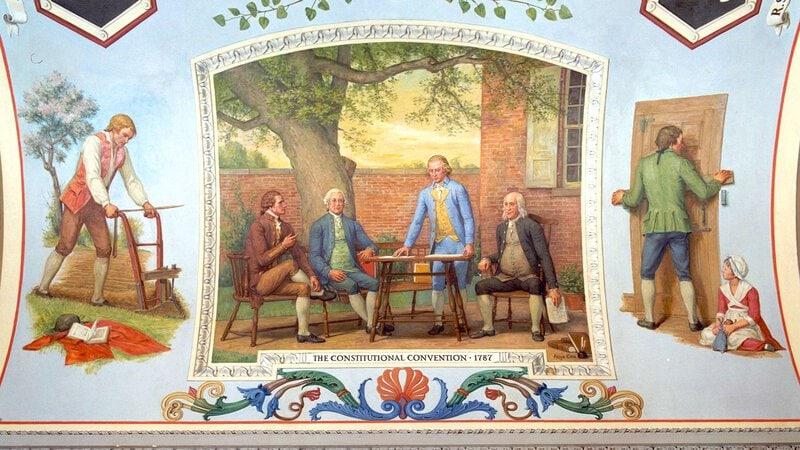

On a sweltering June morning in 1788, Patrick Henry rose inside the Virginia ratification convention and unleashed one of the most ferocious speeches in American political history — warning, in thunderous waves, that the proposed Constitution would devour liberty and hand despots the keys to a continent. Across the room sat James Madison, pale, exhausted, and quietly terrified, because he knew that if Virginia said no, the whole fragile experiment might collapse before it had drawn a single breath.
The Room Where It Almost Died

Eight states had already said yes. One more was needed. Under Article VII of the proposed Constitution, nine of the thirteen original states had to ratify the document before it could take legal force — and Virginia, the most populous state in the union, was still dangerously on the fence. New York, the commercial engine of the young nation, was equally undecided. Without them, a new government might technically exist on paper while being utterly unable to function in reality.
The stakes clarify the weight of a single word. To ratify is not to applaud, to acknowledge, or to agree in some loose conversational sense. It is to give formal, legally binding approval to an act that would otherwise carry no legal force whatsoever. It is the moment a document stops being a proposal and starts being the law you actually live under. In June 1788, millions of Americans who had never cast a vote on the matter were about to have that word applied to them — permanently.
Why nine states? Who nearly blocked it? And what does the ferocity of that fight reveal about the concept of ratification itself? Those questions reach far deeper than any single convention hall.
What “Ratify” Actually Means — And Why the Word Has Always Carried Weight

The word traces back to the Latin ratus, meaning “fixed” or “settled,” combined with facere, “to make.” To ratify something is to make it settled, to nail it down with the force of formal authority. English law inherited the concept and refined it over centuries: ratification is a principal’s legal confirmation of an act performed by its agent — the way an organization might later approve a contract its representative signed before receiving proper authorization. Legal scholars define ratification as the approval or enactment of a legally binding act that would not otherwise be binding in the absence of such approval. Without it, the act simply floats — carrying moral weight perhaps, but no legal teeth.
This distinction between signing and ratification is not a technicality. Signing a treaty and ratifying it are two entirely separate legal acts with different consequences. A signature signals intent and good faith; ratification is the formal declaration of consent that actually binds a state under international law. The logic applied just as cleanly to a constitution in 1787: the delegates who gathered in Philadelphia that summer were agents, drafting a proposal on behalf of the American people. The people — or at least their representatives in special state conventions — had to ratify what those agents had produced before it became anything more than an impressive piece of parchment.
That same logic governs international agreements today. Once a treaty has been signed, each state must deal with it according to its own national procedures before ratification is complete — meaning a signature at a diplomatic summit is just the beginning of a potentially long and politically treacherous domestic journey. The Founders were navigating this exact problem in 1787, and the system they devised became the template for American constitutional law ever since.
Philadelphia’s Audacious Blueprint: The Rules the Framers Wrote for Themselves

The Constitutional Convention made two decisions that were, by any honest measure, legally audacious. The first was to bypass state legislatures entirely and require ratification by specially elected state conventions. James Madison argued the reasoning with characteristic precision: legislatures could repeal whatever they ratified, making the Constitution perpetually vulnerable to shifting political winds. A convention, by contrast, would exercise the sovereign will of the people directly — giving the document a foundation no ordinary legislature could later undermine.
The second decision was the nine-state threshold itself, and it was a deliberate act of defiance against the existing rules of the game. Under the Articles of Confederation — the law of the land in 1787 — any amendment required unanimous consent from all thirteen states. That requirement had strangled every prior attempt at reform. Rhode Island had killed a proposed federal revenue measure single-handedly in 1782 simply by refusing to ratify it. The Framers looked at unanimity and decided it was a trap. So they wrote a new rule: nine states, and the Constitution goes into effect for those nine, regardless of what the others do.
The legal audacity of this should not be glossed over. The Framers were technically operating in tension with the Articles of Confederation — the document then governing the union — by changing the amendment threshold without unanimous consent. Ratification was not just a political milestone; it was itself an act of creative constitutional defiance, a bootstrap operation that only worked because enough people agreed that the old framework had failed and a new one was necessary.
Into this charged atmosphere stepped two competing visions of America. The Federalists — Alexander Hamilton, Madison, and John Jay — argued that a strong central government was the only thing standing between the young republic and collapse. The Anti-Federalists — Patrick Henry, George Mason, Elbridge Gerry, and others — warned that the Constitution concentrated power dangerously, lacked explicit protections for individual rights, and would inevitably crush the sovereignty of the states. Both sides were raising genuinely serious concerns. Both sides understood that ratification, once granted, would be extraordinarily difficult to undo.
The Domino Effect: Which States Said Yes, When, and Why It Was Never Inevitable

Delaware moved first, ratifying unanimously on December 7, 1787 — a fact Delawareans have never entirely stopped celebrating. Pennsylvania followed five days later, then New Jersey, Georgia, and Connecticut in quick succession through January 1788. The early momentum was real. Five states down, four to go, and the Federalists allowed themselves a cautious optimism.
Massachusetts nearly ended it. The convention there ran through February 1788 in a state of genuine crisis, with ratification ultimately passing by only 187 votes to 168 — a margin so thin it could have flipped on a single influential speech. It held only because Federalist leaders made a pivotal political concession: they promised that if Massachusetts ratified, they would work to add a Bill of Rights to the Constitution through the new government’s amendment process. That promise was not written into the document. It was a commitment made under pressure in a cold convention hall, and it saved the Constitution of the United States.
Maryland and South Carolina followed in the spring. Then came New Hampshire, on June 21, 1788 — the ninth state, the vote that crossed the threshold and technically brought the Constitution into legal existence. The news traveled slowly southward, reaching the Virginia convention while Patrick Henry was still mid-thunder.
Virginia ratified four days later, on June 25, by 89 votes to 79. New York followed on July 26, by the knife-edge margin of 30 to 27 — three votes separating the new republic from a potentially fatal crisis of legitimacy. North Carolina held out until November 1789, after the new government had already been inaugurated and the First Congress had convened. Rhode Island, truculent to the end, did not ratify until May 1790, becoming the last of the original thirteen to formally join the union it had been part of geographically all along.
Patrick Henry vs. James Madison: The Ratification Debates as American Drama

The Virginia convention lasted twenty-three days, and Patrick Henry used most of them. He spoke for hours at a stretch, his voice filling the hall with warnings about consolidated tyranny, lost liberties, and a Constitution whose preamble — “We the People” — he found deeply suspicious. It should have read “We the States,” he insisted. The people were being absorbed into a national identity that would eventually swallow everything Virginia had fought for.
Madison’s counter-strategy was almost comically different in style. Where Henry was fire, Madison was mathematics — going through the Constitution clause by clause, paragraph by paragraph, addressing objections with a scholar’s patience and a lawyer’s precision. He was not a natural orator. He was something more dangerous in a deliberative body: he was relentlessly correct. And when the moment required it, he made the same promise Massachusetts had extracted — a Bill of Rights, pursued through the new government’s own amendment procedures. It was enough. Virginia ratified by ten votes.
George Mason’s role in that debate carries a particular poignancy. Mason had been in Philadelphia. He had helped draft the Constitution. And then he had refused to sign it — largely because it lacked a Bill of Rights — and he continued fighting against ratification in Virginia. Even the men who built the document were divided about whether it deserved to become law. Ratification was not a foregone conclusion even among its own architects.
Meanwhile, in New York, Hamilton, Madison, and Jay were conducting the most sustained public persuasion campaign in early American history. The eighty-five essays that became The Federalist Papers were written in less than a year, many under the shared pseudonym Publius, specifically to win the ratification argument in a state whose convention was stacked with opponents. They remain the most important commentary on the American Constitution ever written — born not from academic leisure but from the desperate urgency of a political fight that was very much in doubt.
Ratification’s Lasting Legal Logic: Why the Process Still Governs Us

The model the Founders chose in 1787 did not end with the Constitution’s adoption. It set the template for every constitutional amendment since. Adding to the Constitution requires approval by two-thirds of both houses of Congress and ratification by three-fourths of the states — a supermajority requirement that deliberately makes change difficult, forcing any proposed alteration to demonstrate broad, sustained consensus before it can bind a diverse nation.
The same logic shapes American foreign policy to this day. The Senate must approve treaties by a two-thirds vote — a threshold so demanding that presidents have sometimes structured international commitments as executive agreements specifically to sidestep the ratification requirement. The procedural escape hatch exists precisely because ratification carries such legal weight: a ratified treaty is binding in a way that a merely signed agreement is not.
And the process is never quite as clean as it looks on paper. The Equal Rights Amendment was passed by Congress in 1972 and sent to the states for ratification, but the required number of state ratifications accumulated over decades rather than years, with legal disputes about congressional deadlines and attempted state rescissions remaining unresolved well into the twenty-first century. More than fifty years after Congress acted, the question of whether the ERA has been validly ratified continues to be litigated and debated. Ratification is never a formality. It is the act that converts political will into legal reality — and when that conversion is incomplete or disputed, the uncertainty can outlast the generation that started the argument.
The supermajority logic that made the original ratification so difficult to achieve also makes the Constitution nearly impossible to amend, binding present generations to choices made by people two and a half centuries dead. Whether that is the genius of the design or its deepest flaw depends entirely on which side of any given constitutional argument you occupy — and Americans have been disagreeing about it ever since the ink dried in Philadelphia.
Nine States, One Word, Everything at Stake
By the time New Hampshire cast that ninth vote on June 21, 1788, the Constitution had survived not just political opposition but a genuinely open question about whether Americans would consent to be governed this way at all. The answer, it turned out, was yes — but barely, and only after promises were made, compromises were extracted, and eloquent men on both sides argued themselves hoarse about the nature of liberty and the dangers of power.
What the ratification fight reveals, more than anything, is what the word itself encodes: that legitimacy must be actively granted, not assumed. A document claiming to speak for the people must actually earn the people’s consent through some formal, accountable process before it can bind them. That principle was contested and radical in 1788. It sounds obvious today only because the fight to establish it was so fierce and so close.
In the end, Madison returned from Richmond to write to Hamilton in New York, urging him to keep fighting in a state convention still bristling with opposition. Nine states was enough to start the government. It was not enough to give it the legitimacy it would need to survive and grow. Hamilton understood. He fought, he won by three votes, and the Constitution became the law of a nation — not because anyone declared it inevitable, but because enough people, in enough rooms, chose to ratify it.

 English
 Arabic
 French
 Spanish
 Portuguese
 Deutsch
 Turkish
 Dutch
Dutch
 Russian
 Romaian
 Portuguese (Brazil)
 Greek
Greek