


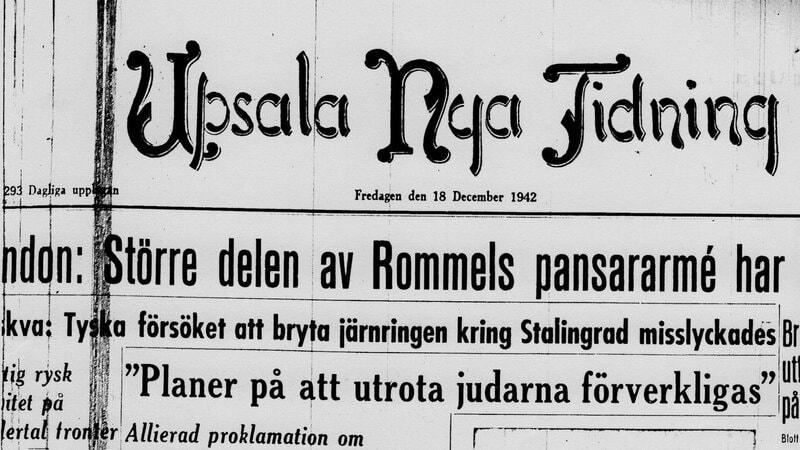

On a Tuesday morning in 1942, somewhere in middle America, a family might have unfolded their newspaper over coffee and eggs, skimmed past the department store sales and the baseball standings, and landed — briefly, barely — on a short dispatch buried deep inside: Jews in Europe were being killed in enormous numbers. Then they turned the page. The information was there, in black ink, in millions of American homes. And almost nothing happened.
A Six-Hour Reckoning

That unbearable gap between knowing and acting is the engine driving Ken Burns, Lynn Novick, and Sarah Botstein’s documentary The U.S. and the Holocaust, which premiered on PBS in September 2022. The series runs six hours across three parts and carries the same unhurried, morally serious weight as the team’s earlier work on the Vietnam War and Prohibition. But this film arrives with a sharper edge, because its subject is not simply a distant catastrophe — it is a sustained examination of American complicity, cowardice, and silence during one of history’s greatest crimes.
The timing of its release was not incidental. Antisemitism was rising measurably in the United States and Europe. Authoritarian political movements were gaining strength. Refugees were being turned away at borders with bureaucratic efficiency. Burns and his collaborators did not need to editorialize; the present was doing that work for them. This was a documentary built simultaneously as an excavation of the past and a warning about the future.
What separates The U.S. and the Holocaust from a textbook account — or from a conventional wartime film that ends with liberation — is its refusal to cast America as the reluctant hero who arrives just in time. The story does not begin at the gates of the concentration camps. It begins in the 1930s, in Washington offices, newspaper boardrooms, and suburban living rooms, where decisions were made about how much to see and how much to say.
What America Knew — and When
One of the documentary’s most disquieting arguments is also its simplest: Americans were not kept in the dark. Wire dispatches from European correspondents, firsthand testimony from refugees who had escaped, diplomatic cables from U.S. officials stationed in Germany — the information existed, it circulated, and it described in credible detail what the Nazi regime was doing to Jewish people across Europe. The question was never really about knowledge. It was about will.
American newspapers did print reports of mass shootings and deportations. But editors made choices — choices that feel, in retrospect, like moral failures dressed as editorial judgment. Stories were buried deep in the paper. Headlines were softened. Correspondents who pressed hardest on the atrocity accounts were sometimes dismissed as alarmists or accused of bias. The machinery of minimization ran on a mixture of disbelief, ambient antisemitism, and a quiet institutional preference for not disturbing readers over their morning routines.
The documentary takes care to portray the ordinary Americans of that era neither as monsters nor as innocents. They were people shaped by the Great Depression’s lingering anxieties, by nativist political movements that had been mainstream for decades, and by a media environment that consistently framed the suffering of European Jews as someone else’s problem. Burns, Novick, and Botstein accumulate this context patiently — not to excuse the choices that were made, but to establish clearly that those choices were choices, not the inevitable product of ignorance.
The film’s most uncomfortable argument, reinforced through survivor testimony and historian commentary alike, is straightforward: knowing and acting are entirely different things, and America chose, repeatedly and at every level of government and society, not to act.
The Closed Door: Refugee Policy as a Death Sentence
Nowhere is that choice more starkly illustrated than in the documentary’s examination of U.S. immigration and refugee policy during the 1930s and early 1940s. The Immigration Act of 1924 had established strict national-origin quotas, and those quotas were not merely maintained during the refugee crisis — they were actively, often intentionally, underfilled.
The State Department, under the influence of officials including Assistant Secretary Breckinridge Long, worked systematically to obstruct the issuing of visas to Jewish refugees fleeing Nazi persecution. Long’s operation did not simply enforce the existing law; it gamed the law, adding bureaucratic layers and demanding documentation that was functionally impossible for people escaping a police state to obtain. Thousands of potential refugees — families with names, children with futures — died in Europe because paperwork was deliberately delayed or denied.
The film uses the story of the MS St. Louis as one of its crystallizing moments. In 1939, the ocean liner carried 937 Jewish refugees across the Atlantic, only to be turned away from Cuba and then from the United States. The American government declined to intervene. The ship returned to Europe. Approximately a quarter of its passengers would later die in the Holocaust. Burns does not dramatize this story — he lets it sit, plain and devastating, in the documentary’s frame.
Public opinion gave politicians the cover they needed. Figures including Charles Lindbergh and the radio broadcaster Father Charles Coughlin gave voice to strains of antisemitism and isolationism that were far from fringe positions in American society. Polling from the period showed broad public opposition to accepting Jewish refugees even as knowledge of the genocide became more explicit. The politicians were not dragging reluctant constituents somewhere they did not wish to go.
Hitler’s American Mirror
The documentary’s most provocative thread — and the one that generated the most discussion when the series aired — is its examination of how Nazi lawyers in the early 1930s looked to the United States as a legal model for racial legislation. The Guardian’s review highlighted the film’s treatment of this disturbing historical record: American Jim Crow laws and race-based immigration statutes served as a direct point of reference for early Nazi racial legislation. German jurists studied how the United States had institutionalized racial hierarchy — stripping citizenship rights, forbidding interracial marriage, building an immigration system explicitly designed to exclude people deemed racially inferior — and found in it a workable template.
Burns, Novick, and Botstein handle this material with precision. The argument is not that America caused the Holocaust, nor that Jim Crow and the Nazi genocide are morally equivalent. The argument is narrower and, in some ways, more difficult to absorb: the United States was not simply a bystander to the ideological architecture of the Holocaust. Some of its own legal structures were present in that architecture’s foundations. The comfortable assumption — that the Holocaust was a purely European pathology, something alien to American democratic experience — does not survive contact with this evidence.
This is what lifts the documentary above a chronicle of wartime failure. It reframes the entire story. The question becomes not only what America did or failed to do during the 1940s, but what America had already built, over previous decades, that gave a murderous ideology part of its legal vocabulary.
The Weight of Individual Voices
What prevents The U.S. and the Holocaust from becoming a six-hour academic seminar is Burns’s instinct — refined across decades of documentary filmmaking — for the specific human detail that makes abstraction impossible to sustain. The series is built around personal letters from Jewish refugees navigating the visa labyrinth, diaries written by people who could see what was coming and needed desperately for someone to open a door, and photographs of families who did not survive.
Survivor testimony anchors every argument in lived experience. Historians specializing in antisemitism, immigration policy, and American political history provide the analytical scaffolding, but the structure rests on individual faces and voices. Burns does not announce moral conclusions. He places evidence before the viewer, layer by careful layer, until conclusions arrive on their own — and hit harder for it.
For educators, the documentary is available through PBS Learning Media with accompanying classroom resources, an acknowledgment that this history belongs in formal education as much as in living rooms.
Why This Story Is Not Finished
Burns has described the documentary as being fundamentally about the fragility of democratic values under pressure — about how ordinary people in ordinary times make ordinary moral compromises that accumulate, incrementally, into catastrophe. The film’s official page at KenBurns.com frames the project as an investigation into how Americans and their leaders responded to one of the twentieth century’s greatest humanitarian crises. What the six hours make clear is that “responding” most often looked like turning away.
The implicit question the documentary leaves deliberately unanswered is the one that makes it genuinely uncomfortable to watch in the present tense. If the Americans of the 1930s and 1940s were not uniquely cruel — if they were simply ordinary people, shaped by ordinary prejudices, making ordinary calculations about political cost and personal comfort — then what does that say about ordinary people today? What buried headline are we skimming past? What crisis are we declining to see clearly because seeing it clearly would require us to act?
The full six-hour series is available on PBS and rewards every minute of the investment. But the essential question it raises requires no viewing at all: somewhere in 1942, a family finished their coffee, folded their newspaper, and went about their day. The small story about mass death in Europe stayed buried on page ten. Silence, the documentary insists, is not the absence of a choice. It is the choice itself.

 English
 French
 Spanish
 Portuguese
 Deutsch
 Turkish
 Dutch
Dutch
 Italiano
 Russian
 Romaian
 Portuguese (Brazil)
 Greek
Greek