


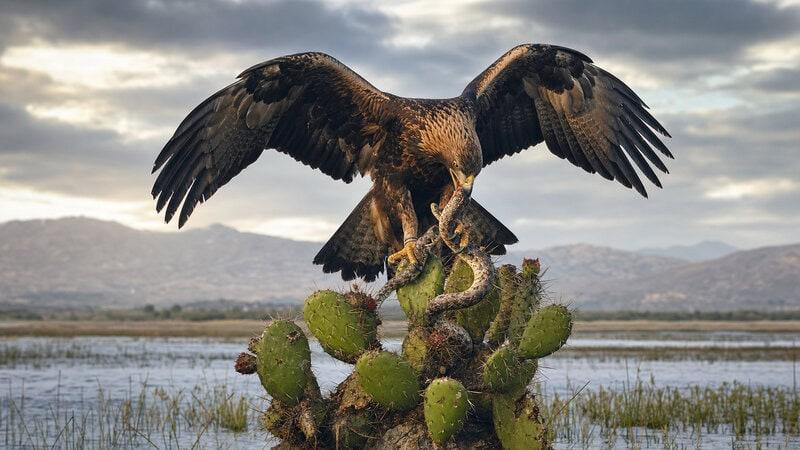

Somewhere around 1325, a bedraggled, road-worn people stood at the marshy edge of a highland lake in central Mexico and saw something that would change the world: an eagle, perched on a prickly pear cactus growing from a rocky island, tearing at a serpent in its talons. For the Mexica — the people history would come to call the Aztecs — this was not a coincidence. It was a covenant.
An Eagle, a Cactus, and the Birth of a Civilization

The god Huitzilopochtli, lord of the sun and war, had promised his chosen people exactly this sign after generations of wandering. When the priests saw the eagle, they did not hesitate. This swampy, mosquito-thick, resource-poor island in Lake Texcoco — a place no sensible conqueror would have chosen — was where they would build their home. They called it Tenochtitlan.
The strangeness of that founding moment deserves to sit with you for a second. The Mexica did not choose this island for its timber (there was none), its stone (scarce), or its farmland (nonexistent). They chose it because a divine vision demanded it. And yet the city that grew from that improbable, reedy outpost would become, by the early 1500s, one of the largest urban centers on Earth — home to an estimated 200,000 or more people, the pulsing heart of an empire that stretched across more than 80,000 square miles of central Mexico.
But here lies one of the more interesting puzzles in pre-Columbian history: when exactly was the Aztec Empire actually founded? Was it 1325, when Tenochtitlan was established on that lake island? Or 1428, when a political alliance transformed a scrappy city-state into a true conquering empire? The answer depends entirely on what you think an empire is — and the difference matters far more than most history books bother to explain.
The Long March: Who Were the Mexica Before the Empire?

The people who would build Tenochtitlan did not begin as lords of anything. The Mexica were Nahua-speaking semi-nomads, and their origin story reaches back to a mythic northern homeland called Aztlan — a name so tied to their identity that it gave scholars the shorthand “Aztecs” centuries later. Where Aztlan actually was, or whether it existed as a physical place at all, remains genuinely debated among historians and archaeologists.
What is less disputed is the long, humbling march southward. For generations, the Mexica wandered through central Mexico, arriving late to the Valley of Mexico — a landscape already carved up by established, sophisticated city-states. Texcoco was cultured and powerful. Azcapotzalco was militarily dominant. The Mexica, by contrast, were newcomers without land, without patrons, and without much status. Other groups viewed them as rough outsiders, useful perhaps as mercenaries, but not as equals.
They fought other people’s wars. They settled on scraps of land other groups didn’t want. According to some accounts, they were driven out of territories they tried to claim. For any group without a grounding myth, this kind of prolonged degradation might have dissolved them as a people. But the Mexica had Huitzilopochtli, and Huitzilopochtli had a plan. They were his chosen people, carriers of the sun’s fire, destined for something the valley’s current rulers could not imagine. That belief — unshakeable, identity-forging, sometimes terrifying in its implications — was the engine that powered everything that followed.
For a detailed account of the Mexica’s emergence from their nomadic period into the complex civilization they became, Britannica’s overview of Aztec history and culture is a reliable starting point.
1325: The Island Is Chosen, Tenochtitlan Is Born

When the eagle appeared — whenever it appeared, and however the priests framed what they witnessed — the Mexica acted. Tenochtitlan was founded around 1325 on a small island in Lake Texcoco in the Valley of Mexico. The lake was shallow and reedy, filled with waterfowl and fish but offering almost none of the raw materials a city needs to grow. No forests. No quarries close at hand. Just water, mud, and the word of a god.
What the Mexica did next was one of the great feats of pre-industrial engineering anywhere in the world. They built chinampas — artificially constructed garden plots made by layering aquatic vegetation, mud, and soil, anchored by willow trees whose roots stitched everything together. These so-called floating gardens turned a liability into productive farmland capable of multiple harvests a year, feeding a population that grew faster than anyone watching in 1325 could have predicted. They built causeways connecting the island to the mainland and engineered aqueducts to bring fresh water across the salt and brackish lake. The swampy island became a fortress city that was genuinely difficult to attack and difficult to starve out.
The founding legend itself was both spiritual event and political masterstroke. By anchoring their claim to this land in a divine sign witnessed by their priests, the Mexica gave themselves something no amount of military force could easily manufacture: sacred legitimacy. This island was not captured or purchased. It was chosen by a god. That distinction would shape Mexica identity, imperial ideology, and cosmological thinking for the next two centuries.
It is worth pausing on the historiographical nuance here. World History Encyclopedia dates the Aztec civilization to approximately 1345-1521, suggesting that even by an early reckoning, the settlement needed time to consolidate before anything resembling an empire took shape. The city was founded around 1325; the empire was a different, later creation.
Survival Mode: Vassals, Mercenaries, and Underdogs

For roughly the first century of Tenochtitlan’s existence, the Mexica were nobody’s idea of a dominant power. Their city-state sat within the sphere of the Tepanec kingdom of Azcapotzalco, the most militarily formidable force in the Valley of Mexico at the time. The Mexica paid tribute. They fought Tepanec wars on Tepanec orders, earning battlefield experience and martial reputation while their masters collected the spoils.
This was the underdog era — grinding, subordinate, occasionally humiliating — and it forged something in Mexica military culture that would later make them formidable. They learned war from the inside out, fighting alongside and against the most capable warriors in the region. They developed a warrior class for whom combat was not just profession but sacred duty. Capturing enemies for ritual sacrifice was spiritually necessary in their cosmology — the sun itself was believed to require human nourishment to rise each morning — and that belief made their fighters extraordinarily aggressive in the field.
The opening they needed came in 1426, when the aging Tepanec ruler Tezozomoc died. His death triggered a succession crisis that fractured Azcapotzalco’s political cohesion. The Mexica leader Itzcoatl and his influential advisor Tlacaelel recognized something extraordinary in the chaos unfolding around them: for the first time, an exit from vassalage was genuinely possible.
1428: The Triple Alliance and the Empire That Actually Conquered

In 1428, three city-states — Tenochtitlan, Texcoco, and Tlacopan — formed what historians call the Triple Alliance. They pooled their military strength, defeated Azcapotzalco, and in doing so crossed a threshold that separates a city-state from an empire. This, most historians argue, is the moment the Aztec Empire was truly born — not on a marshy island in 1325, but in a political compact forged by ambition, opportunity, and generations of patient preparation.
The transformation was rapid and comprehensive. Tlacaelel, serving as a kind of chief ideological architect of the new order, reportedly oversaw a rewriting of Mexica history that placed them at the very center of cosmic destiny — as the people uniquely responsible for sustaining the sun through warfare and sacrifice. Whether or not older records were literally destroyed as tradition claims, the effect was real: Mexica identity was reoriented around imperial purpose. This was no longer a people surviving on the margins. This was a people with a mandate to conquer.
The military results were striking in their speed. Within decades of 1428, the Triple Alliance had subjugated dozens of city-states across central Mexico, building a tribute empire that eventually controlled territory spanning hundreds of communities across the region. Goods — cotton, cacao, jade, feathers, gold — flowed into Tenochtitlan in staggering quantities. The city grew at a rate that seemed to confound the modest circumstances of its founding.
The community debate over whether the empire’s founding date should be placed at 1345 or 1428 really resolves into this: 1325 gave the Aztecs their sacred home, and 1428 gave them their empire. Both dates are real. Both matter. Empires don’t spring fully formed from the earth — they accumulate.
Tenochtitlan at Its Peak: The City That Stunned the Spanish

By the early sixteenth century, Tenochtitlan had become something that defied easy description — which is precisely what Hernán Cortés found when he encountered it in 1519. Writing to the Spanish crown, Cortés reached for superlatives and found them inadequate. His soldier Bernal Díaz del Castillo, writing his own account of the conquest, described the great market at the adjacent city of Tlatelolco as larger and better organized than any market he had seen in Spain — a striking observation given that Díaz had lived in some of Europe’s most cosmopolitan cities.
The scale was genuinely extraordinary. The city’s population has been estimated at well over 200,000 people, placing it among the largest cities in the world at the time and larger than most contemporary European capitals. The Templo Mayor, the great double pyramid at the city’s ceremonial heart, rose in successive stages and was crowned by twin shrines to Huitzilopochtli and the rain god Tlaloc. Causeways wide enough for substantial traffic connected the island to the mainland. Aqueducts carried fresh water from mainland springs across the lake. Chinampas multiplied across the shallows like a green geometry of human ingenuity.
All of it had been built on the same swamp where, roughly two centuries earlier, an eagle had perched on a cactus and a weary people had decided: here. This is the place. Standing the legend next to the achievement, the vision feels almost rational.
For broader context on how this civilization developed and how archaeologists continue to investigate it, History.com’s overview of the Aztecs covers both the cultural depth and the military machinery of the empire in accessible detail.
1521 and the Legacy: Why the Founding Story Still Matters
The empire that took roughly a century to build fell in a single brutal year. In 1521, Hernán Cortés — having assembled alliances with many of the peoples the Aztecs had taxed, subjugated, and made enemies of — besieged Tenochtitlan for approximately 75 days. Disease, starvation, and systematic destruction accomplished what no previous adversary had managed. The city fell. The last Aztec ruler, Cuauhtémoc, was captured. The empire ignited in 1428 was extinguished roughly 93 years after it began.
But something else survived. Beneath the streets and plazas of modern Mexico City — constructed directly atop the rubble of Tenochtitlan — Aztec temples keep emerging from the earth. The Templo Mayor was rediscovered in 1978 during utility construction and has yielded extraordinary archaeological finds in the decades since. The eagle devouring a serpent atop a cactus endures at the center of the Mexican flag and national seal, one of the most widely recognized national emblems on the planet, still carrying the symbolic weight of a founding vision from seven centuries ago.
The Aztec empire’s origin story endures because it is the rare founding myth that actual history partially validates. The eagle and the cactus and the divine command belong to the realm of religion and identity-making. But the engineering that followed was real. The military achievement was real. The city, improbably planted on a lake island because a god demanded it, grew into something that genuinely astonished its conquerors. The full arc of how the Aztecs lived, conquered, and ultimately fell is one of the most compressed and dramatic stories in human history.
The Mexica saw a vision on a swampy island around 1325. They built something so consequential that its ruins still surface beneath a living city half a millennium later. The eagle on the cactus was a story they told themselves — but what they constructed because of it was extraordinary, enduring, and undeniably, stubbornly there.

 English
 Arabic
 French
 Spanish
 Portuguese
 Deutsch
 Turkish
 Italiano
 Russian
 Romaian
 Portuguese (Brazil)
 Greek
Greek