


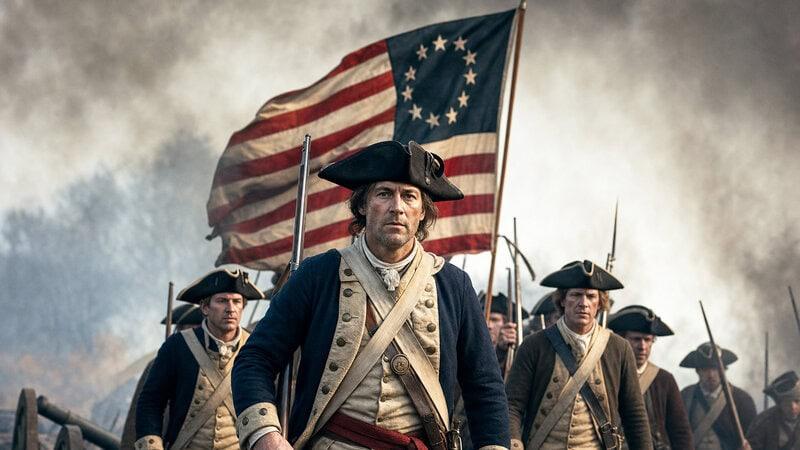

In September 1990, roughly 40 million Americans sat down to watch a documentary about a war that had ended 125 years earlier. Ken Burns’ The Civil War became a genuine cultural event — water-cooler television before anyone used that phrase — and it transformed what Americans believed a history documentary could be. Yet the war that made 1865 possible, the eight-year uprising that conjured a nation out of thirteen fractious colonies, spent most of the television era as little more than a classroom afterthought. The revolution that started everything was, somehow, the last story anyone rushed to tell on screen.
The Disproportion You Cannot Stop Noticing
History enthusiasts searching for a serious American Revolution documentary have spent decades arriving at the same deflating conclusion: nothing came close to Burns’ Civil War. Nothing had even tried in the same way. That gap is the central question worth asking — why did the Revolution get sidelined on screen for so long, treated as settled and already understood, and what does a serious reckoning with it actually look like now that filmmakers have finally committed to one?
Why the Civil War Got the Camera and the Revolution Got the Textbook

Part of the answer is purely visual. The Civil War left behind photographs. Matthew Brady and his contemporaries produced thousands of haunting images — dead soldiers at Antietam, hollow-eyed prisoners, a nation visibly tearing itself apart — and those photographs gave documentary filmmakers instant, emotionally loaded raw material. The Revolution left behind oil paintings and copper engravings. They are beautiful objects, but they require a different, slower cinematic grammar to make viscerally alive, and most filmmakers were not willing to do that work.
The Revolution’s story is also structurally harder for television. Thirteen colonies with wildly different economies, cultures, and interests; an eight-year war with no single Gettysburg moment to anchor a narrative; a cast of Founders so mythologized over two centuries that they read less like desperate, sweating human beings and more like marble statues that occasionally write letters. Drama requires conflict, and the Revolution’s conflict had been smoothed into triumph before most filmmakers were born.
American identity politics played a quieter role too. The Civil War carries unresolved national wounds — about race, about regional identity, about what the country was and what it failed to become — that keep drawing filmmakers back because the argument never fully closes. The Revolution, by contrast, risked feeling like triumphalist history with a predetermined ending: we won, we founded the country, the end. That presumption of resolution made it, paradoxically, harder to dramatize.
The result was a documentary desert. For most of the late twentieth century, a viewer searching for a feature-length, serious American Revolution documentary would find educational reels, brief specials, and fragments — never the sustained reckoning the subject deserved.
‘Liberty! The American Revolution’ (1997): The First Serious Attempt

In 1997, PBS aired Liberty! The American Revolution, a six-hour series that would later be recognized by Smithsonian Magazine as one of the best television treatments of the era — notable praise, partly because the field was so thin. The series did something genuinely fresh: it placed ordinary voices alongside the Founders, reading from the letters and diaries of soldiers, enslaved people, and Loyalists who watched the same events from opposite sides of the argument. The Revolution, told through personal testimony rather than flag-waving, could hold a prime-time audience. That was the proof of concept Liberty! established.
Its limitations were real. The production budget showed at the edges, the pacing dragged through the middle hours, and without the photographic archive that had made Burns’ Civil War so visually arresting, the visuals leaned heavily on re-enactment footage that has aged in the way re-enactment footage always does. But the series proved the subject was viable, and it remains a reference point near the top of ranked lists of American Revolution documentaries nearly three decades later — which says something both about its quality and about how few serious successors arrived.
When Scripted Drama Filled the Gap Documentaries Left

With documentary filmmakers slow to return, prestige drama rushed into the vacuum. HBO’s John Adams arrived in 2008 and brought Paul Giamatti’s sweating, furious, entirely mortal Adams across seven episodes and seven Emmy Awards. For the first time on screen at that scale, the Founders felt like men who doubted themselves, argued with their wives, and had no idea whether any of this was going to work. The marble cracked in the best possible way.
Turn: Washington’s Spies, which ran on AMC from 2014 to 2017, went further underground, following the Culper Ring spy network through four seasons and delivering the Revolution as a thriller — dust, mud, betrayal, and genuine moral ambiguity about who was fighting for what and why. It was among the first major screen treatments to make Loyalists feel like people with legitimate grievances rather than villains wearing the wrong flag.
Then came Apple TV+’s Franklin in 2024, with Michael Douglas navigating the French court as Benjamin Franklin — charming, aging, and exhausted — proving that Revolution-era stories still carry serious star power well into the streaming era.
The irony is pointed: scripted drama did more to make the American Revolution feel alive and complicated than documentary filmmaking had managed in thirty years. Every one of these productions raised the bar for what any future nonfiction treatment would have to clear.
Ken Burns Returns — and This Time He Brings the Revolution With Him

Ken Burns, alongside co-directors Sarah Botstein and David Schmidt, has produced a six-part, approximately twelve-hour documentary series titled The American Revolution, now streaming on PBS. That scale is a deliberate statement. It matches what Burns gave the Civil War and signals that the Revolution is being treated — at last — as an equal subject rather than a warm-up act for the nation’s later crises.
The series centers on a genuinely difficult dramatic question: how did thirteen colonies with wildly different economies, cultures, and self-interests find enough common cause to sustain a rebellion across eight years against the most powerful military empire of the age? How they argued, how they nearly collapsed, how they held together through winters and defeats and betrayals — and what they were actually fighting over, including the foundational contradiction of declaring liberty while practicing slavery — is what the series’ running time gives you room to explore.
Burns and his team apply their signature method: first-person documents read aloud by actors, expert historians speaking directly to camera, slow pans across period artwork that gradually reveal the human story inside the formal composition. The challenge they faced was the same one that stopped earlier filmmakers: how do you make 1776 feel as urgent as 1863? How do you strip the marble off the Founders without stripping away the genuine stakes of what they were attempting?
You can assess their approach in the official trailer on YouTube, where the tone becomes clear immediately: this is not a celebration. It is a reckoning.
What the Best American Revolution Documentary Has to Do

Any serious contender for the best American Revolution documentary must accomplish at least three things simultaneously. It must explain the military and political mechanics of an eight-year war without collapsing into a lecture series. It must humanize figures so mythologized they have become effectively fictional. And it must reckon honestly with the revolution’s central contradiction — that the men who wrote “all men are created equal” owned other human beings and intended, many of them, to keep doing so.
The genre has historically relied on PBS and prestige cable, with no theatrical documentary ever breaking through to a mass audience the way Civil War-driven films have. The Loyalists — roughly a third of colonists who opposed independence — have been chronically undertreated. So have the enslaved men and women who fought on both sides, calculating which outcome offered more freedom, and the French alliance that ultimately decided the military outcome in America’s favor at Yorktown.
Where Burns’ new series stands to outpace its predecessors is in scope and synthesis. The longer runtime allows space for all of those stories. It also allows room for failure — the winters at Valley Forge and Morristown, the near-mutinies, the years when the Continental Army was held together by stubbornness more than strategy. Shorter productions have always been forced to cut those chapters. The honest caveat is this: the best American Revolution documentary is only as good as the questions it is willing to ask. Whether Burns and his co-directors ask the hardest ones — about race, about who the revolution actually liberated and who it left behind — is the most important test the series faces.
Where to Watch, and How to Go Deeper
Ken Burns’ The American Revolution is available streaming on PBS, free with a PBS account, making it the most accessible entry point yet for viewers new to the subject. For anyone wanting to go deeper before or after watching, the 1997 Liberty! series remains available on PBS streaming and holds up as a valuable companion — particularly its treatment of ordinary voices the historical record almost swallowed. Pairing that series with John Adams gives you both documentary rigor and dramatic texture, the two modes that together have told this story better than either could manage alone.
The broader lesson of this long documentary drought is cultural as much as cinematic. A nation’s screen life reflects what it thinks is worth remembering. The Revolution’s decades-long absence from serious documentary filmmaking says something uncomfortable about which origin stories get examined on camera and which get treated as already explained, already digested, already safe to ignore. The American Revolution did not disappear from history — it disappeared from the screen because it was presumed to be settled. The best thing about a twelve-hour documentary is the implicit admission that it is not settled at all. That it never was. That the argument the Founders started in 1776 is, in ways that still matter, ongoing — and finally worth watching in full.

 English
 Arabic
 French
 Spanish
 Portuguese
 Deutsch
 Turkish
 Dutch
Dutch
 Italiano
 Russian
 Romaian
 Greek
Greek