


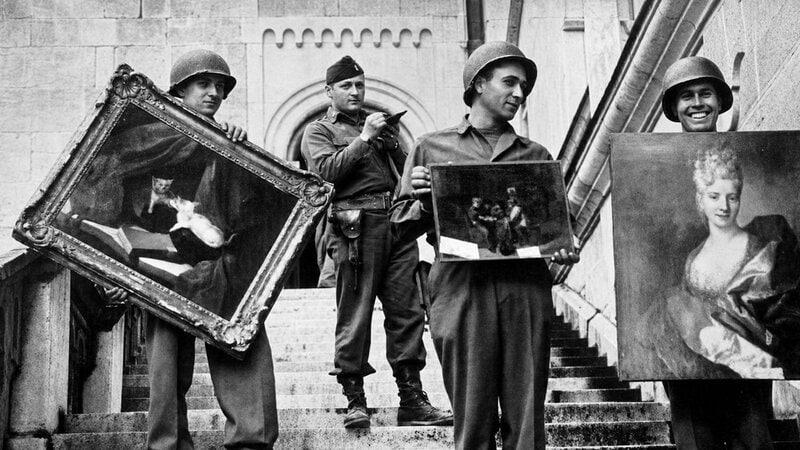

In May 1945, Captain Robert Posey and Private First Class Lincoln Kirstein pressed their bodies through a narrow gap in blown rubble, flashlight beams swinging into cold, mineral-sharp darkness, with no idea they were about to find the most important room in the world.
A Flashlight in the Dark, Miles Underground

The ancient salt mine at Altaussee, Austria, smelled of deep earth and centuries. Water dripped somewhere in the black. Then the light caught something — a gilded frame, then another, then an entire wall of them, stacked and tagged and waiting in the stable humidity that salt tunnels had maintained for millennia. Room after room materialized as Posey and Kirstein pushed deeper: Jan van Eyck’s Ghent Altarpiece, assembled in the fifteenth century and considered one of the most significant paintings in Western history. Michelangelo’s Bruges Madonna. Vermeer’s The Astronomer. Thousands of other works — tapestries, sculptures, drawings, altarpieces — stolen or seized by the Nazi regime and stored here against a future that had not arrived.
What Posey and Kirstein did not know when they squeezed through that rubble was how close everything had come to ending differently. SS officers had placed explosives inside the mine — hidden in crates labeled Beware — Marble, Do Not Drop — with orders to detonate if Allied forces approached. Local miners and Austrian resistance workers had quietly defused them in the days before the Americans arrived. The margin between rescue and catastrophe was measured not in weeks but in hours, possibly minutes.
It was the most dramatic moment in one of the strangest and most consequential operations of the Second World War — and almost no one outside a small community of soldiers, curators, and art historians knew it was happening at all. So who were these people, and how did an underfunded, perpetually ignored unit end up as the last line between civilization and its own deliberate destruction?
An Idea Born in Wartime: Creating the Monuments Men

The answer begins in 1943, in the offices and meeting rooms of American and British cultural institutions, where museum directors, architects, and art historians were watching the Allied advance through North Africa and Italy with a particular kind of dread. Bombs do not distinguish between a Wehrmacht ammunition depot and a medieval cathedral. Artillery does not pause for a fresco. As the war moved through some of the densest concentrations of human cultural achievement ever assembled in one region, the question of who would protect that inheritance became urgent.
What emerged from that lobbying effort was the Monuments, Fine Arts, and Archives Section — the MFA&A — attached to the Allied Expeditionary Forces. Its mandate was broad and, given the resources allocated, almost impossibly ambitious: protect artworks, cathedrals, monuments, archives, and cultural sites from both the damage of combat and the deliberate theft of occupation. Ultimately, 345 men and women from fourteen nations would serve in the unit — a genuinely international coalition that included figures who would go on to reshape the postwar art world, among them James Rorimer, later director of the Metropolitan Museum of Art, and Ted Rousseau, who would become a senior curator there.
In the field, their early situation bordered on farce. A handful of specialists attached to fast-moving armies, they had no dedicated vehicles, little formal authority, and a budget that suggested high command viewed cultural preservation as somewhere between a courtesy and a nuisance. They operated in pairs or alone, scrambling to keep pace with an advance that moved faster than any logistics chain for art protection had been designed to handle. What they had instead of resources was expertise, stubbornness, and — in some cases — the sheer audacity to walk up to a general and explain why he needed to reroute his artillery.
What the Nazis Were Actually Doing: The Scale of the Looting

To understand what the Monuments Men were working against, it helps to understand what the Nazi state had methodically done. Adolf Hitler, a failed art student turned dictator, harbored a lifelong obsession with a planned supermuseum in Linz, Austria — the Führermuseum — that would showcase the greatest art collection in human history, assembled, in his vision, by conquest. The regime’s machinery translated that obsession into systematic plunder on a continental scale.
The Einsatzstab Reichsleiter Rosenberg, known by its initials ERR, functioned as a dedicated art-theft agency operating across France, the Netherlands, Poland, and the Soviet Union. It stripped collections, falsified ownership records, and shipped thousands of objects across occupied Europe with bureaucratic efficiency. Jewish-owned collections were targeted first, their seizure justified by laws the regime had written specifically to enable it. Then came national treasures, private estates, church holdings, and museum collections from every occupied territory.
By the war’s end, Nazi looting had displaced an estimated five million cultural objects — a figure so large it strains comprehension. For the Monuments Men, working with their modest resources and their cars that frequently broke down, the arithmetic was sobering. But the moral weight was heavier still. For Jewish families across Europe, these were not merely cultural losses. They were the last material traces of lives and lineages the Reich was systematically attempting to erase. A stolen painting was also a stolen history, a stolen identity, a stolen proof of existence.
Racing the Front Lines: The Work in the Field

The daily reality of Monuments Men work bore little resemblance to a museum posting. It looked more like detective work conducted in a combat zone. Monuments officers reached bombed cities alone or in pairs, picking through rubble to assess damage, posting off-limits signs on vulnerable structures, and tagging buildings before armies moved on and the moment to intervene was lost forever. They had to argue, cajole, and sometimes publicly embarrass officers into rerouting artillery or halting demolitions near historic sites — a task requiring a particular combination of diplomatic skill and nerve.
As Germany’s position collapsed in the war’s final months, the work shifted toward intelligence. Monuments Men traced Nazi shipping records, interrogated prisoners and captured officials, and followed a fragmenting paper trail through the Reich’s disintegrating bureaucracy. The leads multiplied faster than the manpower to follow them.
One of the most consequential relationships in this phase was between James Rorimer and Rose Valland, a French curator who had spent the occupation years working quietly at the Jeu de Paume in Paris — the staging depot through which the ERR funneled looted art out of France. At considerable personal risk, Valland had recorded the destination of virtually every shipment that passed through. When she shared that intelligence with Rorimer, it gave the Allies a roadmap to some of the most significant hidden caches in Germany and Austria. Without her, Altaussee might have remained undiscovered until it was too late, or been stumbled upon by soldiers who did not know what they were looking at. Valland’s contribution was indispensable, and for decades it was insufficiently acknowledged.
Altaussee and the Mines: The Closest Call

The salt mine at Altaussee had been chosen for its extraordinary natural properties. Constant cool temperature, stable humidity, geological isolation — everything a conservation scientist might specify for long-term storage. The Nazis had spent years moving their most prized acquisitions there as Allied bombing intensified and the prospect of defeat became unavoidable. By the spring of 1945, the mine held thousands of masterworks representing centuries of European civilization, all stacked in the dark, waiting.
The threat of demolition was genuine. That the mine survived intact was not the result of Allied intelligence or military planning. It was the result of Austrian miners and local resistance figures choosing, at personal risk, to act — quietly removing and defusing the concealed charges before any detonation order could be carried out. When Posey and Kirstein finally pushed through the gap in the rubble and began their inventory, they were walking through the consequences of other people’s courage as much as their own.
Altaussee was the most dramatic discovery, but not the only one. In April 1945, the Merkers mine in Thuringia had already yielded Germany’s gold reserves alongside hundreds of stolen paintings — a preview of the surreal scale at which the Nazi state had been concealing the accumulated wealth of a continent. The underground repositories collectively represented one of the most concentrated assemblages of stolen cultural property in history, and finding them was only the beginning of the problem.
The Long Aftermath: Recovery, Restitution, and What Was Never Found
Victory in Europe did not end the Monuments Men’s work. It transformed it. After V-E Day, the unit operated collection points across Germany, cataloguing, authenticating, and preparing millions of objects for repatriation in a logistical operation that stretched years beyond the fighting. The paperwork alone was staggering — ledgers, photographs, condition reports, correspondence — and much of it became the foundation of what is now the Monuments Fine Arts Archives, a documentary record largely digitized today and still consulted by researchers, lawyers, and museum provenance departments working to trace the ownership histories of works that passed through Nazi hands.
The recovery effort was genuinely extraordinary. It was also incomplete, and honesty demands saying so plainly. A significant number of works — particularly those looted from Jewish families in Eastern Europe — were absorbed into Soviet collections under trophy art policies, never returned, and in some cases remain disputed today. Others vanished into private hands or black markets and have never resurfaced. The losses are not a footnote. They are a central and still-unresolved part of the story.
The legal and moral legacy of the MFA&A’s work extends far beyond the objects it recovered. The Washington Principles of 1998, which established international guidelines for the restitution of Nazi-looted art, trace a direct line back to the frameworks the Monuments Men built in the rubble of postwar Germany. The provenance research departments that now exist in major museums around the world are their institutional descendants. The lawsuits still working through courts in multiple countries are the unfinished business of a conflict that ended eighty years ago.
Why This Story Still Matters
The real Monuments Men story is often told as an adventure — and it is one. But underneath the logistics and the mine shafts and the detective work is a philosophical argument that has not aged: that cultural heritage is worth protecting with the same seriousness we bring to protecting lives, that destroying a civilization’s art is itself a form of violence against identity, and that when no one else will stand in the breach, someone has to.
That argument is not safely historical. The deliberate destruction of ancient sites at Palmyra, of manuscripts in Timbuktu, of the Mosul Museum — these were acts in a tradition the Monuments Men confronted directly, carried out by different hands for overlapping reasons: the erasure of identity, the demonstration of power, the severing of a people from their own past. The international frameworks the MFA&A helped inspire remain the primary institutional defense against exactly that impulse, and they are only as strong as the political will to enforce them.
It is also worth insisting that this story belongs to 345 people, not a handful. The unit included women. It included nationals of fourteen countries. It included specialists in architecture, folklore, archives, and classical antiquity — a coalition whose diversity was itself a statement about the kind of civilization they were trying to preserve: one defined not by a single people or a single tradition but by the accumulated, overlapping inheritances of centuries. The Hollywood version inevitably compressed that breadth into a few faces. The real history is wider, stranger, and more interesting.
The image that compresses all of it remains the one at the beginning: a flashlight beam in an Austrian salt mine, catching gilded frames in the dark. Humanity’s most violent century, and the small, stubborn, underfunded group of scholars and soldiers who refused to let it also be its most philistine. They were almost too late. Almost, but not quite — and that margin, and everything that had to go right to produce it, is the whole story.

 English
 Arabic
 French
 Spanish
 Portuguese
 Deutsch
 Turkish
 Dutch
Dutch
 Italiano
 Russian
 Romaian
 Portuguese (Brazil)