


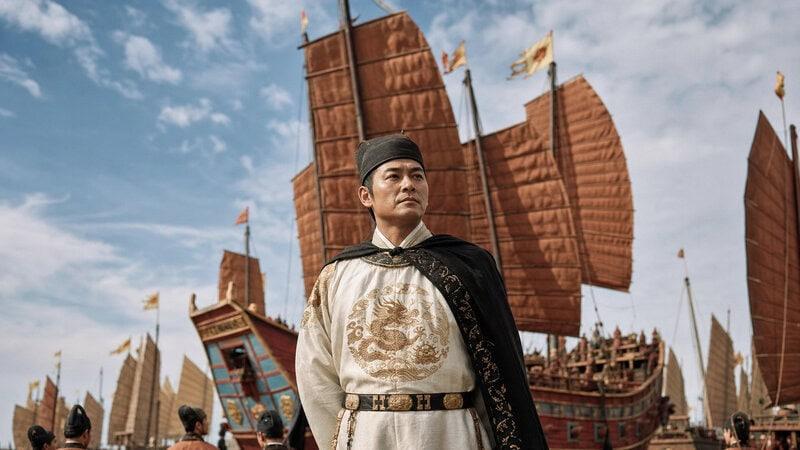

In the spring of 1405, the harbor at Nanjing held a sight the world had never seen: 317 ships, some nearly 400 feet long, crewed by 28,000 sailors, soldiers, diplomats, and doctors, ready to sail into waters no Chinese armada had ever crossed. Columbus wouldn’t leave Spain for another 87 years. Yet within a generation, the empire that launched this staggering fleet would ban the construction of oceangoing vessels, suppress the records of those voyages, and turn decisively inward — one of the most consequential self-reversals in the history of human civilization.
That empire was the Ming dynasty. Its story runs from peasant rebellion to imperial grandeur, from the greatest navy on earth to deliberate maritime retreat, and from a collapsed throne in 1644 to something quieter and more durable: a culinary tradition that traveled with ordinary people across centuries and oceans, eventually landing — among countless other places — on a menu in Greenville, North Carolina.
Who Were the Ming? A Dynasty Born in a Ditch

Ming dynasty history begins not in a palace but in poverty. In 1368, a peasant-born rebel named Zhu Yuanzhang overthrew the Mongol Yuan dynasty and declared himself the Hongwu Emperor — one of the only commoners in the entire span of Chinese history to found a ruling dynasty. He named his empire the Ming, meaning “brilliant” or “luminous,” a word chosen with deliberate intent: this was to be a restoration of Han Chinese civilization after a century of foreign Mongol rule, radiant and unambiguous in its identity.
Hongwu’s personal history shaped everything that followed. He had survived famine, itinerant monasticism, and banditry before seizing the throne, and he governed with the suspicion of a man who trusted almost no one. His reign established the template for the next 276 years: fierce centralization of power, deep wariness of merchants and foreign influence, and a rigid Confucian social hierarchy that ranked farmers above soldiers and placed traders near the very bottom. Wealth generated by commerce was considered morally inferior to wealth grown from the earth.
The scale of what Hongwu built is almost difficult to hold in the mind. At its height, the Ming governed roughly 65 million people across a territory stretching from the South China Sea to the edges of the Gobi Desert. It was, by almost any measure, the most powerful state on the planet — which makes the naval ambitions of its third emperor all the more extraordinary, and its eventual self-imposed retreat all the more instructive.
Zheng He and the Treasure Ships: When China Ruled the Oceans
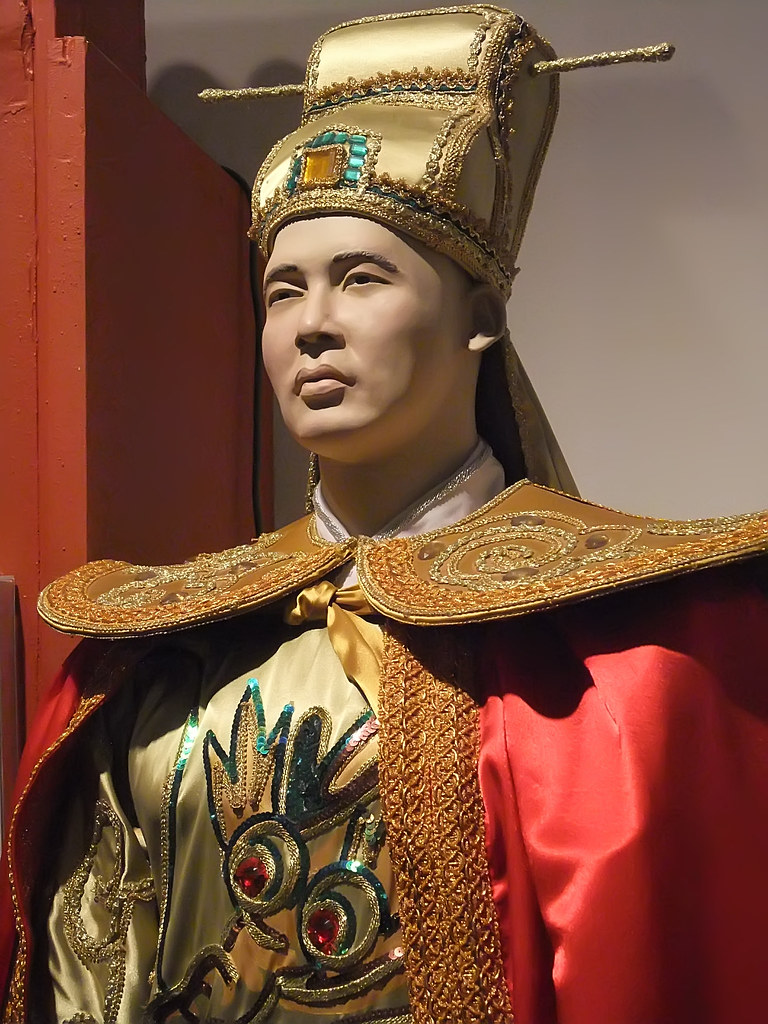
The man who would become the greatest mariner of the fifteenth century was born into an unlikely life. Zheng He was a Muslim from Yunnan province in China’s southwest, captured as a boy during military campaigns, castrated, and brought into imperial service as a eunuch. He rose through the court of the Yongle Emperor — Hongwu’s ambitious, expansionist son — and by 1405 he stood at the helm of the most powerful naval force ever assembled.
The Ming treasure ships, known in Chinese as baochuan, were engineering spectacles. The largest were estimated at 400 to 450 feet long and roughly 180 feet wide — vessels so vast that historians have noted the entire length of Columbus’s Santa María could have fit across one of their beams. But these were not warships in the European mold. They were floating embassies, packed with silk, porcelain, and the concentrated prestige of the imperial court, designed not to conquer but to impress.
The Zheng He voyages — seven of them between 1405 and 1433 — swept across Southeast Asia, India, Arabia, and down the East African coast as far as present-day Kenya and Tanzania. The logic was tributary diplomacy: foreign rulers were invited to acknowledge the Ming Emperor as the axis around which civilization turned, and in return they received trade, protection, and the extraordinary spectacle of the fleet itself. The gifts exchanged were sometimes surreal. On one voyage, envoys from Malindi brought back a giraffe, which the imperial court interpreted as a qilin — a mythical creature of good omen said to appear only during the reign of a truly virtuous emperor. The Yongle Emperor, by contemporary accounts, was visibly moved.
By any measure of their own logic, the voyages succeeded. Dozens of states sent tribute missions to Nanjing. Chinese soft power stretched from Java to Zanzibar. The Ming navy had, in effect, organized a large portion of the known world into a Chinese-centered diplomatic system. And then, almost overnight, it stopped.
The Great Retreat: Why the Most Powerful Navy in History Burned Its Ships

The Yongle Emperor died in 1424, and with him went the political will that had made the voyages possible. Confucian bureaucrats — scholars who had always viewed the maritime expeditions as expensive, destabilizing vanity projects — moved quickly to reassert control. Their argument was practical on its surface: the empire’s northern frontier faced renewed Mongol pressure, the treasury was strained, and resources were better directed toward the Great Wall. But the argument ran deeper than logistics.
The ideological engine of Ming isolationism was the Confucian worldview itself. China was not merely a powerful state; it was, in the Confucian framework, the center of civilization — the “Middle Kingdom” — and it possessed everything it needed within its own borders. Foreign trade implied a lack that the empire refused to acknowledge. Merchants were seen as parasites on the honest labor of farmers. The sea was chaos; cultivated land was order. By this logic, the voyages weren’t glory — they were a category error.
By 1436, the Ming court had banned the construction of oceangoing vessels. Court official Liu Daxia reportedly ordered the records of Zheng He’s voyages suppressed, dismissing them as “deceitful exaggerations of bizarre things.” Ships rotted at their moorings. Shipwrights lost their skills across a generation. The haijin — the sea ban — fluctuated in severity across the dynasty’s remaining two centuries, but the window of maximum maritime ambition had closed permanently.
The Indian Ocean, which Chinese fleets had patrolled and organized, was left open. Within decades, Portuguese caravels appeared off the coast of India. Dutch and English merchant companies followed. The world reorganized itself along sea routes that China had already mapped — and then chosen to abandon.
The Wall Against the Wave: Two Visions of Security

The central tension of Ming dynasty history is a clash between two instincts that never fully resolved. On one side: outward projection — the navy, the voyages, the tributary trade networks that briefly made China the organizing center of an entire hemisphere. On the other: inward fortification — the examination system, agricultural self-sufficiency, and above all, the Wall.
Most of the Great Wall that visitors photograph today was built or substantially reinforced by the Ming. Thousands of miles of fortifications, constructed across generations at enormous human and financial cost, encoded in stone and mortar the dynasty’s ultimate conviction that the existential threat came from the north, not the sea. In a narrow military sense, that assessment wasn’t wrong. The Mongols and later the Manchus were the genuine frontier danger, not European navies.
And yet the irony is almost painful: the Wall didn’t save the dynasty either. In 1644, the Ming collapsed not from foreign naval invasion but from a combination of catastrophic domestic rebellion and a Manchu army that entered through a gate in the Wall — one that a Chinese commander, in one of history’s more consequential decisions, opened himself. The dynasty that had retreated from the world was ultimately undone from within its own fortifications.
The historical question lingers: had the treasure ship voyages continued, would Portuguese and Dutch fleets have found the sea routes to Asia already claimed, already organized under Chinese diplomatic architecture? Historians debate this carefully, and no certain answer exists. But the question itself reveals the scale of what the Ming’s self-imposed retreat actually cost — not in any single dramatic defeat, but in the slow redistribution of global influence across the centuries that followed.
What the Ming Left Behind: Porcelain, Recipe, and Cultural Endurance

The dynasty’s military power evaporated with the throne in 1644. Its cultural exports proved far more durable. Blue-and-white porcelain — the origin of “fine china” as a global category — reached its artistic peak under the Ming and traveled along trade routes to become a luxury good on tables from Lisbon to London. Silk production advanced. Culinary traditions moved with merchants, migrants, and diaspora communities across Southeast Asia and eventually, across centuries and oceans, into Chinese-American kitchens in a country the Ming emperors never knew existed.
This is the quieter legacy: not the treasure ships, which burned, and not the Wall, which was breached, but the everyday material culture — the bowl shape, the sauce technique, the approach to heat and balance — that traveled with ordinary people and outlasted emperors. Chinese culinary tradition didn’t arrive in America through any single event. It came in fragments, carried by Cantonese immigrants in the nineteenth century, adapted to available ingredients and local palates, and layered over generations into the Chinese-American cuisine that has become genuinely its own thing: connected to its origins, transformed by its journey, and deeply embedded in American food culture.
Dishes like General Tso’s Chicken — invented in the twentieth century, likely in New York — represent that layering honestly. They aren’t ancient. But they exist because Chinese cooks were here, working with what they had, feeding communities, and building something new from something very old. The name “Ming dynasty” on a restaurant sign is, in that context, more than branding. It’s an acknowledgment of a thread that runs a very long way back.
Ming Dynasty in Greenville, NC: A Local Institution

Located at 3105 E 10th St in Greenville, North Carolina, Ming Dynasty Greenville has been serving the local community for over 20 years, with some accounts placing its tenure closer to thirty years. That kind of longevity in the restaurant business is not incidental — it reflects the specific trust that a neighborhood builds with a place that shows up consistently, lunch after lunch, year after year.
The restaurant is listed on the official Visit Greenville NC tourism site and maintains an active community presence on Facebook, where over a thousand check-ins reflect real, repeat traffic rather than passing curiosity. Its menu centers on Chinese-American classics — the kind of cooking that has fed generations of American diners and carries, in its own way, the culinary inheritance described above. A local food video gives a candid look at what decades of consistent cooking actually produces. You can explore their full menu at BeyondMenu or check reviews on Yelp before visiting. They can be reached by phone at (252) 752-7111.
What the Ming Teaches: The Price of Chosen Isolation
The Ming dynasty is, at its core, a case study in how a civilization can be simultaneously the most capable and the most self-limiting entity of its era. Its navy proved beyond any reasonable doubt that China could project into the world, organize it, and shape it. Its ideology chose not to. That choice wasn’t made from weakness or ignorance. It was made deliberately, by intelligent people with a coherent worldview, who valued internal order over external engagement and believed China’s greatness was best expressed by perfecting itself rather than chasing the horizon.
That’s what makes Ming isolationism genuinely worth studying, and genuinely instructive beyond its historical moment. Isolationism is rarely about inability. It is about a set of values — about what a society decides it is for. The Ming pursued those values with remarkable consistency for nearly three centuries, even as the world reorganized itself around the absence of Chinese sea power.
The dynasty fell in 1644. The porcelain remained on shelves around the world. The recipes traveled. The culinary tradition adapted and survived, moving through diaspora communities across generations, eventually reaching a restaurant on E 10th Street in eastern North Carolina that has quietly fed its neighbors for the better part of thirty years. The Ming’s most enduring achievement was never the treasure ships, extraordinary as they were. It was the slower, quieter work of cultural transmission — the things that travel not in flagship holds but in the hands and memories of ordinary people, outlasting every emperor who tried to stop the tide.

 English
 Arabic
 French
 Portuguese
 Deutsch
 Turkish
 Dutch
Dutch
 Italiano
 Russian
 Romaian
 Portuguese (Brazil)
 Greek
Greek