


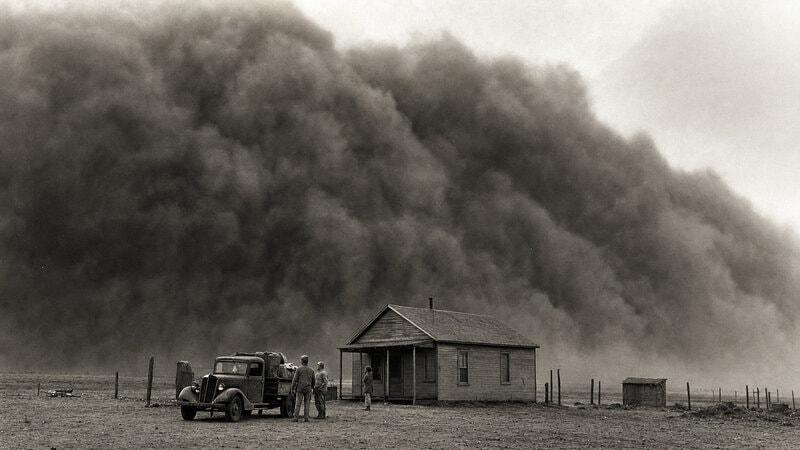

On the afternoon of April 14, 1935, the sky over the Oklahoma panhandle turned the color of scorched iron and then went black. A wall of dust stretching nearly eight thousand feet into the air swallowed farms, towns, and livestock whole, rolling across the plains faster than a car could outrun it. Families who had already survived five years of economic ruin stuffed wet rags under their doors, tied flour-sack masks around their children’s faces, and waited in the dark to find out whether anything would be left when the storm passed. They called it Black Sunday, and it was the moment two catastrophes became impossible to tell apart.
Before the Fall: The Illusion of Endless Prosperity

To understand how America arrived at that suffocating Sunday, you have to go back to the decade before — to the Roaring Twenties, which felt like a permanent carnival but was built on a fault line. Stock prices climbed year after year, and ordinary people bought shares on margin, borrowing heavily to bet on a market that seemed incapable of going down. Credit was easy, consumer goods were cheap, and the future looked like an advertisement in a glossy magazine. What almost no one mentioned at the dinner table was that the farm economy had been quietly bleeding for years. Crop prices had been falling through most of the 1920s, leaving rural America in a slow, grinding squeeze that the jazz and the speakeasies did a fine job of drowning out.
Then the structure cracked. Overproduction had glutted markets. Banks had made reckless loans with almost no regulatory guardrail. A tangled web of war debts and trade imbalances left over from World War One pulled taut across the Atlantic. When investors finally flinched, the whole architecture gave way at once. Black Thursday, October 24, 1929, became the day that symbolized the collapse: ticker tape falling hours behind reality, brokers screaming into telephones, fortunes assembled over lifetimes evaporating before lunch. The crash did not cause the Depression in isolation — it was more like the first domino, the moment a dozen structural failures revealed themselves simultaneously.
The Great Depression struck countries with market economies at the end of the 1920s, though its severity varied considerably. Some nations bent. Others buckled completely. In the United States, the buckle was total.
The Scale of the Catastrophe

Depression-era history has a way of getting reduced to a few familiar photographs — gaunt faces, empty bowls — without the full weight of the numbers ever landing. This was the worst economic downturn in the history of the industrialized world, and according to the Federal Reserve, it was the longest and deepest economic contraction in American history, stretching from 1929 into the early 1940s. Not a bad year, not a rough patch — a full decade of ruin.
By 1933, roughly one in four American workers was unemployed. That statistic deserves to be held, not skimmed: a father standing in a breadline stretching around a Chicago city block in freezing January air, collar up, hat pulled low, hoping no one from church recognizes him. Millions of those fathers existed simultaneously across the country. Meanwhile, farmers in the Midwest were destroying crops they could not sell — pouring milk into ditches, burning corn as fuel — because the cost of shipping goods to market exceeded whatever price they might fetch. Soup kitchens fed millions in cities while surplus food rotted in the countryside. The economy had not merely contracted. It had turned against the logic of human survival.
The duration of the Depression was itself a compounding form of damage. An entire generation came of age knowing only scarcity, and that psychological imprint would shape American politics and policy-making for decades. The people who lived through it never fully trusted abundance again.
Daily Life: Surviving on the Margins

Inside American homes, the Depression played out in intimate, unglamorous detail. Women sewed dresses from the printed cotton of animal feed sacks — manufacturers eventually caught on and began using cheerful floral patterns, knowing the fabric would be reworn as clothing. Families ate lard spread on bread when there was nothing else. Children in some households shared a single pair of shoes and took turns attending school, because only one child could be presentable on any given day.
Shame was a constant companion, and it shaped behavior in ways that are easy to overlook from a distance. Men who had spent their working lives as providers showed up at relief offices with their hat brims pulled low, terrified of being recognized. Asking for help felt like a moral failing in a culture that had told them success was purely a matter of character. The Depression did not just take money. It attacked identity.
But resilience grew in the cracks. Young men rode freight trains from town to town looking for work, a population of roving laborers the country had never seen before. In cities, shantytowns sprouted on vacant lots and in public parks — called Hoovervilles in bitter irony aimed at President Herbert Hoover, whom many blamed for doing too little too late. In small towns, a quiet barter economy reassembled itself: a dozen eggs for a haircut, firewood for flour. The Depression was characterized by high rates of unemployment and poverty that touched nearly every community from Maine to California, leaving no safe harbor in the country.
The Dust Bowl: A Disaster Inside a Disaster

Then came the drought — and the dust.
The ecological catastrophe that became known as the Dust Bowl was not purely an act of nature. Decades of deep plowing had stripped the Great Plains of the native grasses whose root systems had held the soil together for millennia. Farmers had come west with cultivation techniques designed for the wetter, richer soils of the eastern states and applied them without adjustment to land that was fundamentally different. Speculators had pushed cultivation onto marginal terrain that should never have been broken at all. When a sustained drought settled over the southern plains in the early 1930s, there was nothing left to anchor the earth. The topsoil simply lifted into the sky.
At its worst, dust storms carried Great Plains topsoil all the way to the eastern seaboard. Congressional aides reportedly found grit on their desks in the morning — a physical reminder, delivered by the wind itself, while legislators debated farm relief. The scale was staggering, and more than that, it was substantially man-made. The Dust Bowl was a natural drought layered on top of decades of human mismanagement, and the combination was lethal to agricultural communities that had no margin left to absorb another blow.
Farm families who already owed more on their land than the land was worth watched that land blow away in literal clouds. An estimated 3.5 million people eventually left the southern plains. They packed everything that fit into a car or a truck and drove west on Route 66 toward California, where they were called Okies regardless of which state they came from, and where they were met not with opportunity but with labor camps, wage exploitation, and the particular cruelty reserved for people who have lost everything and are somehow blamed for it. John Steinbeck would document their ordeal in The Grapes of Wrath in 1939, but the reality he captured had been unfolding for years before it received that kind of public attention.
How Two Catastrophes Became One

The deepest truth of the Depression era is that the economic collapse and the ecological disaster were not parallel stories running alongside each other. They were braided together, feeding each other through a feedback loop that policy-makers were dangerously slow to recognize.
The mechanism worked like this: failed farms meant failed rural banks. Failed banks meant no credit for local merchants. No credit meant shuttered shops and laid-off clerks. More unemployment meant more bank failures, which meant more farms foreclosed, which meant more topsoil left unworked and more vulnerable to the next duster. The drought did not cause the Depression, but it accelerated every destructive dynamic already in motion. Each turn of the spiral was tighter than the last.
Early New Deal programs, for all their ambition, addressed the economic crisis and the agricultural crisis largely as though they were separate problems requiring separate solutions. It took years — and the founding of the Soil Conservation Service in 1935 — before the federal government began treating land degradation as a national emergency in the same breath as unemployment and banking reform. The delay cost dearly, measured in farms lost, families displaced, and topsoil that had taken centuries to form and blew away in an afternoon.
Roosevelt, the New Deal, and the Limits of Recovery

When Franklin D. Roosevelt took office in March 1933, the banking system was on the verge of total collapse. His response in the first hundred days of his presidency was unprecedented in speed and scope. The Emergency Banking Act stabilized the financial system. The Civilian Conservation Corps put young men to work planting trees and building infrastructure. The Agricultural Adjustment Act attempted to raise farm prices by reducing overproduction. The Federal Deposit Insurance Corporation — the FDIC — insured ordinary depositors against the bank failures that had already wiped out the savings of millions of families.
Not every New Deal program worked as intended, and the Supreme Court struck down several of the most ambitious ones as unconstitutional. Recovery itself was uneven and incomplete: a sharp recession in 1937 and 1938, caused in part by premature reductions in federal spending, demonstrated how fragile the gains remained. It was ultimately the massive federal spending triggered by World War Two mobilization that ended mass unemployment, not the New Deal alone. That nuance matters, because the Depression’s resolution was as complicated as its origins.
The Long Shadow: What the Depression Era Still Teaches
The legislation forged in the Depression’s fire still structures American life in ways most people never pause to consider. Social Security, the FDIC, federal crop insurance, modern banking regulation, and soil conservation law — every major safety net that Americans now take for granted was built on the wreckage of the 1930s by people who had seen firsthand what happened without those protections. The Depression era was catastrophic, and it was also, in a grim and costly way, clarifying.
The psychological legacy ran just as deep. The children who grew up hoarding bread crusts and wearing feed-sack dresses became the parents who never threw anything away, who kept folded bills in a coffee can regardless of how comfortable life became, who flinched at debt in a way their own children found baffling. Researchers studying intergenerational trauma have documented how a scarcity mindset formed in a crisis can shape financial behavior and risk tolerance in the children and grandchildren of survivors, long after the original hardship has passed.
The ecological lesson has never been more relevant. The Dust Bowl remains the starkest proof in American history that environmental degradation and economic catastrophe are not separate categories of crisis — that one reliably accelerates the other, that a country can be simultaneously productive and destroying the foundation of its own survival without noticing until the foundation is gone. The Soil Conservation Service, now the Natural Resources Conservation Service, exists today as a direct institutional response to that lesson, though the pressures on American farmland have never fully relented.
Which brings us back to that wall of dust rolling across the Oklahoma panhandle on a Sunday afternoon in April 1935. It was a weather event, yes — but it was also the physical form of every bad decision stacked up across decades: every field over-plowed, every loan made without adequate collateral, every warning sign ignored in a good year, every structural vulnerability exposed at once. Eight thousand feet of consequence, moving at speed, asking a country that was already broken what it was made of — and whether it had learned anything at all.

 English
 Arabic
 French
 Spanish
 Portuguese
 Deutsch
 Turkish
 Italiano
 Russian
 Romaian
 Portuguese (Brazil)
 Greek
Greek