


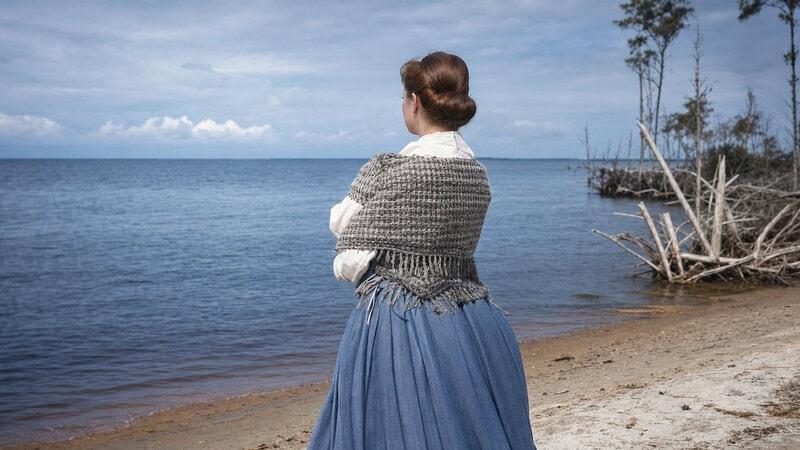

In August 1590, governor John White stepped ashore on Roanoke Island and found a ghost town. The houses had been carefully dismantled. A stout palisade fence now stood where none had been before. And carved into one of its posts, in clean capital letters, was a single word: CROATOAN.
The Governor Who Came Back to Nothing

White had been gone three years — not because he wanted to be, but because the Spanish Armada had consumed England’s naval resources, leaving no vessel free to carry supplies across the Atlantic. He had sailed back to England in 1587, weeks after arriving with the colony, desperately intending to return quickly. Instead, geopolitics swallowed his plans whole. Now he stood in the Carolina heat, looking at the evidence of 117 people who had simply ceased to be where he had left them.
Among those 117 was his own granddaughter, Virginia Dare — the first English child born in the Americas, delivered on Roanoke Island just days before White departed. She would have been a toddler taking her first real steps when he sailed away. She was now, in whatever sense applied, gone. The Roanoke Colony had become the Lost Colony, and John White stood at the precise moment the mystery was born.
But here is the detail that rewrites everything: this was not a massacre scene. There were no bodies, no scattered belongings, no signs of panic or violence. The colonists had apparently left in an orderly fashion, with enough time to take their houses apart timber by timber and erect a defensive structure around what remained. They had, in other words, planned their departure. The haunting question was never really whether they left — it was where they went, and why four centuries passed before anyone came close to a serious answer.
England’s Wildly Ambitious Gamble

To understand what happened at Roanoke, you have to understand how desperately England needed it to work. The Roanoke Colonies were Sir Walter Raleigh’s bold opening move in a high-stakes imperial contest with Spain for dominance over North America, backed by Queen Elizabeth I’s ambitions and her treasury’s chronic reluctance to fund them properly. Roanoke Island, tucked behind the Outer Banks of what is now North Carolina, was the chosen staging ground.
The first colony, planted in 1585, was never meant to be permanent. It was a military reconnaissance operation — soldiers and scientists sent to assess resources, survey the coastline, and establish an English foothold against Spanish interests. When supplies ran dry in 1586, the entire enterprise was evacuated, leaving behind a shaky reputation and a small detachment of men tasked with holding the fort. Those men disappeared too, in a smaller, less celebrated prequel to the main event.
The second colony, arriving in 1587, was a deliberate escalation. Raleigh sent not soldiers but families — 117 men, women, and children chosen to signal permanence, to plant English roots rather than merely an English flag. It was a statement of civilizational intent. It was also, from the first week, a logistical disaster. Relations with neighboring Indigenous peoples were fractured by the violence of the first colony’s soldiers. Supplies were insufficient. And within weeks of arrival, White found himself sailing back to England to fetch more, leaving behind a community of settlers in a fragile, uncertain situation — including his daughter and his newborn granddaughter — never imagining he would not return for three years.
Reading What the Colonists Left Behind

White found two carvings, not one. On a tree near the settlement’s entrance, someone had carved the letters CRO. On the palisade post, the full word: CROATOAN. White himself was not mystified. Before he left in 1587, he and the colonists had agreed on a signaling system: if they relocated while he was away, they would carve their destination’s name. If they left under duress or danger, they would add a Maltese cross above the carving.
There was no cross. The word was clean, deliberate, and informational. White interpreted it immediately as a message that the colonists had moved south to Croatoan Island — present-day Hatteras Island — home of the Croatoan people, who had been among the most consistently friendly and cooperative of the Indigenous nations the English encountered on the coast. The lost colony had, by its own account, a forwarding address.
What happened next is the founding irony of the entire mystery. Storms battered White’s ships as he tried to sail south toward Hatteras. The crew, anxious about the season and the weather, turned back. White never reached Croatoan Island. He returned to England, spent years trying to mount another expedition, and eventually died without ever going back. The mystery that would consume historians for four centuries was, at its origin, a failed follow-up trip.
Where the Modern Evidence Points

The Croatoan connection has moved from plausible interpretation toward archaeological substance in recent decades, driven by fieldwork on Hatteras Island. Researchers from the First Colony Foundation have uncovered English-made artifacts — including a signet ring, gun parts, and food remains consistent with English preparation practices — embedded within Croatoan village layers dating to the late sixteenth century. These are not objects that washed ashore. They are items woven into the fabric of daily Indigenous life, which is precisely what you would expect if English settlers had joined the community rather than perished at its edge.
Then came a revelation from an unlikely source: a map. In 2012, researchers examining the Virginea Pars map — drawn by John White himself and held by the British Museum — discovered a hidden patch concealing what appears to be a fort symbol positioned inland, near the Albemarle Sound, well to the north and west of Roanoke Island. The patch, invisible to the naked eye but revealed through reflectance transformation imaging, suggests the colonists may have split into at least two groups, with some moving to Croatoan on Hatteras and others heading toward the mainland interior.
This dispersal theory has gained traction among researchers. It fits both the archaeological evidence on Hatteras and the existence of what investigators call Site X — an inland location corresponding to the map patch, where excavations have uncovered sixteenth-century European copper and trade goods consistent with an English presence. The colonists, it appears, did what pragmatic people in a survival situation do: they divided, adapted, and spread their odds.
The Lumbee people of North Carolina add another dimension. The Lumbee have long maintained oral traditions describing English-speaking ancestors and cultural connections to early European contact. Researchers have explored these traditions carefully, though they appropriately caution against drawing straight lines where the evidence offers only curves. What the Lumbee traditions affirm, at minimum, is that Indigenous memory of early English contacts persisted — and that the story was never truly lost, only unlistened-to.
Theories That Did Not Survive Scrutiny

Not every explanation for the colony’s disappearance has aged well. The Spanish massacre theory — seductive because Spain had both motive and means — founders on a straightforward absence: Spanish colonial records, which were meticulous about military actions, contain no account of attacking and eliminating English settlers on Roanoke Island. Spanish officials were aware the colony existed and appear to have been largely unconcerned, perhaps because they believed it had already failed on its own.
The narrative of colonists slaughtered by hostile Indigenous peoples collides with the physical evidence even more directly. The Croatoan were documented allies of the English. The calm, deliberate nature of the colonists’ departure — houses methodically dismantled, no distress cross carved — does not suggest people fleeing violence. It suggests people executing a plan.
Perhaps the most persistent obstacle to resolving the mystery has been the mystery itself. The vanished colony became a foundational American legend, the kind of story a young nation used to frame the dangerous, romantic wilderness it claimed to have tamed. Sensationalized treatments and supernatural speculation kept the narrative compelling in ways that made serious archaeological fundraising paradoxically difficult — the enduring enigma served cultural purposes that a clear answer about integration and assimilation simply could not match. The question of what happened to the Roanoke colonists was, in some ways, kept artificially open because the mystery was more useful than the truth.
What Archaeology Is Still Uncovering

Excavations continue at Site X, and the picture being assembled there is painstaking and incremental in the way good archaeology always is. Sixteenth-century European copper, trade beads, and other material culture consistent with sustained English contact have emerged from layers that speak of a lasting presence rather than a brief stopover. This is not a campsite. This is somewhere people stayed.
Technology is reshaping the search in ways John White could not have imagined. LiDAR — Light Detection and Ranging — is now being deployed across coastal North Carolina, allowing researchers to map subsurface features without breaking ground. This matters especially in a region where many candidate sites are also Indigenous sacred spaces, where excavation requires not just scientific judgment but genuine ethical responsibility. The ability to look before cutting has made the research faster, less destructive, and more respectful of the communities whose ancestors are part of this story.
The emerging picture, assembled from map patches and middens and signet rings and oral traditions, resists the dramatic single revelation that a headline craves. It is something more human and more interesting: a community of 117 people who assessed an impossible situation and chose integration over isolation, dispersal over stasis. They became part of the Croatoan world, part of inland trade networks, part of bloodlines and memories that persisted for generations.
What We Owe the 117
The word “lost” has always been the wrong word. It centers English confusion over Indigenous knowledge. The Croatoan people knew exactly where the colonists were, because the colonists were living among them. The framing of a “lost” colony reduces the Croatoan to backdrop in a story where they were, in fact, central actors — neighbors, hosts, and by most evidence, the people who made survival possible. Recovering the full story means recovering the agency of everyone involved, not only the English.
It also means reconsidering what the colonists themselves accomplished. These were not passive victims swept away by fate. They were pragmatic people who read their situation clearly — abandoned by their governor, undersupplied, in a politically volatile landscape — and made the best available choice. They built relationships with Indigenous neighbors strong enough to sustain a community across years and, quite possibly, generations. That is not failure. That is survival of the most human kind.
John White never stopped believing he knew where his family was. He spent his remaining years trying to mount a return expedition, writing letters and pleading with patrons as resources and opportunities slipped away. He died, as best historians can determine, without returning to the Americas. He was a man who had read the answer — CROATOAN, carved in plain English — and lacked only the means to act on it. The same geopolitical forces that created the colony also ensured he could never follow where it led.
Four centuries later, that word carved into a post is being read again, more carefully this time. Not as a riddle. Not as a supernatural cipher. But as what it always was: a message left by people who expected to be found, written in plain English, pointing south toward their neighbors and their new lives. They were not lost. They were waiting. And the archaeology — slow, patient, and growing — is finally catching up to them.

 English
 Arabic
 Spanish
 Portuguese
 Deutsch
 Turkish
 Dutch
Dutch
 Italiano
 Russian
 Romaian
 Portuguese (Brazil)
 Greek
Greek