


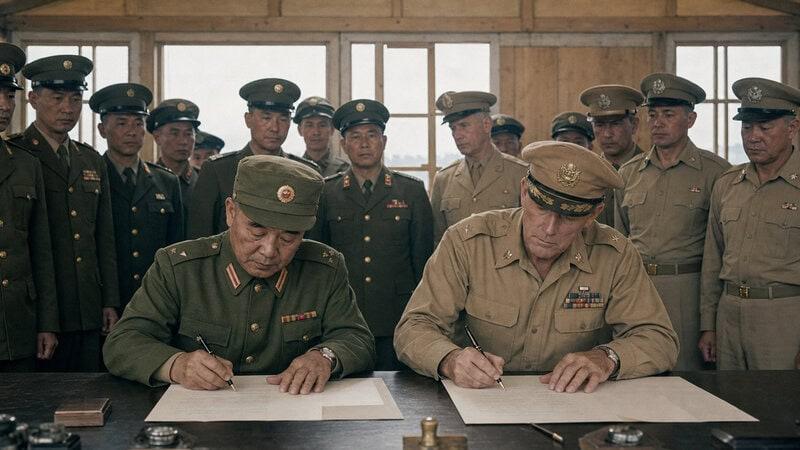

At 10 a.m. on July 27, 1953, in a prefabricated hut at Panmunjom smelling of fresh lumber and nervous sweat, two generals bent over a table and signed their names to a document that stopped one of the bloodiest conflicts of the twentieth century. Then, in a quiet that must have felt almost surreal after three years, one month, and two days of slaughter, the guns fell silent. What almost nobody in that room fully understood was that the silence was not peace. It was a pause. More than seventy years later, that pause is still in effect.
A Line Drawn Almost by Accident

To understand why the Korean War never truly ended, you have to go back before it began — to a single August night in 1945, when two American staff officers, working under a deadline with a National Geographic map spread across a table, drew a line across the Korean peninsula at the 38th parallel. The choice was almost arbitrary: a hasty partition meant to divide the Japanese surrender zones between American forces in the south and Soviet forces in the north. It split farms down the middle. It separated families mid-conversation. It cut through a civilization that had existed for millennia and had never asked to be divided at all.
What followed along that line were years of skirmishes, raids, and mounting tension — until June 25, 1950, a Sunday morning, when the North Korean People’s Army poured south in a coordinated, Soviet-backed assault that overwhelmed South Korean defenses within days. The collapse was staggering in its speed. Within weeks, South Korean and hastily deployed American troops were pressed into a desperate defensive pocket in the southeast corner of the peninsula, around the port city of Busan, in what became known as the Busan Perimeter. The question was no longer whether South Korea could win. It was whether it could survive.
Roughly 1.8 million U.S. service members would eventually rotate through this conflict. More than 35,000 of them would not come home. Those numbers deserve to land with weight, because for decades they largely did not. Korea became the Forgotten War — a label coined not to dishonor the dead but to name something real: how completely American memory leaped from the triumph of 1945 straight to the anguish of Vietnam, leaving Korea in a strange historical shadow. Veterans returned to a country that wasn’t quite sure what to make of a war that had been neither clearly won nor clearly lost.
Three Years of Hell, Two Years of Grinding Diplomacy

The war’s geography lurched wildly, as if the peninsula itself could not decide what it wanted. UN forces were nearly pushed into the sea before General Douglas MacArthur’s audacious amphibious landing at Inchon in September 1950 reversed the tide dramatically, sweeping UN and South Korean forces north toward the Chinese border. Then China entered the war, sending hundreds of thousands of troops across the Yalu River in late 1950, and reversed the tide again. By the time the front lines stabilized, they sat almost precisely where the war had started — along the 38th parallel — as if three years of catastrophic violence had accomplished a brutal kind of nothing.
To understand what that fighting felt like in the body, consider the Chosin Reservoir in the North Korean winter, where temperatures plunged to minus 35 degrees Fahrenheit, rifle bolts froze solid, and morphine syrettes had to be thawed in a soldier’s mouth before they could be used. Marines and soldiers who fought their way out of that frozen encirclement in December 1950 referred to it simply as “the Chosin,” and they said it with a particular flatness that suggested they had no adequate words remaining for the experience.
Peace talks began in July 1951 — but the fighting did not stop. The last two years of the war were in many ways its most grinding, as commanders on both sides sent men at hills and ridgelines not for strategic value but to strengthen their bargaining position at the negotiating table. Thousands died for terrain that both sides knew would be abandoned the moment an armistice line was drawn. Korea became an early, brutal model of “fight and talk” warfare, and the lesson, largely unlearned, would haunt American military strategy for generations.
What the Armistice Actually Said — and What It Left Out

The document signed on July 27, 1953 was meticulous in its military details. It established a Military Demarcation Line, created a roughly four-kilometer-wide Demilitarized Zone on either side of it, set up procedures for prisoner exchange, and created a supervisory commission to oversee the ceasefire. Its closing articles also called for a political conference to negotiate a permanent peace settlement — a conference expected to follow within three months.
That conference never meaningfully materialized.
Three officers signed the armistice: U.S. General Mark Clark on behalf of the UN Command; North Korean General Nam Il; and Chinese General Peng Dehuai. South Korea’s president, Syngman Rhee, refused to sign at all. He was furious that reunification was off the table and that the war was ending with his country still divided. His refusal created a legal complication that has never been resolved: South Korea is not technically a signatory to the armistice agreement, which has complicated every subsequent attempt to build a formal peace on top of it.
The distinction that matters most — and that most people have never had cause to learn — is the difference between an armistice and a peace treaty. An armistice is a military agreement: two armies agreeing to stop shooting under specific conditions. A peace treaty is a political settlement, recognized under international law, that formally ends a state of war. The Korean War has only ever had the former. No peace treaty has ever been signed. There is no date inscribed in any legal instrument marking the war’s formal end, because no such end has ever been declared.
Is the Korean War Still Going?

The honest answer is: technically, yes. No formal state of peace has been declared among the parties. The armistice simply suspends hostilities under terms that both sides have violated repeatedly over the decades, through border skirmishes, assassination attempts, tunnel discoveries beneath the DMZ, and weapons tests of escalating severity. Seventy years on from the armistice, the peninsula remains suspended in a legal and strategic limbo with no obvious exit.
North Korea has conducted six nuclear weapons tests since 2006 and fired hundreds of ballistic missiles in provocative demonstrations. In 2023, Pyongyang officially abandoned its stated goal of peaceful reunification and formally redefined South Korea as a hostile foreign nation rather than a wayward partner state. The DMZ — the armistice line — is now one of the most heavily fortified borders on Earth, lined with landmines, surveillance towers, and the standing armies of two countries that have never formally stopped being at war.
The human dimension of the unfinished war is its quietest tragedy. An estimated 5 million families were separated when the peninsula was divided. The inter-Korean reunion programs that briefly allowed some of them to meet — in controlled, supervised, tearful hours — have dwindled to nearly nothing. Elderly Koreans are dying without ever again seeing the siblings or children they lost across a border drawn before they had any say in it. The armistice line does not feel abstract from that angle. It feels like a wall built through the middle of a life.
Any formal peace process would require agreement among four parties — North Korea, South Korea, the United States, and China — whose strategic interests have rarely aligned across seven decades. North Korea’s nuclear arsenal has become its core security guarantee, the one thing its leadership believes protects it from the fate of regimes that surrendered their weapons programs. Pyongyang has little incentive to trade that guarantee away. The 1994 Agreed Framework collapsed. The Six-Party Talks of the 2000s went nowhere. The 2018 Singapore summit between President Trump and North Korean leader Kim Jong-un produced a vague joint statement and no concrete disarmament steps. Each apparent breakthrough has revealed the same unbridgeable gap between what Washington required and what Pyongyang was prepared to offer.
Why Forgetting Korea Was a Costly Mistake

Korea slipped through the cracks of American memory for reasons that are almost structural. It followed the “Good War” — the clean narrative of fascism defeated and democracy triumphant, a story Americans told with a pride that left little room for ambiguity. And it preceded Vietnam, which would become the defining American military trauma of the century, absorbing all the cultural oxygen that might otherwise have gone toward processing the Korean experience. Korea — a war fought under a UN flag, for limited objectives, producing an ambiguous outcome — fit neither the heroic template nor the tragic one. So it was quietly set aside.
That forgetting carried a measurable cost. Korea established the template for every limited war the United States would fight in the decades that followed: UN authorization, coalition partners, a fight for restoration rather than total victory, an enemy that could not be fully defeated without risking a far larger catastrophe. Those were the exact parameters of Vietnam. The lessons were there to be learned from Korea, and they largely were not. The veterans of Korea — American, British, and from across the UN coalition — deserved better than to have their experience treated as a prologue nobody read.
Today, the Korean peninsula is arguably the most consequential nuclear flashpoint on Earth. The unresolved legal status of the war is not a footnote for international law scholars — it shapes the diplomatic calculus of every negotiation over North Korea’s weapons program, every conversation about sanctions, and every military exercise conducted in the region. The armistice that was designed to be temporary has become, by default, permanent. The political conference it called for never arrived.
Each July 27, National Korean War Armistice Day in the United States asks Americans to pause and honor the roughly 1.8 million who served and the more than 35,000 who did not come home. That is right and necessary. But honoring them fully means understanding what they actually fought in: a war that ended in punctuation rather than a full stop, a war that by any strict legal definition has not ended at all. The generals who signed their names in that prefabricated hut in July 1953 almost certainly believed a peace treaty would follow within months. Seven decades later, the peninsula still waits. The ceasefire holds — barely, sometimes — and somewhere along the DMZ, two armies face each other across a line drawn in an August hurry by men with a borrowed map, still standing watch over a war that nobody ever officially ended.

 English
 Arabic
 French
 Spanish
 Deutsch
 Turkish
 Dutch
Dutch
 Italiano
 Russian
 Romaian
 Portuguese (Brazil)
 Greek
Greek