


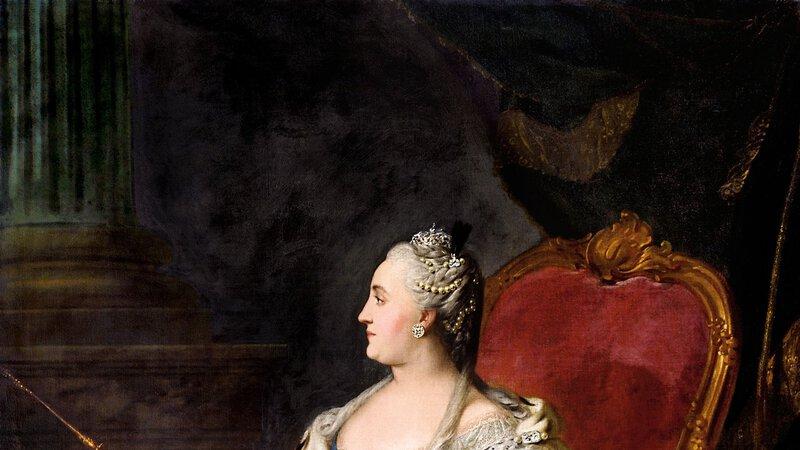

In January 1744, a fourteen-year-old girl from a minor Prussian principality stepped out of a carriage and into the savage cold of a Russian winter. She spoke almost no Russian, carried very little money, and had no claim to anything beyond a modest title and a mother’s ruthless ambition. Within eighteen years, she would seize the largest empire on Earth — and hold it, with iron elegance, for more than three decades.
A Teenage Girl from Nowhere, Headed for the Winter Palace

Sophie Friederike Auguste von Anhalt-Zerbst was born on May 2, 1729, in Stettin, Prussia — the city now known as Szczecin, in modern Poland. Her father, Prince Christian August of Anhalt-Zerbst, held a respectable title and almost nothing else. The family was genteel in the way that costs money they did not have: presentable at court, invisible in terms of real power. Sophie grew up in the particular cold of minor nobility — close enough to greatness to understand it, far enough away to hunger for it.
When the summons arrived from Empress Elizabeth of Russia, requesting that Sophie come to Saint Petersburg as a prospective bride for the Imperial heir, it was less an invitation than a lottery win. Russia needed a suitable, malleable, politically unthreatening princess for the future Peter III. Sophie’s family needed the connection desperately. And Sophie herself — already sharp, already watching, already reading every room she entered — understood immediately what was being offered and what it would cost her to claim it.
The central question of her life was already taking shape before her carriage reached the Russian border: how does a penniless German girl with no Russian blood, no fluency in the language, and no independent power base become the ruler of Russia? The answer would take years to unfold — and it remains one of history’s most audacious stories.
Born Sophie, Made Catherine: The Reinvention Begins

Most people, dropped into a foreign court at fourteen and told to become someone else, would have flinched. Sophie did not flinch. She studied. She absorbed. She transformed.
Upon arriving in Russia, she threw herself into learning the Russian language with a discipline that alarmed her tutors — she reportedly stayed up through freezing nights memorizing vocabulary, walking barefoot on cold floors, and falling seriously ill as a result. She studied Russian Orthodox Christianity with the same ferocity, not because anyone forced her, but because she had already performed a calculation that most adults twice her age would have missed: survival in this court required becoming Russian in the eyes of everyone who mattered.
She converted to Russian Orthodoxy, shedding her Protestant German faith with the same clean deliberateness with which you might change a coat. She took the name Yekaterina Alexeyevna — Catherine — and wore it as though she had been born into it. According to Britannica’s biography of Catherine the Great, contemporaries remarked on how genuinely she appeared to embrace Russian culture, a perception she cultivated with careful, ceaseless effort.
Her Russian accent was thick. Her grammar, for years, remained uncertain. And yet courtiers found themselves disarmed by her warmth and directness — the broken Russian delivered with such confidence and evident delight in the language that the imperfections became almost charming. She made her accent feel like affection rather than deficiency.
The irony was exquisite. Her future husband, Grand Duke Peter — the actual heir to the Russian throne, with genuine Romanov blood — reportedly despised Russian culture. He refused to seriously engage with Orthodox customs, openly idolized the Prussian military and Frederick the Great, and made little effort to endear himself to the Russian court. Catherine, the German interloper, was becoming more authentically Russian than the man born to inherit Russia. She understood what he did not: that legitimacy is not inherited. It is performed, daily, until it becomes real.
A Marriage Built on Mutual Contempt

The marriage to Peter was, by nearly every historical account, a quiet catastrophe. They were intellectually mismatched, personally incompatible, and bound together by political necessity that served neither of them well. Catherine was watched, suspected, occasionally humiliated, and kept in a kind of gilded uncertainty — close to power, excluded from it, never quite safe.
She responded the way she always responded to constraint: she read. During the long years as Grand Duchess, Catherine worked her way through Voltaire, Montesquieu, and the great Enlightenment thinkers of the age, building an intellectual architecture that would eventually shape her entire approach to governance. These were not idle years, even when they felt that way. They were preparation.
She also cultivated allies — quietly, patiently, with the long view that would become her political signature. She built relationships with key figures in the Imperial Guard, with influential nobles, with members of the church. She made herself useful, likeable, and indispensable to people who had no particular reason to care about her survival. As Smithsonian Magazine’s examination of her life notes, this patient, deliberate cultivation of loyalty was central to everything that came next.
She bore a son, the future Paul I, whose paternity became the subject of whispered speculation throughout the court. The uncertainty added another layer of precariousness to her position — she existed in a permanent state of political vulnerability, forever one wrong move from exile, disgrace, or worse. She did not make wrong moves.
The Coup: How Catherine Took a Throne That Was Never Hers

Peter III inherited the Russian throne in January 1762 and immediately set about destroying every advantage he had inherited. In just six months, he managed to alienate the army, offend the Orthodox Church, and infuriate the nobility — a comprehensive act of political self-destruction that left a vacuum crackling with danger and possibility. His decision to withdraw Russia from the Seven Years’ War and return conquered territories to his idol Frederick the Great of Prussia outraged both the military and the court, and proved to be the act that made his removal feel not merely possible but necessary to those around him.
Catherine moved in July 1762. The account of those hours reads like something staged for maximum drama, except that it was entirely real. She rode out at dawn in a military uniform to meet the regiments of the Imperial Guard who had already pledged their loyalty to her — soldiers who had watched their supposed emperor treat Russia with contempt while Catherine had spent years treating them with respect. She presented herself not as a usurper but as Russia’s salvation, and they believed her because she had given them every reason to.
Peter III abdicated without a fight. He died days later under circumstances that historians still debate — the official account cited a hemorrhoidal colic, while more persistent accounts suggested something more deliberate. Catherine was, by the standards of the age, almost certainly aware that his death was convenient. Whether she ordered it, permitted it, or simply did not prevent it remains one of the murkier questions in Catherine the Great’s documented history.
What is not murky is the audacity of what she had just accomplished. A woman with no Russian blood, no legal claim to the throne in her own right, and a foreign accent had seized the largest country on Earth. She was thirty-three years old.
Ruling Russia: The Enlightenment Empress

Catherine the Great ruled as Empress of Russia from 1762 until her death in 1796 — more than thirty years of governance that transformed the empire she had taken by force. The scale and range of her activity during those decades was extraordinary by any measure. She corresponded with Voltaire and Denis Diderot, and even offered Diderot refuge in Saint Petersburg when French authorities threatened to suppress his Encyclopédie. She founded the Russian Academy, established the Smolny Institute — one of the first state-sponsored institutions for the education of women in Europe — and commissioned a sweeping reform of Russia’s provincial administration. She expanded Russia’s territory significantly through military campaigns, most notably the Russo-Turkish Wars, which secured access to the Black Sea and brought Crimea under Russian control in 1783.
Her cultural legacy was equally formidable. The collection she assembled for the Hermitage — purchasing entire European art collections, including those of Johann Ernst Gotzkowski and Sir Robert Walpole’s family — laid the foundation for what is now one of the world’s greatest museums. She corresponded regularly with the philosophes of the French Enlightenment, used those exchanges to shape her image across Europe, and brought architects, sculptors, and scholars to Saint Petersburg from across the continent. As the Fitzwilliam Museum notes in its assessment of Catherine as a collector and patron, the deliberateness of her acquisitions reflected both genuine aesthetic engagement and a sophisticated understanding of cultural power.
Her domestic reform efforts were shaped by her Nakaz, or Instruction, published in 1767 — a remarkable document drawn substantially from Montesquieu and the Italian jurist Cesare Beccaria, in which she laid out principles for a reformed legal code that would be more rational, more humane, and more consistent. She convened a Legislative Commission of more than five hundred delegates drawn from across Russian society to consider the document. The Commission ultimately produced no new legal code — its sessions were suspended when the Russo-Turkish War began in 1768 and never fully resumed — but the Nakaz itself circulated widely across Europe and significantly enhanced her reputation as an enlightened ruler.
The contradictions in that picture are real and should not be papered over. Her Enlightenment ideals coexisted, uneasily and ultimately unsuccessfully, with serfdom — an institution that expanded and hardened under her rule, binding millions of Russian peasants more tightly to the land and to their owners. The nobility that supported her coup expected rewards, and Catherine delivered them: the Charter of the Nobility in 1785 granted the Russian noble class extensive legal privileges and exemptions that came directly at the expense of the serfs beneath them. When the Pugachev Rebellion of 1773 to 1775 erupted — one of the largest peasant uprisings in Russian history, led by the Cossack Yemelyan Pugachev who claimed to be the murdered Peter III — she suppressed it with a ferocity that left little room for the reformist rhetoric she deployed elsewhere. Pugachev was captured, brought to Moscow in a cage, and publicly executed. Power, when genuinely threatened, revealed its own logic, and Catherine was not immune to that logic.
The BBC’s profile of Catherine rightly observes that her reign transformed Russia’s place in the world — and how decisively she shaped the empire’s identity for generations to come. When she died of a stroke on November 17, 1796, she left behind an empire larger, richer, and more internationally respected than the one she had seized thirty-four years earlier. She remains Russia’s longest-ruling female leader. That BBC profile captures well the scope of the transformation she achieved, even as it acknowledges the costs at which it came.
Why the German Question Matters

The fact of Catherine’s German origins was never a secret. It was a vulnerability she carried from the moment she arrived in Russia, and she neutralized it not by hiding it but by outrunning it — by becoming so thoroughly identified with Russia’s greatness that her origins became a footnote rather than a disqualification.
The contrast with Peter III is not subtle. Peter had the Russian royal bloodline Catherine lacked. He had the legal claim. He had the inheritance. He lost everything in six months because he could not be bothered to want it correctly. Catherine had none of his advantages and kept power for more than three decades because she wanted it with a focus and a discipline that no one around her could match.
Her outsider status may, in the end, have been a structural advantage as much as a liability. Rulers who inherit power by birthright can afford a degree of complacency — they arrived legitimately and can remain legitimately. Catherine had no such luxury. She had to earn her legitimacy every single day, which made her more attentive to the court, more adaptive in her political strategies, and more determined in her pursuit of genuine achievement. The result was a reign defined not by coasting on inherited authority but by the relentless construction of new reasons to be obeyed. History.com’s overview of lesser-known aspects of her life reflects how many of her most impressive qualities were forged precisely in the crucible of that precarious position.
The Woman Behind the Myth
Catherine wrote memoirs — candid, self-aware, and strategically shaped. She maintained thousands of letters, to philosophers, to diplomats, to lovers, to enemies, and the correspondence that survives constitutes one of the richest first-person records left by any eighteenth-century ruler. She kept a sharp, self-deprecating sense of humor and a fierce consciousness of how history would eventually read her. She was, in many ways, actively constructing her own legend even as she lived it — which is either a form of vanity or a form of genius, and probably both simultaneously.
The mythology that attached itself to her name after her death — the sensationalized, largely fabricated stories that circulated across Europe and endured for centuries — has done her a specific kind of disservice, replacing a genuinely remarkable woman with a caricature designed to diminish her. As World History Encyclopedia’s assessment of Catherine makes clear, the documented record tells a fundamentally different story: a woman of extraordinary intellectual range, formidable political cunning, genuine reformist ambition, and clear-eyed understanding of the world she operated in — whose contradictions were the contradictions of her age, magnified by the scale of the power she wielded.
She arrived in Russia as a fourteen-year-old who could not speak the language, carrying little beyond intelligence and determination. She learned the language, learned the culture, learned the court, and then — methodically, patiently, over decades — she learned how to run the empire. The girl who stepped off that carriage into the Russian winter had been named Sophie. The woman who died in the Winter Palace, master of the largest country on Earth, had made herself into something else entirely: not just an empress, but the very image of what Russia believed it could be. That she had to invent herself from scratch to do it was not a weakness. It was the whole point.

 English
 Arabic
 French
 Spanish
 Deutsch
 Turkish
 Dutch
Dutch
 Italiano
 Russian
 Romaian
 Portuguese (Brazil)
 Greek
Greek