


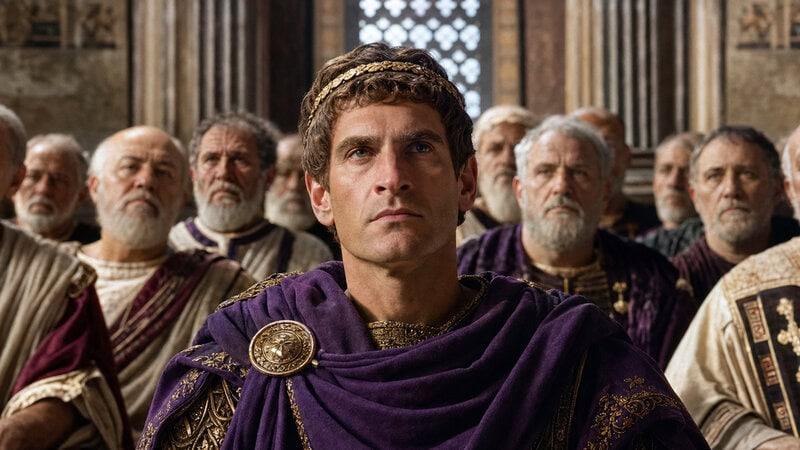

In the summer of 325 CE, a procession of old men shuffled into a palace hall beside a glittering lake in northwestern Asia Minor. Some walked with limps. Some bore the faded marks of torture on their hands and faces — brands, severed tendons, eyes put out during the persecutions that had only recently ended. They had traveled from Alexandria and Antioch, from Persia and the edges of Britain, from the sun-scorched cities of North Africa and the windswept provinces of Gaul. They were bishops of the Christian church, and they had been summoned by the most powerful man on earth to answer a question that was tearing his empire apart: exactly who — or what — was Jesus Christ?
An Empire Holding Its Breath

Constantine had not come easily to this moment. He had clawed his way to sole rule of the Roman Empire through years of civil war, outlasting rivals, executing enemies, and consolidating power with the cold efficiency that supreme authority demands. He had extended tolerance to Christians with the Edict of Milan in 313 CE, ending the era of state-sponsored persecution and transforming a hunted minority faith into something newly respectable, even fashionable, among the Roman elite. What he had not expected — what no one had quite anticipated — was that Christianity, freed from the pressure of persecution, would immediately begin tearing itself apart from within.
The fault line ran through Alexandria, one of the most intellectually vibrant cities in the ancient world. There, a popular and charismatic priest named Arius had been preaching a vision of Christ that was spreading with alarming speed through congregations across the eastern empire. His core claim was deceptively simple: the Son was not co-eternal with God the Father. The Son had been created — the greatest and most perfect of God’s creations, certainly, but created nonetheless. There had been a time, Arius insisted, when the Son simply did not exist.
This was not, as it might appear to modern eyes, a dry dispute for theologians to settle quietly over parchment. It cut to the bone of what Christians believed about salvation itself. If Jesus was not truly God — if he was a supreme creature rather than the divine — then what exactly had happened on the cross? Was it God who had entered human experience, or something less? How Christians prayed, what they thought they were doing when they prayed, what they hoped for when they hoped for eternal life — all of it trembled on the answer. Riots broke out in Alexandria. Bishops fired furious letters across the Mediterranean. Congregations split, singing rival hymns in competing theological camps. Constantine, who had hoped that Christianity might serve as a unifying force for his fractured empire, watched in something close to horror as it threatened to do precisely the opposite.
His letters to the bishops before the council — preserved in the historical record by the church historian Eusebius of Caesarea — reveal a man who considered the underlying theological question, in his own words, extremely trivial. What was not trivial was the disorder. What was not trivial was the threat to the unity he had spent his entire career constructing. And so he acted in the only way he knew how: he called a meeting, paid for everyone to attend, and made very clear that he expected a result.
What Actually Happened at Nicaea

The gathering that assembled at Nicaea in 325 CE was unprecedented in the history of the Christian church — the First Ecumenical Council, a term derived from the Greek word for the whole inhabited world. Constantine provided imperial transport, translators, and accommodation at his lakeside palace in Bithynia. He presided over the opening ceremonies in full imperial regalia, a dazzling and slightly surreal sight for bishops who had spent their careers dodging imperial authorities rather than dining with them. Estimates of attendance vary among ancient sources, but a figure of around 300 bishops is commonly cited by historians, with delegates ranging from brilliant systematic theologians to provincial clergy who had barely traveled beyond their home towns.
The debate that unfolded was not settled quickly or cleanly. The crucial battlefield became a single Greek word: homoousios, meaning “of the same substance.” If the Son was homoousios with the Father — not merely similar, not merely like, but of the very same divine substance — then Arius’s position was demolished. The Son was not a created being. The Son was, in the fullest sense, God.
The resistance to this formulation was real and deeply felt. Homoousios appears nowhere in the Bible. Many bishops were profoundly uncomfortable with being asked to define Christian belief using the vocabulary of Greek philosophy rather than Scripture itself. They worried, not unreasonably, that they were importing foreign concepts into sacred territory. But the theological pressure from the Arian position was equally uncomfortable, and in the end an overwhelming majority of the assembled bishops endorsed the formula. Ancient sources record that only two bishops refused to sign the resulting statement and were exiled along with Arius. The council produced an early version of what we now know as the Nicene Creed, the foundational statement of Christian belief still recited in churches around the world seventeen centuries later.
It is worth pausing to note that the Council of Nicaea addressed considerably more than one man’s theology. The assembled bishops also fixed the method for calculating the date of Easter — ending a chaotic situation in which different churches celebrated the resurrection on different days. They addressed the Meletian schism in Egypt, a separate controversy about how to handle clergy who had collaborated with Roman authorities during the persecutions. They established canons governing the relative authority of major episcopal sees, including Rome, Alexandria, and Antioch, and set rules for clerical discipline and the reception of heretics back into the church. Scholarly resources on Nicaea and the Nicene Creed consistently emphasize this breadth of the council’s agenda, which extended well beyond the Arian controversy even if that controversy burns at its center.
The Creed That Outlasted Rome

What emerged from Nicaea in 325 CE was not quite the text that Christians recite today. The creed produced at Nicaea was refined and substantially expanded at a second great council held in Constantinople in 381 CE, convened under Emperor Theodosius I. It is that later version — the Niceno-Constantinopolitan Creed, though almost everyone simply calls it the Nicene Creed — that became the most widely used statement of Christian belief in history. It is recited in Catholic Masses, in Orthodox liturgies, in Anglican services, and in the worship of many Protestant denominations on every inhabited continent.
The paradox embedded in this fact is almost too rich to be invented. A creed hammered out in political crisis, shaped partly by an emperor’s desire for order and partly by the philosophical vocabulary of the Hellenistic world, became the devotional heartbeat of a religion that would outlast Rome by more than a millennium and spread to every corner of the planet Rome had never reached. The bishops who gathered beside that lake in 325 CE could not have imagined Sunday mornings in Lagos or Seoul or São Paulo. And yet their hard-won, philosophically loaded words echo in all of those places every week.
In 2025, the World Council of Churches is marking the 1,700th anniversary of Nicaea with a year of global commemorative events, including a gathering at the original site in what is now İznik, Turkey. The anniversary draws together Christians of widely different traditions precisely because the Nicene Creed is one of the very few texts they all share — a reminder that their deepest disagreements have roots in a common argument, held in a palace hall beside a lake in Asia Minor, long ago.
What Nicaea Left Unfinished

It would be satisfying to report that Nicaea settled the matter decisively and the church moved forward in serene agreement. It did not. Arianism did not die at Nicaea. Constantine himself later wavered in his support for the council’s outcome, recalled Arius from exile before Arius’s death in 336 CE, and arranged for some of Arius’s allies to be rehabilitated. In the decades that followed, several of Constantine’s imperial successors openly favored bishops who held positions close to those condemned at Nicaea. The Arian controversy burned with varying intensity for another half-century and more — proof that declaring a winner in a council chamber does not necessarily end the war in people’s hearts and minds.
The longer-term consequences of Nicaea extended beyond the Arian question itself. What the council established, with lasting effect, was a template: the idea that Christian doctrine could and should be settled by councils convened with imperial backing. That template generated centuries of further councils — Constantinople in 381 CE, Ephesus in 431 CE, Chalcedon in 451 CE — each producing its own creeds, its own condemnations, its own schisms. It fused, in ways that would never be entirely untangled, the authority of the church with the authority of the state. Historians continue to debate whether Constantine’s intervention helped Christianity clarify its beliefs or distorted the faith’s development by binding it so tightly to imperial power. The evidence points stubbornly in both directions, and the argument has no easy resolution.
There is also the question of what Nicaea meant for those outside the emerging orthodox consensus. Arian Christianity did not simply vanish; it spread among Germanic peoples beyond the empire’s frontiers and remained a significant force in parts of Europe well into the sixth century. The council’s condemnations created boundaries that determined who was inside the church and who was not — a function with profound social and political consequences that extended far beyond theology.
A Hinge Point in History

What is beyond serious historical dispute is that the Council of Nicaea in 325 CE marks a genuine turning point. Before it, Christianity was a diverse, sometimes chaotic, geographically scattered movement without any authoritative mechanism for settling its own internal disputes at a universal level. After it, Christianity possessed a creed, a conciliar structure, and the machinery of imperial support — along with all the complicated consequences that machinery would bring across the centuries that followed.
Every time the Nicene Creed is recited — in a candlelit Orthodox church in Athens, in a parish in Houston, in a chapel in rural Ethiopia — the congregation stands, knowingly or not, in the long shadow of what happened beside a lake in northwestern Asia Minor in the summer of 325 CE. They are repeating words forged in crisis, under pressure, by fallible human beings who were simultaneously trying to describe the infinite and trying to hold a fracturing empire together.
The bishops who gathered at Nicaea believed they were settling a question. What they actually did was open one of the longest and most consequential conversations in human history — about the nature of God, about the relationship between religious authority and political power, about what language can and cannot do when it reaches for the divine. Seventeen hundred years later, that conversation has not ended. It has barely paused.

 English
 Arabic
 French
 Spanish
 Portuguese
 Deutsch
 Turkish
 Dutch
Dutch
 Italiano
 Russian
 Romaian
 Portuguese (Brazil)